 All Entries in the "Lifestyles at Risk" Category

Behavior Mod Working on Highways
Several Western Slope police departments have been taking a new approach to the enforcement of traffic laws this summer. They call the program Positive Response Reaction Pacification but it’s really only simple behavior modification. It works like this:
A police officer observes a driver roaring through a school zone at 50 mph. The driver then runs a red light, makes an illegal U-turn, tears through an inhabited crosswalk and comes to a screeching stop in his front yard just inches away from a large elm tree. Does the officer pursue this reckless criminal and make an arrest? The answer is “No.” A second scenario goes like this.
The same officer observes a delivery vehicle proceeding at the allotted speed limit, signaling when appropriate, driving defensively and politely. He hits the flashing red light on the patrol car and swings into action. Overtaking the delivery truck the officer vaults from the car and approaches the vehicle.
“Good morning, sir,” smiles the policeman. “I just stopped you to tell you that you are doing a fine job operating this rig. We appreciate safe, considerate drivers like yourself on our highways. Here i s a ticket for $25. Just send it in to the circuit court and they’ll send you a check.”
This shockingly innovative program has been in effect since May 1 and has cut the average officer’s work load by as much as 50%. Already it has lowered stress and complication due to messy fines and imprisonment.
“By rewarding positive behavior and ignoring the negative, we hope to educate the public and bring about a profound change in driver mentality throughout the country,” said Juan Concerto, one of the creators of the program. “Already we see motorists following squad cars around trying to catch the eye of the patrolman.”
Suspicious vehicles will still be stopped, according to Concerto, but “the PRRP Program is a step in the right direction,” he winked.
Local man arrested for elk chummin’
(Uncompahgre Plateau) A local outfitter has been arrested and charged with operating an illegal chumming operation here. Melvin O’Toole, 96, of Pea Green is currently incarcerated at Montrose County Prison. He is expected to plead not guilty. Doesn’t everyone.
According to sheriff’s deputies O’Toole engaged in elk baiting during the sacred rutting season and, despite warnings from other hunters, ruthlessly stalked deer all summer long.
If convicted O’Toole could lose hunting privileges for up to ten years and/or face a firing squad. His attorneys told The Horseshoe that he is a strict vegetarian and was only planting cherry tomatoes when taken into custody.
“Our client is innocent and has the right to plant tomatoes at 9,000 feet even if their chance of survival is slim,” said one lawyer. “The very idea that he might try to lure game into his compound is absurd, the charges deceitful.”
O’Toole has been under investigation of late for alleged illegal pot still whiskey production up in the pinions. Authorities here suspect that the glut of single malt sagebrush spirits that hit the street this summer may have been distilled right under their noses. They have been under pressure from local church and civic groups to make an arrest.
Along with O’Toole, police confiscated over 40 salt licks, three barrels of oats, about a ton of cracked corn and assorted bales of hay said to have a street value of $100,000. No poteen, or illegal was recovered and the suspect passed a roadside sobriety test moments after being taken into custody.
According to unreliable sources police were tipped off when O’Toole was overheard saying that the kokanee fishing near Almont “was dynamite.” At that point he was under surveillance and subsequently arrested. – John Doe

Two Rivers and a Pearl
I stuck my toes into the Maekhong in Thailand at Chiang Saen, near the Golden Triangle* and once again in lovely Chiang Khong before crossing over into Laos. The initial sight of the historic river from a slow moving tuk-tuk was reminiscent of seeing the Pacific Ocean or the Rocky Mountains for the first time.
A two-day boat excursion took us east on the Maekhong to Pak Beng for the night and on to Luang Prabang the next day. What a pleasant way to travel. Bring food and your camera. They sell cold beer. Pak Beng is a tiny river town that survives on tourism from these trips. Our clean comfortable room cost $10 and the food was quite tasty. The high point though had to be the service provided by 4 and 7-year-old wait-daughters who delivered the food to the tables and kept a cooking daddy on his toes.
 Spending the evening drinking Bier Lao with fellow passengers from Belarus, Sweden, Japan, Malaysia, Portugal, Brasil, Austria and Argentina presented a spoonful of worldliness. A sort of demented sophistication emerged in an otherwise elemental spot at the bend of an Asian river, populated by warm, sweet people, happy to sell you anything from incense to canned ham.
The next afternoon we splashed ashore on the same great river at Luang Prabang, Laos.
If Luang Prabang wasn’t so inherently charming it could be perceived as overdone. A UNESCO World Heritage Site, it offers a real chunk of colonial Indo-China. The architecture and wide tree-lined streets are reminders of French occupation. The tribes populating the nearby hills are proof of powerful Tibetan and Chinese influences over the centuries.
The city pleases the palate with incredible food and introduces the adventuresome to Lao Lao, a white lightning, poteen derivative that can make the imbiber fly, according to local restaurateur Mr. Ha Ha, over in the next soi. He probably offers tours if you like that sort of thing.
Wats here are even more plentiful than flower markets but not by much. Wake up to roosters and motorbikes then breakfast on the river like Lao royalty before cruising the old city by bicycle. The traffic here is not so crazy, except at morning wake up, lunch, school’s out, parade times, Hmong Market opening, produce delivery days and evening rush hour. The sidewalks are pretty safe**** (for pedestrians) compared to Chiang Mai or Bangkok, and are pretty much rolled up by 11 pm. That’s when the alcohol stops flowing since the blue-nose Communist government doesn’t need drunks wandering around at night. The government, to its credit is allowing tourism to blossom, and in two weeks we rarely saw military or police presence anywhere in the country.
That night from my balcony I heard singing in the street. It was four young women riding their bicycles along the Maekhong serenading the neighborhood with giggles and a soothing song as the river snuck off to sleep.
Luang Prabang is named for the Great Pha Beng, the most sacred Buddha in Laos which was kept in Luang Prabang until the end of the American War when either the Chinese or Russians “borrowed it”, according to a persistent local rumor. Or the Great Pha Beng could be hiding in the Central Market or perched high above the Hmong Night Market. Maybe it is reclining near the river or out pep talking the water buffalo. With all the people, the life and the color anyone could just blend in.
I woke up to the sounds of drums at dawn calling the monks to gather alms. It was rather impressive except that the place quickly filled with mindless Westerners sticking cameras in every face before getting back on their hotel tour buses to go eat bacon and eggs. I went home disappointed that such a potentially spiritual exchange could  become so diminished.
Stopping at a good coffee house on the way back to the hotel chanting Baw sai naam-taan, karuna (No sugar please) I spent half the morning trying to teach the resident parrot how to bark like an Irish Wolfhound but to no avail. Then I stopped and pay a formal visit to a small, compliant, shaggy mutt who enjoys attacking orange saffron-covered monks. He seems to like everyone else. Talk about metaphysical discrimination. What was he doing in a past life? Maybe he thinks they are Creamsicles. Although he keeps the streets safe from these peaceful Buddhists, he had yet to master the menacing bark of the wolfhound either.
Most of the monks are accountants and pastry chefs in real life and are only temporarily clerics anyway, sent on a sabbatical of soul searching. They are more plentiful than the wats, which are more plentiful than the flower markets but not the surrounding hill tribes. Our incredible host (and renown linguist) Yeng Cha Felix is Hmong and, in addition to lots of info on Luang Prabang, he fills us full of hill tribe culture, which dominates northern Laos. Hmong, Katu, Shan, Mien, Akha and Khmu villages stretch across Mayunmar, Thailand. Laos and Vietnam and the hill tribes are slowly assimilating to the Lao ways.
On to Nong Khiaw
Due to the damming up of the Nam Ou River one can only float parts of it north of the Maekhong confluence and up toward Phongsali. This time the benevolent Chinese government is building the dams with a smile.** Despite these changes the town of Nong Khiaw still welcomes the morning fog and suns itself until the mountain takes the light. It is burn season around these parts and the smoke is visible, especially if one climbs the 2 miles up to the summit view for a peek.

The town of Nong Khiaw from across the Nam Ou River
If you do this hike make sure to leave at dawn and bring water. The jungle can be forgiving in the later hours. Do take a hiking stick as descent can be more challenging than the ascension. Cold water tastes great after this pleasant ordeal.
“Two bottles of cold water, please.”
“Twenty-five thousand (Laotian kip).”
“But I paid twenty yesterday.”
“Oh, you pay attention…Twenty.”
It’s a little game the merchants play, as both sides in the international exchange/balance mass sums worth at least 75 cents. If a visitor pays attention he is seen as human. If the buyer is willing to pay more he is seen as a rich, stupid tourist. Yes: The price varies, smiles abound and globalization is right there on the horizon: You want fries or chips with that chicken-fried water buffalo?
Bring a backpack full of little presents. Crayons, balloons, colored pipe cleaners, small stuffed animals and books in Lao are, as one might imagine, big with the children. It is proper etiquette to give the gifts only to the parent to give to the child so as to curtail the dreads of begging. One family with four kids wiped us out one afternoon but we know where to get more.***
Perhaps the most enchanting part of Nong Khiaw is riding a bicycle through the mountains to the nearby villages. On the way one passes the Pha Thok Cave where residents hid from the bombs straying from the nearby Ho Chi Minh trail and aimed at Pathet Lao soldiers operating in the region.
Deep in the Kingdom of a Million Elephants
the people ran to Pha Tok Cave
at the roar of the American bombers.
Few could spell Communism.
Many did not make it.
Arriving in tiny Ban Huey Lek we were invited to the family house of a beautiful girl named Bouachan, a 22-year-old resident, who had taught herself English. The food was superb and so were her linguistic abilities. We met for lunch the next day at traditional Lao cuisine place that offered the same delicious menu as the last place. While diversity may not be the calling card, quality and creativity awaits the hungry at every little table. Try the sticky rice with Lao sausage accompanied by mounds of fresh greens and mango slices.
Our lodging, called Lao Sunset, consisted of a shaved wood and paper cabin hanging off a cliff directly above the river. It had all the basics with a beautiful view, great porch, perfect bed, big bathroom and mosquito net for $120/week. The staff, comprised of young chatterbox girls, warmed up to us once they figured out we didn’t expect them to do anything. Since our Lao is limited and they did not speak any English we spoke Spanish to them and we all laughed a lot. One of the ladies even said Hasta Luego when we departed.
But the big news around our soi today is that some Parisian lads have bought a baby monkey. It’s over at their boat booking office, which they appear to operate at times. Monkeys have always liked me. This one was no  different. Once I sat down she scurried up my legs and arms until she sat on my shoulder. Then, yawning crawled into my lap and went to sleep…for thirty minutes! “Hey monkey, what do you think this is? I have things to do today.”
Nong Khiaw qualifies as another exotic paradise on a planet that is blessed with endless beauty. The rivers, the mountains, the way of life just now changing from what had been for centuries a river dependent culture. The river is eternal. We are only here for a short time. Who wouldn’t like waking up in the fog and going to sleep with the sound of one lone riverboat still plotting its way along. Perhaps tomorrow the flatboat will go to Muang Ngoi or all the way up to Phongsali near the Chinese frontier.
Leaving on the boat back to Luang Prabang there is only one thing wrong: I forgot to say goodbye to the monkey. I guess I’ll have to return to visit Nong Khiaw after she’s grown up a bit. I just hope she looks both ways when venturing out into traffic.
*Golden Triangle Opium Museum nothing more than a lot of specimens in glass cases. Don’t see anyone sampling or reclining with the possible exception of a Buddha or two. Not particularly recommended although countryside is splendid)
**After the Pathet Lao took over the reigns in Vientiane the Chinese called in their markers. In return for support during the war they took most of the old growth forests of Northeast Laos back to China. Although the forests have returned with a force, a sense of foreboding remains as the 21st Century closes in on what were pristine, primitive river communities that have thrived here for centuries. Everyone is not all too happy about the dams.
***It is not always clear what these kids have and do not have. For instance we really didn’t know what something like crayons represented. Had they seen them? Do they want to use them? Do they have drawers full of crayons from the last travelers who came through town bearing gifts? It is likely that, when given in a cordial mien, the recipient’s parent will be receptive and the children will get some fun loot.
****There is virtually no violent crime here and theft is minimal.
Photos by DeLinda Austin
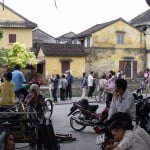
Sweet, salty ancient city
Hoi An, Vietnam
Dawn dreams fade into green rice fields and foggy skies.
“It’ll burn off in an hour,” she says looking out at our neighbors and their water buffalo already at work. “Until then I want to sit here and watch the rice grow. Listen, the local garbage truck is playing happy wakeup tunes.”
This lazy behavior will pass for now he thought but once the sun is properly up it’s heads down and pedal to the metal. The ladies of the terrace would not think well of guests that arrive for breakfast with egg already on their faces, awash in a sea of indecision or simply not hungry.
We had traded the roughing it rivers of Laos for the tranquility of the Central Vietnam coast. A stopover in Hanoi, “The Land of a Million Noodle Shops” where water puppet theaters, daily batches of cheap beer and street food abound, was noisy and crowded. Every street corner seemed to be filled with children’s furniture, teas and steaming pots of local specialties

Hoi An Waterfront
Hanoi is anarchy with bits of thousand-years-old culture hanging onto the back of a motorbike, horn a blasting. (Editor’s note: Please be advised that what says roast chicken on the menu may in fact be roast chicken feet which many people are said to enjoy.)
An hour away by plane and a short drive delivers us to The Hoi An Greenlife Homestay. Of all the enchanting guesthouses in this world heritage locale, this one stands out. The room is spacious and airy while bright green rice fields dominate the view. The design is thoughtful, the touches plentiful, the location perfect and the attitude of the staff (Ngoc, Dung, Loan and Ni) was beyond measure. This is the way to operate a successful guesthouse. We suggest making reservations at least two months ahead and specifying the rice paddy view.
The breakfast feast (included in the room tariff of $40 for two) starts with delicious Vietnamese coffee (see Sweet Revenge saga coming up) and juice. Our morning munching continues with spicy Morning Glory and plates of accompanying greens. Then we have friend sticky rice and stuffed dumplings (Ban Bao) with an impressive fresh fruit plate and baguette. The main course is comprised of Cao Lau, a pork soup dish similar to Pho which is beef-based. It drowns out any call for fried eggs. Cau Lau is a Hoi An original and one won’t find it outside of Hoi An, so they tell us.
These daily breakfasts were also the site for the final chapter of the “Sweet Revenge” Saga, which began in Bangkok some five weeks earlier. Every morning a bitter struggle ensues between Fresh Coffee Aficionados and what we will call Nescafe Thought. Unless you like coffee that tastes like Dr Pepper you are in for a test of wills. The problem is that coffee is taken with lots of sugar and sweetened milk here. Never mind that the crop is grown in country. Forget that some people actually like the taste of coffee.
In Lao they say Baw sai naam-tan karuna, which means no sugar please. I managed to communicate that on the last morning in that wonderful country and enjoyed the exchange immensely.
Therefore, if you’re not paying total attention at all times you will be presented with a hot cup of sweet Nescafe and a smile. The most effective way to get the coffee you like is to ask for fresh coffee (it’s probably hidden back between the mangoes and the goat’s milk) and bring your own unsweetened milk or cream. After a few episodes the server will see that you are picky about your morning brew and make the necessary adjustments, maybe.
Even after extended conversations about coffee quality here and the caffeine subculture worldwide I still got Nescafe and sweetened milk from the same nice people who would always do what it takes to make me feel special. (Many of our readers have written in suggesting that one skips the coffee thing altogether and go directly to a morning beer or breakfast cylinder, a malt beverage whose taste tends to be more regulated and controlled and does not depend on  foreign additives after the fact.)
After devouring the fare we grab our bicycles (compliments of the guest house) and towels and head to either to the more local An Bang Beach or Cua Dai Beach, with its bigger hotel scene. Both measure up quite well to beaches in Brasil, Thailand or the Mediterranean.
Alas, the situation threatens to turn stressful. Which beach should we go to today? The Adventures of Bicycles and Buses is a little less frightening on the An Bang route and if the visitor gets off the beaten path and into a village or two he can avoid some of the large traffic on a skinny roadway. The entire matter of survival has something to do with fish streaming together into the sea but I never grasped the concept. (Make note that during the 6 am rush hour all contrived understanding curves, digested explanation charts and personal growth data should be tossed out the window until at least 8 am when the bicycle hoards are culled a bit.)
But back to the beach: Near the main beach road sits Baby Mustard, a restaurant and cooking school in the Tra Que Vegetable Village. Great food woth a garden view. Ask for Ms. Cao Nhu Nguyet and the sesame pork dish. Lunch and dinner served daily.
Ringed by Cham Island and the gentle surf of the East Sea our beach experience comes complete with coconut palms, bicycle parking lots, rows of lounge chairs and ice-cold Saigon, Tiger, Bierre Larue beers for a dollar.
Highly recommended at An Bang is Nam Gia Seafood, a family operation…second stall from the right, next to last bicycle parking area.
“What if the beer isn’t cold?” I ask a young lady from Nam Gia. “You no pay,” she says. What if it’s too cold?” You pay double.” She smiles.
Roaming the beaches here are legions of hawkers we call hawkettes. They sell an ungodly number of pear-brained, non-essential items and some utilitarian treasures such as sunglasses and peanuts. They are smart and funny as a rule, and can be easily disarmed by a personal touch. Soon the conversation can be hijacked to family and children. “What’s your name beautiful lady? Do your children like crayons and balloons?”
Then the mindless selling is on hold for a moment as they size you up. They talk to my companion about hair and skin tones and call me Happy Buddha Belly, which I prefer to accept as a term of endearment.
Pedaling home amid mad cabs and buses, we see that a local man named Buffalo Yung will pose with his oblivious animal for one dollar. His new book How To Placate an Angry Water Buffalo reportedly comes with an assortment of favorite water buffalo snacks meant to sooth the savage beast. We stop. How could we not?
After six hours in salt water and sand a shower is heavenly. Then a stroll to town for dinner. The stalls are still jammed with junk and the hawkers are busy. The crazy drivers now have lights on their vehicles.
“Hello. You buy something?” rings in my ears. Through the narrow streets we pass people selling everything from cycling tours to baskets of squid. You see a kaleidoscope of quick movements, vivid color and motorbikes, cooking schools, designer sunglasses, spas and a throng of tailors that will make you a new suit in 24 hours.
 Vietnamese food is one treat after another. One can sample rice pancakes at Tam Quang Minh, a local vegetarian eatery on Ly Thai To Street near our guesthouse. Ban Xeo (the pancakes) are filled with bean sprouts and other vegetables and/or shrimp served with greens, pickled vegetables, and spring rolls all wrapped in rice paper. Add hot sauce and dip the whole concoction in peanut sauce. Go on. You know you want to. Also Blue Dragon Café on the Thu Bon River next to the Hoi An Market is good and the hosts very warm. Vietnamese specialties are the draw at Ong Bee Lounge, on Nguyen Duy Hieu near the Central Market. Cam Ga signs are everywhere – famed chicken and rice dish. Of course, the most famous Vietnamese dish – Pho – (fur), delicious beef and noodles, is everywhere.
NOTES:
*Fly to DaNang from Hanoi or Saigon (HCM City), then 45 minutes to Hoi An for $20.
*Never saw cops or soldiers or crime in Hoi An in two weeks.
*No detectable animosity toward Americans? Average age there is 21.
*“Chinese were in Vietnam 1000 years, the French for 150 and the American 15” – appraisal by Vietnamese friend.
*If you are hungry in Vietnam you haven’t been paying attention
Another day, another dong? According to my calculations I saved $387 on gasoline and toilet paper in two months while traveling. Saved $85 by not buying the cute baby monkey in Nong Khiaw, Laos = $472 to get through April and May.
– Kevin Haley
Password and user name needed at Pearly Gates?
(Gunnison) Persons wishing to enter the kingdom of heaven this spring may be required to provide a password and user name at the gates. The adoption of these data safeguards looks to be an attempt to control hackers and identity thieves, even at this celestial capacity.
The passwords and user names should be chosen/determined by the individual candidates and must be registered properly so as to coordinate entry when that entry comes up. Passwords will not be sent to hopeful recipients according to stipulations on www.paradise.com, the heavenly web page.
“This is going to be a problem for people who have yet to master computers,” said a high-level source who talked like an archangel or maybe even looked like Saint Peter himself.
Passwords must be 10 letters long with no numbers included while user names should be no longer than 15 letters and should include at least one number and one capital letter. Zip codes, telephone numbers and Social Security identifications or winning lottery combinations will not be accepted.
For most people the inclusion of passwords and user names is merely inconvenient while for others the news has come down like the initial impact of a cold January toilet seat.
COLONA MAY GO OFF DOLLAR STANDARD
The town of Colona has announced that it will likely pursue “other means” for conducting business and paying debts. Abandoning the dollar as legal tender may be in the works due to a sluggish economy and consumer confidence statistics pointing to further fiscal pitfalls.
Right now residents here are trying to determine a course of action that might substitute Cloonies for dollars or simply go to a structured barter system utilizing local assets such as venison, trout, marijuana and firewood. Cloonies are paper currency still backed by gold and silver harvested from mining sites in the higher mountains. Locals say they have stockpiled enough of the precious metals to finance a railroad.
“At least we adhere to a standard,” said one private party here. “We don’t just go around printing paper money and then throwing it at problems like some gov’ments have been known to do.”
Avalanche of Red Tape Closes Pass
(Silverton) The Riverside Snow Shed and segments of highway along Ruby Wall continue to be blocked by massive red tape. Often a symptom of later spring melting and refreezing conditions, the bureaucratic slides have arrived early this year.
Although the exact data remains buried, state officials think the slide “happened in the middle of the night when nobody was watching”.
Instability of this genre is most likely to occur in the spring, especially when the state legislature is in session.
Several local agencies have quickly denied involvement, going to impressive lengths to distance themselves from responsibility only to discover that the avalanche would be classified as a natural disaster, a status that does not demand accountability.
Meanwhile all snowplows, front-end loaders, honey buckets and snow blowers have been summoned to expedite the removal of the red tape. Dung beetles are on standby.
“You thin snow freezes hard? Try red tape,” said one specialist on the scene. “Red tape is, by design, almost impossible to cut through. I just hope we get to blast. Dynamite is far more fun than a pick ax.”
Governor Hickenlooper, when asked to comment on the affect of the roadclosure from his desk in Denver said: “Where?” – Kashmir Horseshoe

