 All Entries Tagged With: "San Juan Mountains"

PORTRAIT OF AN ARTIST AS A MADMAN
by Jonathan Lowe
Leaving the gallery after having previewed Ni Ne’s premier exhibition at the Metropolitan Museum, I had the unsettling sensation that I was being followed. While it is true that art critics must occasionally deal with such bouts of paranoia (their words being so vital to the success of failure of an artist’s career) I nonetheless had my apartment searched for bombs and microphones prior to releasing this review. Suspecting something of Ne’s propensity for both ingenuity and revenge, I also called Rent-A-Doberman and shortly had six froth-mouthed canines roving the premises. Only after these precautions were taken could I settle into the chair in my hotel room four miles away and begin to compost my thesis: “The Man Is Mad”.
When we say “the artist is difficult” we sometimes mean that he lacks style in the classical sense (i.e. he doesn’t waste money on picture frames, pedestals or ties to wear to museum parties). On other occasions what we mean–as a compliment–is that he has dis-placed the typical social and commercial connections to the mundane realities of bourgeois westernism with the idiosyncratic and arbitrary willfulness to explore the deeper dimensions of emotional suppression and compromise. (He hates rich socialites but won’t go so far as to refuse to sell them an interesting piece for their den or foyer.) When it is applied to Ne, however, our statement takes a slightly different shading, and what we do actually mean is that the artist is certifiably insane.
Of course we would never actually say this, for fearing to appear out of touch with the contemporary mediums of artistic expression. (i.e. Even if we knew nothing of art, it would be the height of idiocy to admit it except when caught at home watching Nascar with a six-pack of Coors Light.) But the truth remains. I must confess that Ni Ne’s background is some-thing of a mystery. No one knows his age either. What I might be discussing here is a difficult child. All I have to go on is an interview purportedly conducted with his parents in a New York Chinatown restaurant. It appears in the exhibition catalogue opposite a picture of Ni standing behind 600 layers of Saran Wrap.
Portrait of the Artist As A Madman – Interview #611
Interviewer: Can you tell me where Ni went to school?
Wi Ne: We teach him here in shop. He made best Woo-Soo duck in Chinatown.
Interviewer: No–I mean did he learn to paint, and to sculpt?
Wi Ne: You sure he not in trouble with cops?
Interviewer: No, no, no. Where did he learn about art?
Wi Ne: Oh he know zippy about art. He pretty good with knife and wok, though. We still get many calls for his Sweet-or-Sour Pig.
Interviewer: How old is Ni?
Wi Ne: Well…Let’s see…I forget.
Interviewer: How old are you, then?
Wi Ne: Well…Let’s see. His mother there is…
Fi Ne: Don’t you dare!
Interviewer: Did you know that your son is having a one man exhibition at the Metropolitan Museum of Art next month?
Wi Ne: That fine with us…and you tell him so. As long as he don’t strain himself, huh?
When questioned, the museum director could offer me no other reason for the presence of Ni’s work there than that the selection committee had flown to Honolulu for “remedial inspiration” classes, and that in the interim had left the upcoming exhibit schedules in the capable hands of his secretary. Joining the said secretary on her coffee break, I attempted at some length to discuss her relationship with Ne, but all I could get out of her was that Ni was “nice” although she admitted having a thing for Thai Kick Boxing and Street-Fried Chicken smothered in soy sauce.
“I never got a look at him, it was always so dark,” she explained. “But he always said the most original things, like lets go roll around in some original recipe. He was such a good kisser, too. Are you suggesting my letting him have a studio to work in at night was a mistake?”
The answer to this question is obvious, as we shall see.
“THE DEAD AND THE DYING”
To enter the Ne gallery, one must first push aside several hanging figures of Nazi war criminals in various stages of decomposition. In this exhibit Ne seems to be saying that “payday is not always on Friday”. Such would explain the inclusion of Hitler as an old man, still clutching a piece of fishing net and a mini-skirt, a gift from his son.
When we say “this artist is difficult” we sometimes mean that he lacks style in the classical sense (ie he doesn’t waste money on picture frames, pedestals or ties to wear to museum parties).
“RHAPSODY IN RED” Here are the video-taped highlights of a dozen fires and volcanic eruptions, including William F. Buckley’s discussion of the national deficit. At first I thought I’d wandered into Sears TV department, because of the salesman standing there. But when he said, “Can I interest you in LIFE or PROPERTY? i reevaluated my assessment, and decided he must’ work for Allstate. As it turned out neither hunch was correct and I knew it when I shook his latex hand. This marks the point at which I first thought Ne was ridiculing my sanity. “IT’S A SMALL WORLD
AFTER ALL” This is an example of “maximal” as opposed to “minimal” art. Demanding participation (not just contemplation), the exhibit requires that one get down on his hands and knees and crawl through a welded steel cylinder. As one gets closer to the end, the cylinder gets smaller and begins to spin. Crawling frantically out the other end, you are confronted by a convex mirror which makes you appear two feet tall. I have no idea what this all means, but suspect it has something to do with Ne’s disdain for critics in general, and the world at large. “TWO PEOPLE ARGUING” This piece illustrates a typical domestic scene: a husband and wife in a squabble over finances. He appears to be throwing a calculator at her while she reads from the novel “The Moneychangers”. With articulate and chilling detachment, Ne has placed a third–and sexless–figurine in one corner with a gun. “STAIRWAY TO HEAVEN” At the top of this escalator is a sign with fine print reading “NOW WHAT?” Beside the sign is a wok and a cookbook.
With articulate and chilling detachment,
Ne has placed a third sexless figurine in one corner with a gun.
“PRETERHUMANS” Here Ne has assembled the photos of many con-temporary rock stars in the hope that aliens visiting from the socially discriminating planet of Wackonia might feel guilty about having stranded them here. “CONSCIENCE, THE FEAR OF BEING TOLD WHAT TO DO, DEPENDENCE, APATHY & TOTAL RESIGNATION” An elaborate title to describe a dummy, in the act of punching out a time clock.
“THE MIND; A SELF PORTRAIT” Here, in what appears to be a subterranean environment, Ne has placed a trapezoidal collection of mirror fragments hanging and turning on piano-wire filaments. Below, shaped in crude replica from the death masks of great composers, philosophers, and statesmen are piles of heads made of iridescent yellow wax. One head–that of Nietzsche–has pale green neon eyes, and is smoking a cigarette. The sign below it reads, rather unpretentiously: FOR THE DEN OR FOYER “REVENGE IX” Skipping nos. (perhaps they were too sanely conventional?) Ni Ne (Nine?) has one figurine (resembling a famous film critic) tied to the ceiling by his toes. Another figurine (discreetly concealed behind 600 layers of Saran Wrap) appears to be trying to start a chain saw. Through a cutaway in the wall, one can see into the next room where a gathering of Chinese sit eating Ken-tucky Fried Chicken while watching “Kung Fu Rodeo”.
Footnote: After further contemplation and interpretation of the inherent symbolic content of this show, I an: recommending it highly, and wish to congratulate the museum for its foresight in bringing a new and original talent into the limelight.
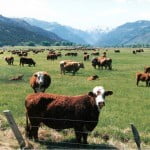
Do cows know that it’s summer?

Do these bovines realize that it is summer?
Ouray Making Fortune on Tourist Soup
(Dexter Creek) Progressive marketing icons in this landlocked county seat have developed a recipe for Tourist Soup, which is reportedly brewed daily in the town’s municipal swimming pool.
Every spring town workers clandestinely prepare the pool (or pot as they call it) for the arrival of the “soup meat”, or tourists, starting in June. The thermal waters must be monitored hourly to insure a proper heat is maintained. The vegetables must be smuggled in and distributed in the now murky broth then the spices and herbs must be added in just the right measure so as not to distract from or dominate the final taste and aroma.
Then the soup is trucked over Red Mountain Pass to be sold to brokers in Durango for distribution, mostly to unsuspecting Third Whirled Countries and Grand Junction.
Our cookie-cutter little tourist economy is nothing more than a front for this more lucrative operation,” said Jimmy Scoggins who has gone so far as to serve the soup in his lavish Ridgway hardware emporium.
“In rare instances a complete tourist ends up in the final concoction but we go to great pain to avoid this due to strict county ordinances on cannibalism, which he called reactionary.
The soup itself, canned under the jurisdiction of Alf Bisque, comes in a wide variety of flavors including Okie, Texan and Kansas Chowder. Gourmet versions are available using Californians and Front Rangers.
Authorities became suspicious last season after a Utah man reported several masked men dumping industrial loads of vegetables into the deep end after dark. He claimed that carrots, potatoes and onions were boiled live in the curdling waters in direct violation of another county ordinance. He shared his concerns with police and has not been heard from since.
“The soup cartels are making too much money for some nosy flatlander to ruin everything,” said a former executive now mouthpiece for the Vegetarian Curmudgeons, a militant garden club. “Just wait until the little ice climbers show up this winter. We’ve got to keep up with supply and demand and there are a lot of people out there who want more of Ouray than an RV slip and a personalized license plate.”
The entire episode appears earmarked as just another version of the same old story: “Cooking with a hundred is always more difficult than cooking with a few” Bon Apetite!
Green Lawn Key to Pearly Gates says Preacher
(LaPlata Purgatory Post — June 25, 2015)
People who maintain a nice plush lawn are more likely to get into heaven than folks who let their grass turn brown says Rev. Billy Dee Wannamaker. Speaking at the Blinding Restitution and Collection Plate Temple here Wannamaker, who has lived all but one day of his 57 years in Grand Junction, told a packed house “Green is good.”
“Why would God allow anyone into the Kingdom who couldn’t even take care of his lawn?” asked the reverend. “Think about it.”
Wannamaker’s sermons gained much notoriety back in the 90s when he successfully brought back a seeded lawn at Walker Field. In 1997 he directed what is now known as “the virtual miracle at Mack” where sagebrush was turned to sod before the eyes of the assembled.
He then sent Mesa County a bill for the water saying he owned the patent for irrigation systems in North America. Confused, frightened bureaucrats even sent him a check.
“That,” smiled one of the faithful, “was the Rev’s biggest miracle of all.”
– Fred Zeppelin
Master Race Planned for Utah
(Moab Monkeywrench – Deseret Edition — June 10, 2015)
The First ever Master Bicycle Classic kicks off this weekend near Canyonlands National Park. The race is expected to draw more than 400 participants and crowds numbering in the low thousands despite the raging heat.
Promoters told The Horseshoe that the race would bring $40,000 into the local economy. Not particularly anxious to elaborate, they concluded that since all the motels are filled and all the campgrounds overflowing “the event is a success before it even starts.”
If these people spend enough money we could shut this whole shooting match down until the fall when the temperature resumes a normal flow.
Melting bicycle tires and heat exhaustion are only a part of the fun according to an unidentified bicycle repairman.
“I have already sold 200 custom-made ice bag rubber insulators and it’s not even noon.” – Red Archer
DOW May Introduce Primates to San Juans
Silverton, CO — Monkey Business Release — June 10, 2015
Monkeys will soon roam with the bear and the elk in the San Juan Triangle if state Division of Wildlife zoologists have their way. A decision on the breakthrough placements will be made this week.
“When we say monkeys we mean Japanese Snow Monkeys, a species that could do quite well in these mountain environs. They live in cold, mountainous weather in Japan and the food chain is quite similar to that in our mountains,” said Betty Caige, an animal corrections expert with the DOW. “We cannot include tropical varieties on our new roster since most could not survive the harsh winters. The Japanese Snow Monkey, or macaque troupes are well suited for cold and snow.”
Until now genetic engineers have been reluctant to relocate macaques due to the potential for petty feuds with marmots, sheep, lions and ptarmigan that live up high in summer months. However after tedious study, researchers determined that since none of these species climb trees, conflicts could be easily averted.
“We see no reason why snow monkeys and the indigenous population can’t live as good neighbors,” said Caige. “We envision bighorns showing macaques the way to the hot springs and monkeys helping bears get honey from precarious branches.”
Exactly where the new residents might fit into the food chain is not clear although most contributing scientists view the primates as part-time carnivores who, if hungry enough might surround a deer or catch an occasional rabbit.
“They are smart,” said one biologist but not smart enough to build traps or blinds to catch game,” said Caige. “Most of these monkeys are primary vegetarians and will survive on leaves, berries and bark. But on special days they might feast on insects, eggs, small birds and even a fish or two.
“It’s difficult to imagine making it through an entire winter with nothing to eat but bark,” laughed Caige. “The monkeys will probably revolt and demand transfers. Why couldn’t we drop bananas during the brutal months?”
Forest Service bosses hope to create a much-needed source of cheap summer employment within these macaque ranks. Chores such as greeting campers, cleaning latrines and collecting tent fees are not out of the question.
“Monkeys can execute most tasks now performed by National Forest staffs and greenies and they don’t need a paycheck on Friday. They will work for bananas.” – Marvin Tinkleholland


