 All Entries Tagged With: "Lake City"

Three more reasons to visit Stockholm soon

Three reasons to visit Stockholm soon
GATHERERS ARRIVING DAILY
(Montrose) The local airport is jammed hunters today. But this year the annual migration of rifle totters is accentuated by the presence of more than 100,000 gatherers. The gatherers, the secondary component to the ancient order of humankind, have long been linked to hunters, making up a precedent to agrarian sects, Sumerian brew masters and the more sophisticated Puritan-Abolitionist-Yankee Insurance Linkage Conspiracy.
The gatherers, a rough, hungry looking pack of beggars, wasted no time in their struggle to feed themselves and their shabby offspring. Roots, berries, small trees and shrubs fell before the mighty onslaught. Later in the afternoon the barbaric hordes confiscated parking bunkers, lights, road signs, county commissioners and even bits of asphalt before moving on to high country redoubts along the Uncompahgre Plateau, rainy Dry Creek and the painfully crooked Straights of Colona (oerthodontisima reconoitera).
“Frankly we’re happy to have these folks around this time of the year,” quipped Melvin Toolini, executive director of the Chief Colorow Soil Conservation District. “Not only do they haul out a lot of debris but they keep the hunters in check.”
Gatherers, associated with hunters since before anthropology carved its name on the wall, are quieter and usually far more sober than the average orange-clad meat seeker. They travel in small bands (often without a decent bass player), shadowed by teeming ox carts crammed full of everything from discolored banana peels to rusty snuff cans to impartial elk droppings to soggy balls of string to curious Spam tins to discarded passages of the United States Constitution.
“We observed one hunched-over gatherer attempting to digest the Bill of Rights just the other afternoon on Simms Mesa,” said Toolini, “but the federals happened by, and with the aid of complacency, succeeded, in driving the madman off into the dark Forest of Illiteracy.
For the uninitiated, the Constitution and Bill of Rights are very dangerous documents that, falling into the wrong hands, could threaten our way of life.
The gatherers are expected to remain in the region until everything is gathered. Then they will move to the Confront Range where their massive warehouses are located.
– Kashmir Horseshoe
UTAH ACCUSED OF STEALING ELK
(Moab) The state of Utah has once again been accused of stealing Colorado elk. A formal complaint was filed in district quart here this morning calling for the return of the animals and undisclosed reparations that would be paid to Colorado from its neighbor to the west. The document alleges that diabolical and covert factions representing the powers that be in Salt Lake City have been kidnapping elk from the Uncompahgre Plateau and smuggling them past elite border patrol divisions at Mack, Dove Creek and LaSal Junction.
“These evil connivers have been disguising the elk as jumbo holiday fruit baskets in order to slip past the guards,” said Melvin Toole, a recognized expert in cattle rustling who spent ten to twenty at Canon City working toward advanced degrees on the subject. “They’re obviously trying to beef up their own pathetic herds in order to compete for out-of-state hunters.”
Utah is already doing a bang-up job of competing with Colorado in the arenas of skiing and summer tourism.
“This is a sensitive issue due to fiscal overtones,” said Toole who remains true to his warped contention that since there is no longer a state tourism tax there is, in turn, no longer a reason to be nice to tourists.
Meanwhile sources in Utah insist that they have never stolen so much as a Columbine from Colorado.
“We won them elk fair and square in a poker game in Rangely last month,” said one Utah wildlife officer. “Yeah I know Mormons ain’t supposed to gamble but we got carried away with the all them pretty chips and all.”
According to the latest count some 350 elk and a few hundred deer are currently missing and that represents grand theft, punishable by fines and penal servitude.
“They can’t prove a darn thing,” added the Utah suspect, “since the elk cross the borders whenever they like and nobody holds wapiti branding sessions anymore.”
St. Roscoe Appears to Arkansas Hunters
(Cimarron) In a rare mid-week appearance Saint Roscoe, the patron saint of RV enthusiasts, visited three different hunting camps on Wednesday evening warning inmates as to the dangers of camp beans. Showing up at dinnertime at a large encampment on the West Fork of the Cimarron St. Roscoe encouraged hunters to eat more greens while out in the woods.
“Believe you me,” began Roscoe, “if you see the forest as your ally it is imperative to embrace some form of the vegetarian experience.”
The occupants of the camp, all from Arkansas, smiled and offered Roscoe biscuits and gravy. All agreed that the saint was quite inebriated and repeatedly yielded to a small pint bottle that he had in his coat pocket.
“I’ve never seen a polyester leisure suit in that shade of blaze orange,” said one hunter.
Hopefully he won’t be back,” quipped another. “He was scaring the daylights out of the horses.”
Saint Roscoe stopped by for a few minutes at two other camps in the vicinity but according to everyone involved he had already forgotten his message and was content to exchange hunting tales with the assemblage.
KBUT TO BROADCAST HUNTING SEASON
(Crested Butte) Once again KBUT-FM will broadcast the current hunting season in its entirety. The program, expanded this year to include Grand Mesa and the Quartz Creek Valley, will run from October 14 through November 22. It will most likely cover all special seasons as well as farmer’s season. Peasant season will not be featured in that the directors of the station feel that it is inappropriate.
Interested parties are reminded that there will be no televised coverage of the event.
“The mounting dog problem is not a subject that is suitable for the barber shop, the poker table or the common bar room. Questions of morality like this belong in the Town Council chambers.” -Kashmir Horseshoe
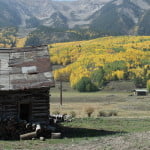

HOW I TAUGHT OURAY TO HUNT ELK
by Uncle Pahgre
The following is a excerpt from Whiskey, Women, Wapiti and Weapon’s Charges,
a history of little-known faith-based militia movements in America.
When I first entered the camp of the Tabeguache band I was amazed by the number of horses in the makeshift corrals. Three scowling braves guarded the outer perimeter of the village, comprised of over 200 lodges. The Uncompahgre, “rocks that make red water”, flowed peacefully in the October sun.
What was that awful aroma rising from this rough coterie? I soon found out it was that of mutton, a gift from the Los Pinos Agent. He wanted the Utes to become farmers and give up their hunter-gatherer lifestyle, to herd sheep when they’d rather spend their time at honorable endeavors like stealing horses from the Comanche and raiding Cheyenne strongholds to the east. Like Old Joe Meeker, Ivy League agent too would find the tribes a tough bunch to convert.
In addition to about 150 Tabeguache warriors there were another 40 men belonging to the Yampa and Uintah bands and Southern Ute warriors from the Weeminuche, Capote and Mouache bands. They had come together to discuss the recent intrusions of the whites and plan the winter’s survival. It was 1860. In addition to the men there were many women of each band mixed with Jicarilla Apache wives, children and uncounted dogs running about madly. There was no livestock to be seen since the Utes killed all wild game and ate it on the spot. A few Navajo slaves were evident in the background of the camp activity.
A medicine man approached us chanting, then glared at me and my friends, who stood shaking in their boots. He was harmless, said I, and more curious than anything else. I embellished a tale of the ghosts of the Anasazi, or Chindees as the Navajo call them, to distract my fellows from their fingered weapons.
After a week in the woods I was looking for a long soak in hot water. The Utes generally set up their larger encampments near natural hot springs and before long I spied stream coming off the river. Before I met Chief Colorow some years back I thought hot water was what one sat in before dressing up and going to the whore house on Saturday night…not that I ever did, mind you. It was Colorow who years before had convinced me that the all but scalding water was healing.
Now I’ve always been one to respect another man’s culture, unless it’s the growing kind, so I jumped right into the Ute chief’s pool. Damn. It was hot. He might have turned to me and said, “Yeah, it’s about 107 degrees,” but the tub thermometer hadn’t been invented yet, least ways as far as some plump chief knew. That water was beautiful. All my aches and pains seemed to float down the Uncompahgre.
Colorow was a bit of a hot head all right, but wouldn’t you be a bit pissed off if a bunch of strangers with picks and mules moved into your backyard? The next morning Colorow and his band escorted me to my first horse racing rendezvous up in Baker’s Park.
It was then that I encountered a young Ute brave who spoke good Spanish. His name was Ouray and he sat at the head of the table with his wife Princess Chipeta. She was quite attractive while he was a short, dark man who loved to race horses. When it came to betting he didn’t miss a beat either. I watched as time and time again his chosen horse won.
“That’s because I’m the chief,” he smiled, when I asked him about his curious good luck.
“Ute law says chief must win. We’ll give it up after the next race and head back to my hogan. I have to let the younger braves have a chance.”
It was there where we got on the subject of elk hunting. Chipeta, who had joined us in the hogan shrugged and said goodnight. As she disappeared through an aspen grove Ouray frowned and confessed that his good fortune with horses did not extend to hunting elk.
“Even my own wife has better luck bringing home an elk. Every year we go out, she nails an animal then tells the village that I downed the bull elk so as to keep face. Nobody dares to give advice on hunting because I’m the chief and it would be disrespectful. When I was a boy my father was always out of town and nobody else felt comfortable teaching the son of a chief to hunt. The truth is that I am a lousy hunter and in turn an unworthy chief.”
I was shocked. Here I sat with the King of the Utes and he’s sharing a sob story. It was too much to believe. He said he had never downed an elk in his life and that his success with bear and deer came only due to the large population inhabiting the San Juans.
“One can’t go for a stroll after dinner without seeing at least a herd of deer and several rambling bears,” he explained. “If you can’t bring down a bear you’re really out to lunch. Chief Ignacio hunts them with a sling-shot. I think he’s suspicious as to my elk hunting prowess. He’s always wanted my job.”
Afterwards we spoke of his people and the goings on to the east where white men sought yellow gold at the expense of the Arapahoe. This wise warrior could see the writing on the wall. His appraisal of the desperate situation was quite astute and it was clear why he had been chosen chief. We later talked of changes, of the white man’s sense of progress but he always returned to his frustration with landing an elk.
It was getting late but he went on until I had no other option but to offer my services in the woods. Having come from a long line of trappers and frontiersmen I had a few tricks up my buckskins. We would meet at an agreed spot and with a little luck he would bring down an elk. He headed off to his hogan and I fell into a deep sleep.
The next morning was cold and I dressed for it. When I arrived at our meeting spot he was already there. He looked like a hunter at least with buckskins and loincloth and bright war bonnet. With him he had a set of golf clubs. He had been hitting pine cones with a driver and each one sliced off into the woods.
“Maybe the bonnet is scaring away the game,” I joked.
“It scares the fish,” he said bluntly.
Not wanting to dwell on eccentricities I avoided any comment on the golf clubs.
We headed east toward what is now called Difficulty Creek and camped for the night. The next day we were joined by several others and encountered a large herd of elk on the banks of what the whites call Wild Horse Creek. We watched.
“Do you have a hunting license?” asked Ouray.
“A what?” I responded.
“A hunting license. Otto Mears told me I had to have a hunting license to shoot an elk.”
At that point he produced a crumbled piece of paper signed by railroad scalawag and toll road pirate Otto “Million Dollar Highway” Mears. Upon examination of the document I realized that Chief Ouray’s name was nowhere to be found. In fact, the “license” was no more than an old pass to the Silverton Northern Railroad.
“How much did you have to pay for this?” I asked the chief.
“Not much. Little man (Mears) threw in golf clubs and necklace for Chipeta. It’s pure silver.”
Not wanting to ruin it for Ouray I shut up about the license and the necklace…and besides, the golf clubs looked almost brand new.
“What do you plan to do with the clubs?” I then asked as Ouray took a few practice swings.
“Get elk,” he said.
“With that slice?” I thought. My work was just beginning.
“What’s it like having a whole town named after you?” I asked the chief.
“Indianapolis?” he queried. “I don’t know. I’ve never been east of Garden City.”
Discretion being the better part of geography I let that statement go as well, in fact I wouldn’t have touched it with a four-legged, four-foot, five-iron.
After scouting the herd from above, the other Ute hunters who had joined the party began to tighten the circle around the animals, picking out stragglers and young cows as the prey. All at once the hunt was on. In no more than minutes six elk were down, the others allowed to scatter. The Tabeguache band quickly dressed out their kill, hung the meat in the shade, and feasted on ancient delicacies. One small calf was totally consumed by the ravenous hunters, some who preferred the bow to the rifle.
That next morning they packed out all the elk meat on seven different horses and returned to the encampment, now excited by the news of the kill. All five elk would be eaten within the next two days and some of it jerked. The dogs ate what was left of the bones, the entrails having been left on the spot of the kill for the wolves and coyotes. The hides were taken for clothing and shelter.
How superior this culture is to the white civilization that spawned such men as Charles Baker, John Gunnison and yes, Otto Mears. Everyone knows his place in it. No one needs more than what it takes to survive. Essentials, though, include horses and hot springs.
It was the next day that I presented my favorite muzzle loader to the Ouray, who accepted it as the treasure that it had become. He told me I was an accomplished hunter and that he had learned much from our association. But one fact remained: He was yet to down his elk. The morning shadows lifted as we made our way across Wild Horse and into dark timber. As we stepped back into the sun a small herd of elk appeared just above us. They had not spooked. I told Ouray to stay close and keep his eyes open.
As we crept up to a prime vantage point I fingered my arrow. Standing erect I carefully placed it across my bow, pulled back and let it go. Suddenly the herd spooked and there were elk everywhere. My bull dropped like a sack of concrete. Ouray jumped up and rushed the herd with what I believe to have been a six-iron. No luck again for the chief.
We dressed out my kill and headed back in the direction of the big camp. With any luck we’d run into more elk and I began to lecture my friend.
“Now see here chief,” I began. “It’s time to can the clubs and stick to bow and arrow. You have to get up close and be steady when you fire.”
Ouray listened well. When I showed him how to disguise himself in a coyote pelt he wanted to try it on the spot. When I suggested a balanced stance he picked up on it right away. After an hour I even had him tracking and listening to the ground for footsteps. He was a natural. Why he had never picked up these skills remains a mystery.
In a mater of miles we came onto a small herd and followed the wapiti down a tree-lined gulch until they stopped. Ouray could barely contain his excitement when I began to circle around to the north and attempt to drive the herd in his direction. As I made off I saw that he had donned his coyote attire and was testing his bow. I was sure he’d get his elk this time.
Arriving out of breath I moved into position and began my descent. One of these animals was about to find instant fame at the end of an arrow. His antlers would hang in the lodge of a great Ute chief. All the braves would be reassured that Ouray was the strongest and most able to lead them. I moved toward the herd. Evacuating the premises three large bulls moved straight toward Ouray’s ambush.
Then I heard a thundering cry followed by a triumphant cheer as only two of the three bulls continued on through the narrow gulch. Had he finally been successful?
As I came upon him in the draw he sat gutting out a bull elk. It was tough to see where the arrow had pierced the animal…or if, indeed an arrow had been fired at all. The chief sat smiling, a badly mangled nine-iron at his side. We returned with our animals to the camp that evening and there was much celebration. Ouray was as proud as a cock pheasant.
The next time I saw Ouray was in 1866, following the American Civil War. With that conflict completed, Manifest Destiny was again nipping at the heels of the Utes. Ouray was now recognized as spokesman for all of his tribe. He had agreed to another new treaty which prohibited white prospectors from the San Juans and guaranteed the Utes sole autonomy in the region. He still had the rifle and the antlers from his first kill.
I think at the time Ouray knew the treaty would be broken, and so it was in April of 1874 with a new treaty which opened up the mountains to prospecting and confined the Utes to a shrinking reservation.
But back on that night in 1866 whites were still trespassers, elk were plentiful and coexistence seemed possible. The entire western half of the continent was still one big beautiful fairway. Then Chief Ouray told his dinner guests that I had taught him how to hunt elk in the silver mountains. – Kevin Haley


