 All Entries in the "Hard News" Category

FABLES FOR OUR TIME
The Moth and the Star
A young impressionable moth once set his heart on a certain star. He told his mother about this and she counseled him to set his heart on a bridge lamp instead. “Stars aren’t the thing to hang around,” she said; “lamps are the thing to hang around.” “You don’t get anywhere chasing stars.” But the moth would not heed the words of either parent. Every evening at dusk when the star came out he would start flying toward it and every morning at dawn he would crawl back home worn out with his vain endeavor. One day his father said to him, “You haven’t burned a wing in months, boy, and it looks to me as if you were never going to. All your brothers have been badly burned flying around street lamps and all your sisters have been terribly signed flying around house lamps. Come on, now, get out of here and get yourself scorched! A big strapping moth like you without a mark on him!”
The moth left his father’s house, but he would not fly around street lamps and he would not fly around house lamps. He went right on trying to reach the star, which was four and one-third light years, or twenty-five trillion miles, away. The moth thought it was just caught in the top branches of an elm. He never did reach the star, but he went right on trying, night after night, and when he was a very, very old moth he began to think that he really had reached the star and he went around saying so. This gave him a deep and lasting pleasure, and he lived to great old age. His parents and his brothers and his sisters had all been burned to death when they were quite young.
Moral: Who flies afar from the sphere of our sorrow is here today and here tomorrow.
The Unicorn in the Garden
Once upon a sunny morning a man who sat in a breakfast nook looked up from his scrambled eggs to see a white unicorn with a golden horn quietly cropping roses in the garden. The man went up to the bedroom where his wife was still asleep and woke her. “There’s a unicorn in the garden,” he said. “Eating roses.” She opened one unfriendly eye and looked at him. “The unicorn is a mythical beast,” she said, and turned her back on him. The man walked slowly downstairs and out into the garden. The unicorn was still there; he was now browsing among the tulips. “Here, unicorn,” said the man, and he pulled up a lily and gave it to him. The unicorn ate it gravely. With a high heart, because there was a unicorn in his garden, the man went upstairs and roused his wife again. “The unicorn ate a lily,” he said. His wife sat up in bed and looked at him coldly. “You are a booby,” she said, “and I am going to have you put in the booby hatch.” The man, who had never liked the words “booby” and “booby hatch,” and who liked them even less on a shining morning when there was a unicorn in the garden, thought for a moment. “We’ll see about that,” he said. He walked over to the door. “He has a golden horn in the middle of his forehead,” he told her. Then he went back to the garden to watch the unicorn, but the unicorn had gone away. The man sat down among the roses and went to sleep.
As soon as the husband had gone out of the house, the wife got up and dressed as fast as she could. She was very excited and there was a gloat in her eye. She telephoned the police and she telephoned a psychiatrist; she told them to hurry to her house and bring a strait jacket. When the police and the psychiatrist arrived, they sat down in chairs and looked at her with great interest. “My husband,” she said, “saw a unicorn this morning.” The police looked at the psychiatrist and the psychiatrist looked at the police and the police looked at the psychiatrist. “He told me it had a golden horn in the middle of its forehead,” she said. At a solemn signal from the psychiatrist, the police leaped from their chairs and seized the wife. They had a hard time subduing her, for she put up a terrific struggle, but they finally subdued her. Just as they got her into the strait jacket, her husband came back into the house. “Did you tell your wife you saw a unicorn?” asked the psychiatrist. “Of course not,” said the husband. “The unicorn is a mythical beast.” “That’s all I wanted to know,” said the psychiatrist. “Take her away. I’m sorry, sir, but your wife is as crazy as a jay bird.” So they took her away, cursing and screaming, and shut her up in an institution. The husband lived happily ever after.
Moral: Don’t count your boobies until they are hatched.
If Grant Had Been drinking At Appomattox
By James Thurber
The following story is the fourth in a series including “If Booth Had Missed Lincoln,” “If Lee Had Not Lost the Battle of Gettysburg,” and “If Napoleon Had Escaped to America.”
The morning of the ninth of April, 1865, dawned beautifully. General Meade was up with the first streaks of crimson in the eastern sky. General Hooker and General Burnside were up, and had breakfasted, by a quarter after eight. The day continued beautiful. It drew on toward eleven o’clock. General Ulysses S. Grant was still not up. He was asleep in his famous old navy hammock, swung high above the floor of his headquarters’ bedroom. Headquarters was distressingly disarranged: papers were strewn on the floor; confidential notes from spies scurried here and there in the breeze from an open window; the dregs of an overturned bottle of wine flowed pinkly across an important military map.
Corporal Shultz, of the Sixty-fifth Ohio Volunteer Infantry, aide to General Grant, came into the outer room, looked around him, and sighed. He entered the bedroom and shook the General’s hammock roughly. General Ulysses s. Grant opened one eye.
“Pardon, sir,” said Corporal Shultz, “but this is the day of surrender. You ought to be up, sir.”
“Don’t swing me,” said Grant, sharply for his aide was making the hammock sway gently. “I feel terrible,” he added, and he turned over and closed his eye again.
“General Lee will be here any minute now,” said the Corporal firmly, swinging the hammock again.
“Will you cut that out?” roared grant. “D’ya want to make me sick or what?” Shultz clicked his heels and saluted. “What’s he coming here for?” asked the General.
“This is the day of surrender, sir,” said Shultz. Grant grunted bitterly.
“Three hundred and fifty generals in the Northern armies,” said Grant, “and he has to come to me about this. What time is it?”
“You’re the Commander-in-Chief, that’s why, said Corporal Shultz. “It’s eleven twenty-five, sir.”
“Don’t be crazy,” said Grant. “Lincoln is the Commander-in-Chief. Nobody in the history of the world ever surrendered before lunch. Doesn’t he know that an army surrenders on its stomach?” He pulled a blanket up over his head and settled himself again.
“The generals of the Confederacy will be here any minute now,” said the Corporal. “You really ought to be up, sir.”
Grant stretched his arms above his head and yawned.
“All right, all right,” he said. He rose to a sitting position and stared about the room. “This place looks awful,” he growled.
“You must have had quite a time of it last night, sir,” ventured Schultz.
“Yeh,” said General Grant, looking around for his clothes. “I was wrassling some general. Some general with a beard.”
Shultz helped the commander of the Northern armies in the field to find his clothes.
“Where’s my other sock?” demanded Grant. Shultz began to look around for it. The general walked uncertainly to a table and poured a drink from a bottle.
“I don’t think it wise to drink, sir,” said Shultz.
“Nev’ mind about me,” said Grant, helping himself to a second, “I can take it or let it alone. Didn’t ya ever hear the story about the fella went to Lincoln to complain about me drinking too much?
“So-And-So is a fool,” said Lincoln. “So this fella went to What’s-His-Name and told him what Lincoln said and he came roarin’ to Lincoln about it. ‘Did you tell So-and-So I was a fool?” he said. ‘No, said Lincoln, “I thought he knew it.’ ” The General smiled, reminiscently, and had another drink. “That’s how I stand with Lincoln,” he said, proudly.
The soft thudding sound of horses’ hooves came through the open window. Shultz hurriedly walked over and looked out.
“Hoof steps,” said Grant, with a curious chortle.
“It is General Lee and his staff,” said Shultz.
“Show him in,” said the General, taking another drink. “And see what the boys in the back room will have.”
Shultz walked smartly over to the door, opened it, saluted, and stood aside. General Lee, dignified against the blue of the April sky, magnificent in his dress uniform, stood for a moment framed in the doorway. He walked in, followed by his staff. They bowed, and stood silent. General Grant stared at them. He only had one boot on and his jacket was unbuttoned.
“I know who you are,” said Grant. “You’re Robert Browning, the poet.”
“This is General Robert E. Lee,” said one of his staff, coldly.
“Oh,” said Grant. “I thought he was Robert Browning. He certainly looks like Robert Browning. There was a poet for you, Lee: Browning. Did ya ever read ‘How They brought the Good News from Ghent to Aix’? ‘Up Derek, to saddle, up Derek, away; up Dunder, up Blitzen, up Prancer, up Dancer, up Bouncer, up Vixen, up—’ ”
“Shall we proceed at once to the matter in hand?” asked General Lee, his eyes disdainfully taking in the disordered room.
“Some of the boys was wrassling here last night,” explained Grant. “I threw Sherman, or some general a whole lot like Sherman. It was pretty dark.” He handed a bottle of Scotch to the commanding officer of the Southern armies, who stood holding it, in amazement and discomfiture. “Get a glass, somebody,” said Grant, looking straight at General Longstreet. “Didn’t I meet you at Cold Harbor?” he asked. General Longstreet did not answer.
“I should like to have this over with as soon as possible,” said Lee. Grant looked vaguely at Shultz, who walked up close to him, frowning.
“The surrender, sir, the surrender,” said Corporal Schultz in a whisper.
“Oh sure, sure,” said Grant. He took another drink. “All right,” he said. “Here we go.” Slowly, sadly, he unbuckled his sword. Then he handed it to the astonished Lee. “There you are, General,” said Grant. “We dam’ near licked you. If I’d been feeling better we would of licked you.”
Colorado man runs fishing boat into White House
(Warshington) A Sapinero man started out the day fishing for breakfast in the Gunnison River and ended up catching hell for dinner on the White House lawn. Now he can barely recognize his crumpled bass boat, which mysteriously crashed into the White House yesterday. The incident, which took place on the heels of a similar intrusion last month, has sent shockwaves through the inner sanctum of the Secret Service and left local police baffled.
“I don’t have any answers either,” flinched angler in the spotlight, Melvin Toole as he was questioned by authorities last night. “One minute I was cruising the Gunnison in my extended cab, double-barrel, aluminum tuna boat and the next I was on the East Coast. I must have taken a wrong turn at Leaps Gulch, but I don’t remember crossing the Rockies or the Mississippi either.”
Questions over White House security, voiced after a renegade airplane landed on the West Lawn in September, have once again been reiterated, with all sorts of government agencies denying the blame for this recent episode.
“The Department of Transportation blames the Secret Service while the Secret Service blames NASA, who in turn is pointing the finger at the local DC cops,” said on White House aide. “Meanwhile nobody around here is getting anything done. What else is new?” he laughed.
Toole, a former daredevil trapeze artist turned sous chef, is being held in lieu of bond at an undisclosed location. He is expected to undergo tortured tomorrow.
Neither the President or his family were at home at the time of the crash.
Some 30 healthy kokanee, which had been snagged by Toole prior to his departure from Colorado, were presented to a throng of homeless persons gathering on Pennsylvania Avenue. These unfortunates had assembled to listen to some self-proclaimed prophet sing the praises of pyramid marketing. The fish, which fed some 200 people, was a bonus, and with loaves purchased from a local bakery, almost Biblical.
Toole, who is wanted in Wyoming for sheep rustling and impersonating a bale of hay, told authorities that he would fight any charges brought against him.
“I’m not a terrorist!” he bellowed, adding that he hoped the Obamas had collision insurance.
– Small Mouth Bess
MARS DECLARED WILDERNESS AREA
(Ridgway) The planet Mars has been designated Wilderness for eternity according to a spokesman for the Disappointment Valley Optimist Club, executive sponsor of the move. With the support of the powerful We Be Victorian contingent of Ouray the conservationists successfully lobbied the Congress (with presents and loud noises) convincing that legislative body to do something about what they say is “the potential development of the Red Planet by the end of the century.
“Let’s not wait until we overbuild to start creating green belts and open space,” said one Optimist sadly. “Isn’t it enough that we’ve trashed this planet?”
As is the tradition, no motorized vehicles or oversized ice chests will be allowed on Mars. In addition cameras will be banned as will radical solar energy exploration which, as we all know, is blatant terrorism.
Critics of the development say the action comes as a diversionary tactic. Only last week the Senate passed legislation allowing a Wal-Mart to be built on Venus. Simultaneously, the House agreed to allow industrial fracking in North Dakota and massive logging operations to continue in the Northwestern United States.
“Now they have their pound of flesh,” said one developer of the environmental efforts, “just when we were starting to talk water rights. Oh well, our waferboard condos will look spiffy on Neptune.”
– Uncle Pahgre

The night the little people took over O’Leary’s
Straight away let it be said that Irishmen are often prone to hallucinations of mind and spirit.
I know that, for certain, great grandpa came from Kerry and was well acquainted with lots of leprechauns and many a mermaid.
But I’ll be swearin’ to this tale that I’m about to tell. For, it really did happen. And I’m not one to be makin’ up drivel.

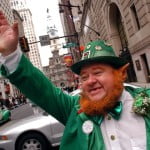
Leprechaun hailing a cab on downtown Philadelphia, 2009
It was just a week ago tonight that I was rousted out from under the cozy confines of my electric blanket by the post midnight rattle of the telephone.
On the other end, talkin’ a mile a minute and in all the official language he could muster, was none other than himself, our local police chief.
“Mr. O’Neill,” he said. “Upon checking the latch of your bar this evenin’ we did notice that you went off and left the lights blazin’ and the jukebox blastin’ one of those Irish songs you insist on botherin’ yer customers with.”
Well, this was unsettling news, for, although I didn’t dare tell the chief this, I knew as sure as Harp has bubbles that I had doused the lights and unplugged the box when closin’ the joint just a few hours previous. So, keeping my wits about me, I assured the concerned cop that everything was fine and dandy, but that I would drive down to O’Leary’s and check things out my own self.
Which is what I did.
And upon arriving at the outer limits of the snoring little town of Parachute, all muffled by a soft layer of new snow, I ascertained that, sure enough, my old brick and boards pub was twinkling wide awake like a tree on the courthouse lawn at Christmas time. A curious thing, in the least. For just hours ago the last whiskey had been spilt and the last human fixture removed from a barstool and sent home to his mad wife and happy dreams.
Now, it is not that I place any stock those old tales about pukas and banshees or boogiemen, but I thought it’d be to my benefit and safety to approach the old building with a degree of caution. And I did. I sneaked up on the back door with the car lights off and cased the place before doin’ anything rash.
Just as the chief had said, the lights inside were shinin’ full tilt and the box was blastin’ a reel to beat the band. Takin’ a quick peek through the crack in the door I could see that there wasn’t a soul inside and that all that electricity was goin’ to waste.
Now it’s not a brave man that I am, but one concerned about hefty bills from Public Service. And so I fit the key in the lock and pushed my way inside.
The place was empty, spooky almost. The bottles shined in the light and the ghosts of my customers in hard hats seemed to wave at me from their assigned perches along the bar. And then I shut the door behind me.
Laughter and Irish curses rolled over me then. Pipe smoke hung around the lights and small figures began taking shape in every chair and on every stool. Gartered bartenders standing on empty beer kegs were pouring draws and sloshing pitchers about behind the battered mahogany bar. The Wolfe Tones reel that I had been hearing before had changed to enchanted flutes and fiddles, the likes of which my ears had never before been blessed with.
And I stood there with my keys in my hand and began counting in my head the number of Murphy’s that I’d allowed myself before goin’ to bed and concluded there was only two and that on Grandma Maggie’s grave I wasn’t drunk. Yet, the little people partying there around me paid me not so much as a random glance.
There were fat roast beefs and platters of fried cabbage soaking in butter and sprinkled with sugar all about and a bottle of my best Tyrconnell on every table. Guinness was running from every spigot like faucet water. Faery queens in crimson velvet and capes of ermine flitted about the dance floor enraptured by the Irish airs being woven from the flutes and strings and bones of a faery band.
At the biggest table a group of little men refilled their glasses and clapped time to a newly uncorked jig. They were fun-faced little gentlemen, dressed not as pretentiously as the women; in velvet derbies with matching vests and silken knee stockings.
And, sure as I can’t doubt my own two eyes, there was Liam O’Leary, my great grandfather’s own arrogant leprechaun, sittin’ at the head of the table. On his right sat a sparkle-eyed old man who looked, like me, to be of the mortal persuasion. By the devil, he was familiar to me, too.
But just then O’Leary eyeballed me standin’ with my feet stuck to the floor by the back door and in an instant the music stopped and the tiny revelers all froze in their tracks.
Should I not have been caught so dumbstruck, I might have asked to see all their I.D.s.
“Well O Danny be the divil, if it isn’t the martal bahrkeep, himself,” O’Leary said winkin’ to the old man on his right. “And I see ya got the invitation we sent ya, Pathrick.”
Beaming at his sawed off cohorts Liam bragged. “What a grand party it is, too, if I do say so meself! Come over here, laddie, and sit by me and your grandfaether. Have a tumbler full of this bad beer.”
Sure enough, that old fellow was my great granddad, himself, who promptly poured me a glass o’ golden lager beer which, when tasted, kicked magically like stout. This being done the party resumed and from then hence no one paid me any never mind. Except my handsome, gray-headed great grandfather, “Big Pat.”
For a long enough time he merely rubbed my already tousled head and stared at my soul with his old politician eyes. Family stories had always held that “Big Pat” had had a way with the little people, that his Democratic oratory in the Pendergast precincts had been blessed with the butter of blarney because of his being held in good stead with the magic folks.
I guess I already knew, even then, that the old man from his place in Heaven — or the furnace room, as the case might be — had been keepin’ a close eye on me, his namesake, because O’Leary had told me as much on a previous occasion.
The first time the obnoxious little imp appeared in front of me– long ago in a dimly lit college newsroom — he had blasted me in the name of my departed namesake for bein’ “phony Irish.,” for thinking that my heritage was a pitcher of green beer, not in centuries of suffering and English spit.
That night grandpa didn’t have to say anything. I knew this was just another small reminder. I knew why I had been summoned the night the little people took over O’Leary’s.
St. Paddy’s Day was coming soon. The bar, of course, would be done up in banners and plastic party hats. The Jameson and Murphy’s and Harp and Guinness would run like the Shannon. We would surely wax phony Irish to beat the band.
The old man was in my bar that night to make sure I could still see through the green costumes, the cardboard cutouts and crinkly St. Pat’s hats and know that to be Irish was to be rich. That the people strong enough to have stayed on the “ould sod,” deserved more than a toast on March 17. They deserved a piece of my Irish heart and soul.
The following morning I woke up on my front porch sharin’ a blanket with the dog, sifting through various excuses (for my wife) and explanations (for myself).


