 Author Archive for M. Toole

ANASAZI RUINS BLANKET HEADWALL
(Crested Butte) The discovery of what experts say are a bulwark of ancient Anasazi ruins has closed the popular Headwall to skiers until further notice. The cliff cascades to the crumbling structures, thought to be dwellings or temples, and then drops into Paradise Bowl, where no further presence of the Ancient Ones has been detected.
The Anasazis, like their brothers at Mesa Verde may have lived here as long ago as 800 AD. When, or even if, they built anything resembling these ruins is not clear. Historians know that Utes, who lived in the Elk Mountains later on constructed lavish hunting camps and winter cities yet, because they were made of straw and/or sticks did not survive attacks. The Anasazi built their house of brick.*
Despite the inconvenience suffered by skiers, the news was greeted with excitement by local history buffs who say the discovery proves the Anasazi were alive and well in the Gunnison Valley. Sources at Western State College plan a series of field trips to the area so as to collect data and possible artifacts.
“Up till now we thought the Anasazi were concentrated up in Vail,” said Dr. Billy Glacé, of the Old History Department at the college. “We’re relieved that these revelations have suggested that the Anasazi may have spent at least weekends here.”
Other observers say the Ancient Ones were only second home owners and should not be considered legitimate residents.
“We don’t think these indigenous people had enough time to create ancient ruins by design,” said Almont resident and author of Totem Pole Blues-Arts Festivals in Native America, Gabby Haze.
“Their itineraries were demanding, their agenda pressurized,” Haze offered. “Most of their time was spent growing food and hunting. Housing was a distant priority and the architecture was determined by what materials were close at hand,” he explained. Actually none of us has a clue as to who built all this or who may have hung their head dresses here, but, since there were no white folks around in those days, we have agreed that it’s probably Indians.”
The find has also provoked interest within the construction industry in that it may save thousands of years in the study of effective condoization of remote spots all over the world.
“We can’t afford to build anything that good around here,” said local developer, Betty Marmotbreath, “not if we want it to fall down in time for resale.”
Ski officials did not say when the Headwall may be reopened. At present it appears that the ruins will be covered with visquine until spring. Until then skiers will be rerouted to the northeast and allowed access to the run. Then in June, unless the world ends, teams of archeologists will descend on the place in order to determine the origin and condition of the ruins.
* In Ute legend these flimsy, yet fortified bunkers did not survive even the most minimal of assaults, especially the calculated excursions by the Big Bad Wolf, aka US Cavalry, between 1876 and 1884.
Paper Donates Archives to Local Pound
(Manana) The San Juan Horseshoe has donated some 15,000 tons of old issues to the local dumb friends shelter here. The black and white newspapers, all in excellent shape, are meant to provide a safe, sanitary and sustainable answer to clean up procedures and speed up puppy training methods currently employed at the pound.
The generous contribution will allow the facility to create a more serene environment leading to happier and more adoptable young pets. The issues, from 1977-1987 had not been reviewed since 2000 and were just taking up space.
“The gift will provide comfort to so many,” said a tearful Averill Glee, who is allergic to cats. “The problem we have now is that our employees get distracted, reading the older stories and photos and the puppies end up peeing on the floor.”
Pound Principals promise that these glitches will disappear in time. On the first day as recipients, staff covered about 2 acres in cage floors and lined hot spots on the geriatric wing.
Other local papers, attempting to get in on the recycle plan were turned away.
“Their stories are too dated to use with young puppies. We feel that nonsense and satire are more gentle than banner headlines when it comes to potty time,” said Glee. “One must keep in mind here that we are not trying to scare the animals but rather soothe them at their time of need.”
The newspaper plans to write off the gift along with mounds of cosmic debris and untapped potential curious to its popular website.
– Suzie Compost
Ain’t Gonna Work On Maggie’s Farm No More
“Welcome to Zimmerman’s,” he bellowed. “We have a full line of furniture for your home or office. This month’s specials include sofas and dining room sets. Now through Tuesday if you buy an oak desk we’ll throw in the matching credenza for half price. But enough about that for now. Where are you from?”
“We’re from over in Duluth,” he responded. “My name is Joey and my wife is Johanna.”
Well then, welcome to Hibbing. Why not wander around and look at our showroom and if you have questions my son Harold will be only too happy to help you. Harold has decided to take over the family business instead of going to New York to write poetry. His mother and I are quite proud of him. Harold?
“Oh, where have you been, my blue-eyed son?”
“I’ve walked and I’ve crawled on six crooked highways,” said Harold.
“Yeah, it’s quite a ways from Duluth,” answered Joey.
OK, I’ll leave you in the capable hands of my son,” said the father.
“I’ll know my song before I start singin’,” said Harold.
“We’re looking for a bedroom set but I just can’t make up my mind between redwood and mahogany. Do you have time to show us some?”
“I’m not sleepy and there is no place I’m going to.”
“There’s so much to choose from…I’ll never decide…”
“Just like a woman with her fog, her amphetamine and her pearls.”
“I beg your pardon, young man.”
“Her passport shows a face from another time and place.”
“What?”
“I have something made of silver or of golden, either from the mountains of Madrid, or the coast of Barcelona.”
“We’re looking for something made here in Minnesota.”
“I know that you’re dissatisfied with your position and your place. Don’t you understand it’s not my problem.”
“Wait a minute. We came all the way from Duluth to look at furniture not to be insulted. People on the Iron Range don’t talk like that.”
“No reason to get exited. There are many here among us that think that life is but a joke.”
“Would you show us something in pine. Something in a neutral color?”
“Tangled up in blue?”
“Yes, the carpet is blue. Can we look in the warehouse too?”
“Go lightly from the ledge, babe. Go lightly on the ground.”
“Excuse me! My wife is not accustomed to be called “babe”. She’s been through a lot trying to redecorate our home and…”
“Seems like every time you turn around there’s another hard luck story that you’re gonna hear.”
“What? Enough of this nonsense. Don’t you have any answers? We’re going out to the warehouse…”
“In the jingle, jangle morning I’ll come followin’ you.”
“These end tables are nice. How much for the sofa?”
“Your sister sees the furniture like your mamma and yourself.”
“This stuff is nice but I rather liked the bed in the window.”
“Oh, oh, we gonna fly down in the easy chair.”
“But we’re not in the market for an easy chair. We told you we’re looking for…”
“Lay Lady Lay. Lay across my big brass bed.”
Now see here young man. Mind your manners. My husband won’t put up with any more shenanigans.”
“But tonight I’ll be staying here with you.”
“In your dreams! That’s enough. We’re going back to Duluth where people have some respect.”
“There’s nothin’ you wish to be ownin’?”
“Don’t get pushy. You act as if you were the only furniture store between here and Fargo. We can’t make up our minds right now.”
“Don’t think twice, it’s all right.”
“Well that’s better. Thanks for your input. We may be back and when we do we’ll ask to speak to a more knowledgeable clerk. Good-bye.”
“You just kinda wasted my precious time.”
“Well, Harold how do it go?” asked the father.
“He wants eleven dollar bills and you only got ten.”
“That’s OK you can’t make every sale. Tomorrow will be better.”
“None of them along the line know what any of it is worth.”
“You said it, son.”
“I can’t stay in here. Ain’t it clear…”
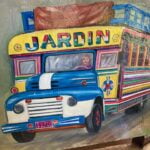
Colombian Color
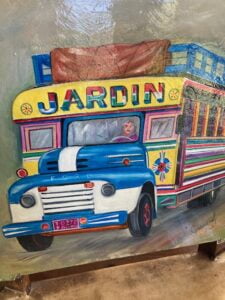
A chiva painted on the back of a wooden chair in Jardin, Antioquia. Colors abound here in the green countryside with palms and pines sharing the soil.

SOUTHERN LITERATI EULOGIZE THE BENEFITS OF OKRA
(Yoknapatawpha, MS) Why is it that the Southern writers are often considered the cream of the crop in the United States? The answer may be as simple as a slimy vegetable called okra.
According to a recent survey 89% of all Dixie scribes eat okra (when in season) at least once a day. They eat it fried, in gumbo and mashed up in salads. They eat it boiled, broiled and barbecued. Although the seemingly inconsequential plant has no obvious properties that may enhance creativity, the edible, mucilaginous pods are seen as brain food in some segments of Old South society.
Authors such as William Faulkner, Tennessee Williams and Marjorie Kinnan Rawlings are said to have been virtual okra hounds consuming as much two pounds of the vegetable in a typical sitting. Other writers, such as William Penn Warren would not even sit down to a meal until it had been determined that okra was on the table.
According to family members Erkstine Caldwell was even worse. While writing Tobacco Road he constantly munched on chocolate-covered okra and allegedly distilled a powerful intoxicant from the plant. The list goes on. Ellen Glasgow grew prize okra in her massive garden, Joel Chandler Harris gave tons of the stuff to trick or treaters at Halloween.
“The noted Southern writers talked about what happened on a ramshackle front porch after dinner,” says Dr. Efram Pennywhistle of the Pea Green Literary Composium, “while other American writers (with the exception of Twain, Hemingway and Fitzgerald who used okra in a stream of consciousness technique) tended to render a message of greater proportions. Which was more effective, more entertaining? It’s like the difference between catfish and lobster.”
According to academia okra alone won’t make one a great writer. He needs discipline, imagination and originality along with a bowl of pedantic gumbo.
“It’s like a lot of things worth doing,” continued Pennywhistle. “Once one gets past the initial slime the rest of it goes down easy.”
– Small Mouth Bess
“Humor is the prelude to faith and laughter is the beginning of prayer.” – Reinhold Niebuhr

Icy Streets and Leash Laws Clash
Council Reconsiders Priorities
(Crested Butte) The town council here may rescind a 150-year-old leash law, due to safety considerations, on Crested Butte’s icy streets and alleys. The action came Monday night as elected officials argued the merits of the long standing ordinance compared with the safety of its dog-walking citizens.
Arctic weather and seasonal moisture here have combined to create treacherous conditions, especially on the town’s north-side streets and alleys. Even Elk Avenue gets a little dicey early in the morning and after sunset.
When a pedestrian mixes an already precarious stroll with approved dog walking methodology a chain reaction is likely to take place. The walker often finds himself flat on his face, horizontal with the pavement, compliments of his over-eager mutt. Of course, a well trained dog, accustomed to healing, will not create such a hazard but even the most well behaved animal cannot be expected to perform to perfection with all the distractions (canine and otherwise) common to the town limits.
“We need leash laws in Crested Butte or we’d have dogs running around everywhere,” said one councilperson. “The restrictions are necessary for the safety and well being of the animal as well as for the general populace. However when butted up against icy sidewalks and dangerous streets we must reconsider the legislation.”
In a rare departure from existing policy another councilman warned that a slick walk at the receiving end of aggressive canine thrust could easily result in injury, and possible lawsuits.
“If we just rescind the law during periods when the streets are bullet-proof we might save everyone a lot of hassle,” he said. “We could operate along the lines of the parking laws with certain areas off limits on certain days. We could put up signs all over telling people when and where they could safely walk their dogs.”
Taking no action of the matter and leaving decisions in the hands of the people was not an option, according to the first council member who insisted that maintaining the current status would not solve the problem and that allowing people to police themselves was ridiculous.
“That’s like a Washington lobbyist volunteering for military duty in Iraq,” she said. “It may look good on paper but it will never happen. If we just suspend leash laws until mud season we should avoid disaster. When the real thaw arrives we might even implement higher fines for dogs at large and recoup our losses by June.”
After an hour of proposals it appeared that the law makers would suspend the leash laws for a trial period.
“Either we terminate the law altogether or groom Elk Avenue,” laughed one rogue councilman sitting in the back of the room. “What about protecting drunks and persons too busy talking into their cell phones to pay attention to the conditions? What about flatlanders unaccustomed to negotiating ice? They are people too!”
He then angrily departed the chambers, slamming his laptop, hurling his Sorrels and designer Italian sunglasses into the hallway for dramatic affect.
In other developments the remaining council members voted to deny further liquor licenses to canine groups (the first such action taken toward any applicant in over 30 years) and to ban heated dog houses due to cited high energy use in the often inefficient dwellings. Critics of the action say the council is merely punishing outside dogs for any part they might have in the crisis.
– Fred Zeppelin


