 Author Archive for M. Toole

San Juan Horseshoe: In Defense of Flies
Since the beginning of the summer I have heard nothing but complaints about these bothersome insects that we call flies. Granted, they are rather obvious and painfully persistent. Maybe it’s because there seem to be so many of them and they all look the same (at least to humans).
Let’s get to the meat here.
Fly-related commerce satellites such as the fly swatter, fly paper, repellent, sprays, screens, and nets, not to mention an assortment of fly fishing equipment might not exist if not for these little balls of buzzing snot.
Do flies not deserve their place in the sun?
Let’s talk about deer flies. The kind that often bites off more than they can chew. They attack livestock, people, horses…ah yes, horses. Would these proud animals have such glorious tails without the presence of flies?
And what of cleanup operations?
Without becoming terribly graphic: Flies are great little janitors cleaning up everything from leftover picnic items to poop. Who else would ant this job? Not the bees or spiders that everyone is so quick to protect. Not mammals. Not most birds.
Flies are an important variable in population control, feces transportation and garbage management. They do not cause traffic jams, rob liquor stores, start bar fights or insist on holding on to destructive or trite opinions.
People do these things but it’s probably against some archaic law to smash humans with a fly swatter.
Flies are excellent athletes and dancers (quick and able to avert disaster). Their eyesight rivals that of the ostrich and the rhinoceros. They are not good arm wrestlers but make up for that shortcoming with adeptness and the speed of divine proportions. They can also walk on ceilings.
As a source of food flies maintain a strong influence on toads, wasps, dragonflies, damselflies, preying mantises, hummingbirds, ducks, domestic cats, sparrows, shrews, robins, bats, skunks and geckos as well as an assortment of carnivorous plants like the Venus Fly Trap. Also bears eat maggots and salamanders eat fly larva. Would we have these animals starve?
So the next time that familiar buzzing is about to drive you nuts try a little tolerance. Catch the fly and place it outside so that it can come back in at first opportunity. Clean any caught fly so it is free of disease. Welcome these creatures of God with a little sugar on the counter and when the flies land don’t wave at it like a moron. Instead encourage it with a sound slap on the back.
A HIKER’S GUIDE TO HIKERS
Curious observations of human behavior in the San Juan & Elk Mountains
with Melvin O’Toole
One of the most dangerous threats to hikers on our San Juan and Elk Mountain trails is other hikers. From National Forest to State Park, from Wilderness Area to mountain peak, growing numbers of hiking and backpacking enthusiasts are creating perilous conditions for themselves, for you and for posterity.
In an actual hiking situation it is essential to identify various types of hikers, so that you might better understand how to interact with them, or get away from them altogether. Avoidance of certain species of incompatible hikers (called trekkers in more anal circles) may save your life or save you from an afternoon of unremitting anguish.
Learn to spot all kinds of hikers from a safe distance, identify them with rapid-fire accuracy, and be prepared to take evasive action to avoid detection and/or direct contact, “No I don’t want a drink of tepid creek water from your saliva-caked water bottle. I have my own cold water from town sans parasites.”
Here are some of the more common categories of hikers. The well-rounded outdoorsman will be quick to assimilate these classifications into a early warning system of his own:
The Elegant Hiker
Able to negotiate steep, winding San Juan switchbacks in high heels and a cute tennis skirt the female looks good on short hikes but the make-up fails on the longer jaunts. Characteristic markings: jewelry glittering from the fingers, earlobes and neck along with the perfect unruffled hairstyle are sure to attract predators such as mountain lions and bandits. In some cases the male dons priceless treasures too since he is concerned with plumage and first impressions in the woods. Both ascend and descend the trails as if they were negotiating a grand ballroom staircase (Frankly, Rhett they do give a damn).
Head held up high in designer boots, they fail to study the path before them for all kinds of debris both dangerous and simply annoying. These are the kind of people who are appalled by a pile of elk shit but aren’t the least bit offended by miles of parking lot asphalt poured over former pasture, at their local shopping center. NOTE: The Elegant Hiker NEVER ever perspires. In a hiking costume that costs more than a used car, they keep up if it’s not too steep and breathe deep if it’s not too high. Mountain Goats and Bighorn Sheep are safe when one of these comes gingerly up the trail. Bears like the jewelry. These hikers are likely to invite you to party at their condominium and often carry credit cards on their hikes.
The Slob Hiker
The perfect antidote, or anecdote, to the Elegant Hiker. The Slob Hiker is perpetually unshaven, grimy, uncombed and in need of a shower. He or she thinks bad hygiene is compatible with the forest. His gait is heavy, a stomping, assertive, destructive stride patterned after Godzilla or an oil exploration crew. He appears to have just awakened from a long hibernation and smells the part. Trailside wild flowers are often his first victims. White t-shirt and canvas shorts are tinged gray with wear and age. Grease-stained handprints are clearly detected.
This type of forest visitor can be identified by a strange call, a hoarse bellowing that sounds tragically like a badger in heat, which could lead to countless tribulations as the hike goes on. He loves to chatter to himself on the trail breaking serenity for others while he points out painfully obvious points of interest. “Look! A pine tree!” or “Look… A rock!” He pees everywhere. This hiker is loaded with spittle which is discharged constantly, leaving signs of his presence embraced by pack rats and deer flies. The Slob Hiker is happy to take your picture or pose for one. Watch your camera.
The Survivalist Hiker
This one would never think of breaking trail without an assault rifle or at least a pistol holstered to the side. High caliber is the key here…not his person but his weaponry. His pack is full of ammo but he has a granola bar hidden away in case of emergency. He carries a knife or bayonet for potential hand-to-hand combat with aggressive alpine creatures or topographic terrorists. Difficult to detect due to a barrage of camouflage that blends well in any environment – be it the Iraq desert, the Congo rain forest, the Rockies or the chic El Lay hip-hop disco, this person carries enough to win whatever competition he has imagined. He has provisions and supplies enough to feed a small militia along with buried emergency rations and backup gear to keep him comfy in the forest for about three years.
Then there is the cyanide pill in case he or she is captured. Away from his bunker he is often anxious and clearly nervous when approached. He can be unpredictable and downright ugly when it comes to right-of-way on the trail and electric storms on the ridges. Paranoid people like this should not go into the woods. They should stay home in the cities and suburbs where the secret police can monitor their daily activity. Just because he points a gun at you doesn’t mean it’s loaded.
The Name Brand Hiker
Easily recognized due to his or her resemblance to a pretty LL Bean or Eddie Bauer model from the respective catalogues, the Name Brand hiker should not be confused with the Elegant Hiker although the species share many common traits. The manufacturers label is always proudly displayed on clothing, footware, gear, hats and even socks. A T-shirt proclaiming Old Navy, Nike or GAP completes the outfit. Rarely seen on the actual trail, this hiker prefers to stay home and do laundry and shop on the internet. Name Brand hikers also exhibit the best smiles, the best tan, the best canteens, the best dogs and the best cars to take them to the trailhead. Their Day-Glo packs are crammed full of unnecessary but tasteful accessories along with clothing options for any change of weather.
These strollers can be easily identified by two unmistakeable traits: They are the only ones wearing fanny packs (apparently nobody has let them in on the joke) and they actually consume boring handfuls of trail mix, chocked full of nuts, seeds, roots, bark, herbs and dried fruit that even the local squirrels and chipmunks won’t eat. Some of these folks are more informed than experienced in that they have read all of the guidebooks and maps but never seem to have time to get into the woods.
The Back-woodsy Hiker
Aka: The Natural, this hearty breed not only tackles the most challenging, death-defying trails and summits but does so with a minimalist demeanor. He or she can spend up to a week in the wild with just a bottle of water, a toothbrush and some crackerjacks. He climbs in flip-flops or barefoot, running circles around the hiker that just spent $300 on some glorified flatland Chinese footwear, made for the mountains. He likes the feel of rocks, pine needles and horse manure on the trail. When he wears a shirt it is a bit of tattered memorabilia from some masochistic triathlon in Leadville or Maui. If he wears trousers, they are of the cut-off variety with lots of room to hang loose.
Not to be confined by packed gear he or she relies solely on wits, finesse and luck. For the evenings the Backwoods species carries a Swiss Army knife, a pair of backup thongs, a few waterproof matches and a boat bag filled with homemade wine. He can then subsist on the trail mix and water all day then let it all hang out in camp by adding a handful of party wine to the fare. With this beverage he can survive another few days, with no serious after-effects, when the crackerjacks and toothpaste run out. Helpful in a tight spot but likely to leave you behind so you can get lost again. Always has the answer, or at least a light.
CU Miracle Many Years Ago
- Next to the discovery of gold, this has to be one of the finest moments in Colorado history. It was back in 1994-CU vs Michigan. A last minute hail mary from Kordel Stewart to Michael Westbrook for a comeback like no other in the annals of University of Colorado football.
- How the team will perform in the Pac-12 in 2014 is anyone’s guess.
- Maybe this photo could provide inspiration?

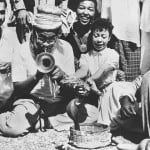
Snake Charmer…
- We could not resist posting this photo but cannot tell who is behind that horn. Dizzy Gillespie? Miles Davis? If anyone recognizes the charmer please email us.

Alaskans Relieved
(Juneau) Alaskans breathed a sigh of relief today when it became apparent that Russian nationalist, Vladimir Zhironovsky, would not attempt to seize the 49th state. Zhironovsky, a leading persona non grata in many capitals of Europe, had threatened to retake the land mass along with Finland and Poland.
“We had set up naval defenses in the Norton Sound with reserves stationed along the Kuskokwim Range,” said Jeff Brown, editor of The Juneau What, published here, in the capital. “People were really scared. It’s pretty dark up here this time of the year and we couldn’t tell if Red Army units had crossed the Bering Straight or if the whole thing was just a lot of political bulldozing.”
Brown told The Horseshoe that most of the firearms dealers had sold out of bullets by last week and that most of the state’s private airplanes remained in the air expecting an attack at any minute.
The almost 600,000 square mile Alaska, now known as the “Last Frontier”, was purchased from the Russian Tsar for a paltry $7,200,000 by the United States in 1867. Secretary William Seward negotiated the purchase as fellow citizens poked fun at the acquisition calling it “Seward’s Folly” and/or “Seward’s Icebox”. It was only through the discovery of gold in the region in the late 19th Century that America realized what it had stumbled upon.
When reminded that Vladimir Putin and not Vladimir Zhironovsky was in control of the Russian military Brown insisted that, nonetheless, his fellow citizens would remain on alert.
“Those Ruskies all look alike to me,” he gestured. “Besides that we get a little bored during January and the threat of total destruction really got us all jacked up. It provided a needed break from the monotony that winter can present.”
When contacted in Moscow Zhironovsky denied ever threatening his neighbor to the east saying that he only meant to placate the ultra right-wing by throwing them a scrap or two. According to a recent account in the German mouthpiece, Welt am Sonntag, Zhironovsky plans to visit Alaska in July to do some salmon fishing if he can obtain the proper credentials. – Mel Toole
FINBAR REMAINS IN BELLY OF WHALE
(Cork) Gaelic mariner and self-proclaimed discoverer of America, Finbar the Sailor, remains lodged in the belly of a large blue whale according to sources here. The infamous salt has been in that capacity since before Christmas.
Although communication has been all but nonexistent since that time, scientists studying the phenomenon feel that Finbar is still alive due to atypical, sporadic acts on the part of the marine mammal.
“We don’t think the whale meant to eat Finbar,” said Dr. Efram Pennywhistle, a British marine biologist assigned to the case. “It was just a case of being at the wrong place at the right time and looking a lot like lunch. The whale would probably have preferred fish and chips to that gasbag Mick,” the Englishman offered.
The Republic of Ireland has pledged to call in an assortment of experts including Jacques Cousteau, to aid in Finbar’s rescue. Already a convoy of French battleships is anchored of the coast in apprehension of Finbar’s release. They plan to dump gallons of green champagne overboard in the hopes that the host animal might consume the stuff and burp, thus expediting an uneventful release of the seaman.
Friends say that the Irish sailor will be disgorged whenever he, or the whale, gets around to it. Critics say his predicament is of his own doing. “He’s always been fascinated by the Biblical account of Jonah and the Whale and now he’s got a ring-side seat for all the action. It’s just one more of his cheap publicity stunts,” said Mona Kelp, of Save the Whales. “I, for one, say leave him in there!” – Gloria de Quirk
POSTAL WORKERS ON SABBATICAL
(Washington) After a flurry of activity over the holidays some 40,000 postal workers will journey to Peru for a much needed rest. While relaxing in the South American country the workers will study the behavior of Peruvian postal workers, a group which never succumbs to stress. In many remote Peruvian mountain areas the mail is often weeks late and some packages never arrive at all, but no one seems to mind. In fact, most of the natives there deliver their own mail. “People in the United States are spoiled,” said one organizer of the trip. “We could learn a lot by observing postal practices in South America.”
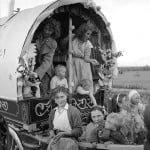
Gitano Summer
by Uncle Pahgre
That the Egyptians and the Chaldean strangers Known by the name of Gipsies, shall henceforth Be banished from the realm as vagabonds. – Longfellow: The Spanish Student
Just about the time the gray hairs outwit their youthful counterparts it becomes clear that our memory fades as well. Episodes of youth are shrouded in the pure green paradise of summer, which lasts forever. When I was a boy it never even seemed to get dark on summer nights along the San Miguel. Then the great snows of Depression Decembers amounted to at least twenty feet dumps, not paltry six inch flirtations common to the mountains today. Flooded pastures and crisp quake leaves filled in the gaps of the daily celebration. That’s what some remember, the pleasantries, the simplicity of the Rockies. Others, who were offered the same joys, recall the strife and that’s the basic difference between the old gentleman who strolls the cigar evening, cane in hand and the curmudgeon who sits whining in his wilting rocker, the victim of it all, damning his final hand of cards before the deal is over. In was one of these summers, 1937 or 1938 that Placerville cautiously received the Gypsies from Spain.
For decades our town had been a major railway hub shipping cattle and ore along with hardrocker necessities and food to feed the hungry miners up in Telluride. The rails brought a landed assortment of humanity from bums to bankers. Local cowboys, dreaming they had finally made the big time in Dodge or Abilene kept the local sheriff busy on Saturday nights. Otherwise his position demanded visiting his constituency and drinking their lemonade on the peaceful porches of the San Juans. I had just turned ten years old the night the Gypsies pulled their brightly painted wagon into town. “Watch out, they’re gypsies,” said Mrs. Caldwell from her sun porch, the one built for her by her son, before he left for the trenches of France in 1917. “What do they want here,” she continued, throwing fear into the little bones of her grandsons, moonstruck behind pioneer curtains at the nomadic entourage spilling from the waggish carriage. “They want to sharpen your knives and repair your pots and pans,” said Dr. Twill, the local dentist and the closest thing to a mayor that we had. “They don’t mean any harm.” “I saw them up in Leadville last month and they were nothing but trouble,” quacked another citizen.
“They steal horses and put evil curses on people. They read palms, relish fortunes and sell sugar pill remedies for everything from broken hearts to the gout.” The dark-skinned cargo ascended from the wagon as one copper smith surrounded himself with unfinished wares and began to tune his violin. The Roma children looked around at the bustling little burg intent on new friendships and maybe a little mischief. The men announced their services, quite accustomed to the hostile stares of the stay-at-home world. “Maybe they have whiskey,” said a thirsty Mr. Brennan, who had come across the Atzigan in France in the early Twenties on his way to America.
“They always have bootleg of some sort…and cigars.” “I don’t trust them. Just look at their patchwork clothing,” continued Mrs. Caldwell. “Those horses look too good to be pulling around a carnival wagon like that one. I wonder where they stole them.” Brennan took offense. “We had gypsies in Ireland, but we called them Travelers,” explained Brennan. “Some say they arrived from India via Persia, others said they were the landless ancestors of those orphaned during the Cromwellan Wars of the 1600s. Displaced at best, they wandered my island under the constant scrutiny and suspicion of near-do-wells who themselves had little more than a thatched roof over their heads. I guess everyone has to have someone to look down on so as to prop up their precarious existence…”
“Say what you will, Brennan, popped Carl Perkins, a Cousin Jack from Marshal Basin, “but I’ll be keeping a close eye on that bunch. They’ll steal anything that ain’t nailed down good.” I remember asking my father if he had a nail of two to spare reflecting on treasures such as my fishing pole, my American Flyer and my Joe Lewis photo up on the wall next to my bed. “I tell you there’ll be trouble until we run them out of town,” said Perkins. The patriarch of the Gypsy family couldn’t help but feel the weight of the bucolic reception. He was a veteran of the kind of discrimination aimed at those who would reject assimilation even on the rare occassion that it is offered. People who stay to themselves and jealously guard their diminished culture don’t mix well. The only reason they had ventured into town was to buy provisions, sharpen knives and perhaps trade a horse or two.
“Fine looking horses they’ve got,” repeated Mrs. Caldwell. These wanderers were recent refugees from the civil war that ravaged their native Spain, outcasts from a conflict that had not officially requested their presence but churned up their lives anyway. The kindred’s grandfather had joined the Anarchist Party in 1935 after bold strikes had gained a little leverage for starving peasants in Andalusia. He worked in the fields, harvesting grapes for the wealthy sherry producers around Sanlucar. One day in 1936, after the Nationalists had liberated Cadiz he was taken from the fields by a Falangist gang and murdered in a nearby ditch with about 20 other leftists, who had no politically ideology except their hunger.
The Fascists had no tolerance for Reds, especially low-caste tinkers who joined the unions and burned churches. It was soon after that his son, Emile, sold what little he had and escaped to America with his new wife and the remnants of both families. After a sojourn into the local market, where they traded in services and paid the rest in gold, the residue of rovers wandered back to their camp, set up along the river near Specie Creek. It was there that the local sheriff, bored of cowboys and lemonade, would visit them that night. Emile, who had crowned himself King of the Gypsies (a title confused in the translation from Romani to English) since there were no other Gypsy pretenders in earshot to denounce his throne, greeted the lawman from atop a stunning white Arabian. “Where did you manage to acquire such a fine horse?” he asked. abruptly as Emile’s family watched from the campfire. “Did she just wander into your camp one night?”
“I traded two raindrop colts for her over near St. Elmo,” answered Emile. “I’ve got a bill of sale here…” “No reason to produce a piece of paper what may or may not be legit,” said the sheriff. “Fine horse. I hope you folks ain’t looking for trouble. We’ve got a nice little town here and I won’t have a bunch of gypsies throwing a wrench into things. You can stay until you’ve completed your rounds here but at the first sign of trouble I’ll lock you up and ask questions later.” Emile, accustomed to harsh treatment from the authorities, smiled and said he understood the sheriff’s concerns, adding that there would be no problems and that his family would be gone by the end of the week. That was the same night that Arnold Blackman’s young quarter horse came up missing.
“One minute he was in the corral and the next he was gone,” explained Blackman at the sheriff’s office. “He’s a lazy beast and has never shown the inclination to wander from the bountiful pasture near my cabin. I can’t explain it. Even if he took off he’d surely be back by now.” The sheriff rode back out to the gypsy camp and, interrupting the evening’s music, demanded to see Emile. “We got a quarter horse missing from the Blackman place. Know anything about it?” he accused, spitting chew from the hole under his long drooping mustache. “No, sir,” answered Emile. “You know that horse stealin’ is still a hanging offense in this part of the country,” he frowned. “Now tell me what you know about the disappearance.” With his family dumb struck Emile denied any knowledge of the occurrence. “You’ll be coming with me until you regain your memory,” said the sheriff. “We don’t cotton to thieves around here. Nobody steals nothin. The last time a horse turned up missing there were your kind about.”
- Gypsy wagons traveling through Placerville in the 1930s. Always under suspicion due to a tainted reputation, the nomadic Roma survived as smiths and tinkers, often telling fortunes and playing music in communities that tolerated their eccentric way

Emile smiled attempting to take the heat off his tribe. As his children looked on he agreed to accompany the lawman to the local jail, a cedar log shack at the far eastern end of town. And, while his family tried to make sense of it all, that’s where he spent the night. “Your damn right he’s got Blackman’s quarter horse. They’ve hidden it in the woods,” said Mrs. Caldwell. “Lord knows what else they’ve walked off with,” said Perkins. “Sticky-fingered bastards. I say let’s burn them out tonight. Then maybe the big cheese will start to melt.” Mr. Brennan then spoke up. “We’ve got no proof of any wrongdoings on the part of those people. You can’t just…” “No proof!” cracked Perkins sarcastically. “Did you take the horse, Sam or did he just vanish? The Irish don’t steal, or do they?” he pushed.
Brennan just glared back in the face of Perkins, considering his options with the much larger miner. “Sam Brennan is not under suspicion here, Perkins,” said Mr Twill. “The animal could be anywhere.” “He’s somewhere under that gypsy tent,” continued Perkins. “I say we load up, go on out there and see for ourselves.” “Not so fast,” said the sheriff. “If he’s guilty he’ll pay dearly. I assure you. But until we have proof there’ll be no more of that talk.” The whole town was soon abuzz with rumors about gypsies, magic potions and enchanted horses. Some said the nomads had secret powers over the living. Others shuddered that they were in league with the dead, or worse. The sheriff returned from a cross-examination at the jail with nothing to report. “Tomorrow we’ll search for proof and question the rest of his band,” said the sheriff. “They won’t leave the county with their leader in jail. I told that bohemian that he could save a lynching if he came to and told the truth but he denied any connection with the disappearance.”
“Meanwhile I’m out a good horse,” shrugged Blackman. “I don’t trust those people…” “There’s one way to be sure that he won’t steal again,” said Perkins. “I won’t stand for gypsies coming into my country stealing and laying out curses…I say let’s string him up now!” The strawberry vigilantes had regrouped at the Blackman place. The threat of spilled blood was already on their hands. A rope hung on the wall. A man was in the cell. A large cottonwood lingered with wide gaps on its dance card for the evening. “What are we thinking?” sensed Mr. Twill.
“What insanity! If you kill you’ll never be the same people, even if he’s guilty of stealing 100 horses! We must maintain a sense of justice or we’re no better than common murderers.” “Stealing is stealing and hanging is hanging,” chimed in Mrs. Caldwell. “What other choices do we have? I say burn them out and run them down the road. Then we, as a town, can replace Blackman’s stolen mount. We don’t want those people skulking around at the edge of town anyway.” “Running them off is too good for them,” said Perkins. “They need to be taught a lesson. A man dancing from a limb don’t steal. Let’s proceed with a little frontier justice…the terrible swift sword and all…” “I’ll shoot the first man that forces his way into my jail,” threatened the sheriff, adjusting his holster.
“Now you all settle down or the Gypsy will have a lot of company. We’ll pay a visit to their camp first thing in the morning and sort this thing out. I promise that, if the Gypsy had anything to do with this you’ll get your justice. I didn’t like the way he sat on that Arab. If he’s to blame it will give me great pleasure to dispense the law.” Emotions continued to run amuck. Nothing this important had happened in Placerville since the ore train was robbed by those boys from Utah in 1898. The imagined fortune, in reality amounting only to about $100, had left three men dead and one train guard blind. Before that there were Utes to contend with, water wars and bandits from the Disappointment Valley showing up for afternoon tea. Imagine this brash gypsy appearing right here in the daylight and by nightfall a valuable horse is gone. It all adds up. Who wanted to sleep while a felon cooled his heels in the midst of a once peaceful patch of paradise? A slap in the face. No one went home. The hour grew late as a jug was passed around. Talk turned tough, then subsided, then got tough again.
As the dawn approached everything remained on edge. A small contingent of Emile’s family bravely arrived and begged for mercy saying he had not committed any crime. They we’re received by the stares of the righteous intent on an eye for an eye. “You’d better have that horse hid real good,” threatened Perkins. “We’ll be coming your way before breakfast to see what else you’ve been up to. When we’re finished your Gypsy King will be sucking dust.” Emile’s wife asked to see her husband but was denied by a tired sheriff now facing the mob mentality of his neighbors. Twill cautioned against hard talk in front of the children. Perkins countered by calling them little thieves whose daddy wouldn’t be coming home. Blackman appeared with a shotgun which he pointed menacingly at the Gypsies. He ordered them off his land. No one moved.
Everyone was so worked up that they didn’t see the logger from Sawpit leading the prodigal quarter horse into Blackman’s corral. The man’s name was Christy. He was covered in sawdust as he approached the group. “Got another swig of that hooch?” he asked. “It’s been quite a trek from my camp to here. Seems your boy has fallen in love. I found him down by my gate, making eyes at my Appaloosa filly. Didn’t know where he belonged until I did some snooping around. The brand is hard to decipher. Fine looking horse though.” In the early morning light a jury of eyes met and quickly dropped to the ground. No one said anything. Perkins looked at Brennan for acquittal. Mrs. Caldwell busied herself with her apron, yawning about chores and chickens to feed. The sheriff galloped over to the jail to free its inmate. People prepared for the day. Members of Emile’s family shed tears of relief. A terrible miscarriage of justice was narrowly averted in Placerville. A few days later the sheriff rode out to the gypsy camp which had been deserted the morning before. There was nothing there. The visitors had moved on to sharpen knives, tell fortunes, and maybe trade a few horses.


