 All Entries Tagged With: "Ridgway"

People Age, Exhibit Common Traits
(Science of Science – Montrose, Colorado – January 10, 2015)
Most people are growing older according to a study recently conducted by a national internment service. The results, though hardly surprising, represent the first cross-section data collected on the subject.
That everyone gets the same going away party in the end is an often unmentioned quagmire that doles out equality without prejudice toward race, color, creed or sexual origin/preference.
“We found that in every case the participants were getting older on an annual basis,” shared one pollster. “Some continue to lie about their age as if that might somehow defer their cosmic curtain call.”
Indications are that young people spend a great deal of time trying to look older while older people almost spend the same amount of time trying to look younger. Researchers likened the behavior to that of Asian women covering their faces in the sun while snow white Europeans don coconut oil on chase lounges trying to bring a little color back to Paris.
One man, who said he had forgotten his name, told The Horseshoe, “I’m 87 years old and I don’t worry about this kind of thing. Death is the one thing we don’t have to keep track of. It will come find you when the time
Arrives.” – Ripple Van Winkle
“Frankly I’m a little bit pissed off at the masses.” – Karl Marx
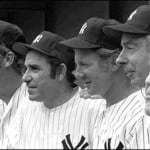
Take Your Base, I’ll Take Mine
A Critical Analysis of the National Sport
by Quentin Parquay, Royal Legion of Sport
(Editor’s note: Mr. Parquay, a literary critic with The London World and former fellow at Oxford University, has been dedicated enough to sit through rain delays, extra-inning games and traffic jams so as to compose this international peek at baseball in 2015. Although well versed, drifting from Kahlil Gibran to Oscar Wilde, Parquay admits he possesses a limited knowledge of the game having experienced his first contest only last week. The following expose is reprinted from The Hamilton Hemorrhoid, a well- respected, often painful British sports bulletin. It has appeared Steamboat Magazine. Unlike golf, baseball was never immortalized by George Bernard Shaw as (to paraphrase) “a pleasant walk ruined.)”
Baseball: 1.) a game played with a bat and a ball by two opposing teams of nine players, each team playing alternately in the field and at bat. The players at bat, after hitting the ball in fair territory must then run a course of up to four bases laid out in a diamond pattern in an attempt to score runs. 2.) a questionable competition of North American origin that promotes bad language, hooky, jawing, bad manners, superstitiousness and the spitting/chewing of tobacco. 3.) the ball used in the game of baseball.
My interest in the field of baseball began when I first ran across “Casey at the Bat” in 1990. Although the epic poem had been around for decades it had not circulated through the offices of a man who dissects playwrights and Gothic novelists. I hope the following will be entertaining to the reader and beneficial to the fringe fans and the arts as well.
THE FAN
We Brits cannot afford to be critical of abhorrent fan behavior after the escapades of our cohorts at most football (soccer) matches from Cornwall to Kent. The counterpart American aficionado is actually quite calm and well behaved compared to the football fanatic. He only becomes dangerous toward the late innings after drinking cup after cup of overpriced light beer.
The aesthetic distance between the audience and the main characters is of special interest to anyone wooed by the theater. The left field character, for instance, is closer to the audience and can be more objective about how his lines are perceived in the grandstands. The thrower (pitcher) cannot gather this same kind of feedback. The audience however is well in earshot of various asides mouthed by fielders and the funny-dressed men behind fourth base that you call home plate.
The fan is most often in sympathy with one team or the other. He is most vocal at points of tension between singular characters or sometimes with entire groups of players. He is prone to embracing myths and often makes references to the supernatural as he metaphysically munches on hot dogs with onions and mustard and burnt peanuts, salted in the shell. His metaphors can be figurative, trite and/or utterly classic. His hyperbole is common only to the colonies. In later innings the fan gets swept up in the flow of dramatic monologue that results in comic relief or didactic tragedy.
THE CHARACTERS
- CHARACTERS IN COSTUME ON STAGE

Reflecting on the scene behind home plate we see one over-dressed character (the catcher) that carries with him a host of mandatory duties. He must not only catch the ball each time it is flung at him, but he must field difficult “pop flies”, cover his base, backup first base and throw down to second in the event of an attempted steal attempt. (We will discuss thefts and squeezes later in this article). While there is little morality involved in the steal, the catcher is often measured by his pinpoint response to the instant plot. In the local vernacular we hear fans loudly encouraging this catcher to “gun him down” or “nail him with a low throw”. This should not be taken as anything violent. The successful application of these throws and tags can often bring down the curtain for an inning.
The catcher’s associate behind the plate is called the umpire, a living allegory who attempts to impose his own doctrine. This dark character converts acceptable language into persuasive, tight, one-syllable chants with the sacred narrative “Steeerike, Bawww or Yurooout!”. Otherwise most of the communication is in sign language that is reminiscent of Shakespeare that holds the audience in awe.
Amusing reaction to the umpire often dwells on King Lear’s cry: “Thou hast eyes to see…and see not!”
The rest of the extras dress alike so much that it lends an eerie, almost robotic essence to the performance. Each of the two reams is represented by wearing its own costume. It is within the professional ranks that we find strong connection to ancient bestiaries and ethnic euphemisms with names like “Tigers, Cubs, Braves and Giants”. On the local level this practice has been methodically embraced. Long socks may represent the desire to return to simpler days while “softball” fashions clearly illustrate a yearning for a
modernistic, almost impressionist, rendezvous with the keystone future. Significant action generally soils the players’ costumes but adds a delightful descent from the loftiness of pre-game ceremonies.
THE PLOT
Everything happening on the diamond is synchronized into nine innings where one team tries to outscore the other by whatever means available during the scenes that add up to an act. The two teams could play an eternity if the thing reaches extra innings. Imagine a summer day and a pastoral scene in right field where a player is responsible for catching the ball before it hits the ground, then hurling it back into the infield (main stage). He must do this before any players “tag up” and make their way around all four bases and off the set and backstage into the dugout. If the ball is caught cleanly the acting batter is out and has no further lines until he comes up to the plate again in two or three innings. If the fielder misses the ball the hitter gains access to any number of bases while other supporting cast scores runs. The clumsy fielder is often then seen as a goat. Continued performances of this quality will often result in an understudy placed in his position.
The main actor and navigator of the plot is the pitcher since he initiates the action. He delivers his lines while perched on a pompous little hill 60 feet (18.3 meters) from the batter’s box. He throws a variety of pitches to the catcher aimed at confusing, overpowering and terrifying the man with the stick (bat) in his hand. The umpire then watches closely as curves, sliders and fastballs cause negative capability of the part of the person trying to make contact (with a rounded bat) with the little spinning ball. Some of these pitches exceed 100 miles (or 161 kilometers) per hour. The fastball coupled with an array of sneaky pitches often causes the batter to pop up, ground out or strike out (signified by K for some unknown reason). These activities in no way represent literary onomatopoeia since there is no sound emanating from the ball as it travels to the plate. The onomatopoeia magically occurs when the ball slams into the squatting, supporting actor’s round, oversized glove. Here we see the frontline struggle by the designated protagonist to stifle the antagonist by making contact with a fiery sphere chucked in the direction of his head and vital body parts. It is here that we see another character, the manager, wheel out onto the field angered by the exposition of the background.
THE SET
The set can be universal as well as specific to baseball. The only props are the three bases and the plate, the walls, the mound, the backstop, the dugouts (2) and the scoreboard. The size of the stage varies greatly from set to set but is always characterized by white lines that protrude from home plate to the first or third bases. These are the symbols of the action. It is the actor who brings it all into perspective.
During my last sports melodrama the hero was a young pitcher for the Colorado Rockies. His saga was one of ever-increasing pathos. He quickly extended his poetic license by hurling a “loaded up” ball at the batter’s head. Soon after he balked, a clear sign that he neglected to prepare his lines before taking the stage. By the end of the inning he had reached absurd capacities in low comedy by allowing three other actors to reach untenable positions without exiting the stage. The tone of the play then becomes one of anticipation, bordering on anxiety. The guilt-ridden child actor is sent away by his rigid master to a place called the Minors that was never described by Dante or even the unholy angels. Each summer pantomime contains endless and simultaneous dramas with characters intact. It is this mysterious show and tell that stimulates the lifelong fans of the game. How appropriate in both a literary and mirthful sense. Play Ball!
“The check’s in the mayo.” – famous promise in Dixie.
MAKES SENSE…
- LIGHTHOUSE RESTAURANT IN MONTROSE SAYS IT ALL

MEDIDOR DE LECTOR MORDIDO
(Especial de la Montrose Looking Glass – 10 de enero 2015)
Un lector de metro no identificado sufrió una serie de picaduras de ayer al intentar leer un medidor de agua. La víctima, un empleado del Distrito de Agua Tri County, soportó bits en los brazos y las piernas en un ataque vicioso y no provocado.
La policía ha detenido hierba Hemplestick, de 2933668294592744 Road, que lo acusa de asalto agravado. El agresor se encuentra actualmente en pruebas para determinar un motivo para su comportamiento agresivo. Las autoridades no descartan la rabia, el estrés financiero o la enfermedad de las vacas locas en el incidente.
El lector metros heridos, a tiempo parcial humana de Olathe, está descansando y recuperándose en el Hospital de St Roscoe en Guisante, donde coquetea con las enfermeras y mira por la ventana todo el día.
Los abogados de Hemplestick dicen que su cliente está loco y debe hacer tiempo mientras el fiscal está pidiendo indulgencia desde el ataque puede caer bajo la jurisdicción de la controvertida Ley Make My Day. El juez, que estuvo ausente en la audiencia previa al juicio condenó a todos a tres días por insubordinación y otra semana en el desprecio por tirar bolitas de papel y goma de mascar en la corte.
Fuentes de Tri County dicen que han cortado el agua de Hemplestick en su residencia y su cuenta comercial, amenazando a su creciente operación de maíz dulce en California Mesa.
Hemplestick, que una vez jugó en la Selección Nacional de Fútbol Uruguay, sáb visiblemente alterado en el área de penalti, consultar con los abogados sólo cuando se le solicite. Este último episodio representa segunda ofensa oral del Hemplestick en los últimos 12 meses. Los lectores recordarán que fue acusado de morder a su cartero desde hace mucho tiempo en la parte superior del cráneo, sin razón aparente en abril. – Dinty Moore
“Sala Cleaver inventó poliéster para que pudiera dormir en su traje.”
-Lumpy Rutherford
Opinion Prompter Could Change Political Landscape
from Departed Culture Review – June, 2015
Social scientists and computer techies agree that the days of intelligent political discussion may be over. With the newly released opinion prompter one’s strong beliefs on all subjects is are as close as a click! Now nobody will ever forget his opinion on anything.
There are times when technology needs no introduction. The impact is felt before it hits the marketplace. Pepsi Brothers Opinion Prompter is one of these products. Despite an incredible capacity for data and memory it works like a simple prompter. Just load the machine, categorize subjects according to vehemence or lightheartedness and you’re ready to go.
“How many times have you been engaged in a heavy political discussion with another moron when, just like that, you forget your opinion on a matter. Wow, you could even forget if you had had an opinion at all’” said Jerald Yarmouthe, owner of the Tip-of-the-Tongue Opinion Prompter patent for the Western United States.
“Well worry no more. Now instead of thinking, you just click and your highly detailed opinion on an issue pops up. Every chronicled episode, each unprocessed bite of information, every illogical summary will be right there in your hand,” he stressed.
Yarmouthe said the opinion prompter is guaranteed to run circles around the competitor no matter if he/she knows what he’s talking about or not. He claims to have sold 45 of the little machines in the Republican House already.
“Forgetting your opinion on matters is normal, especially as we get older,” smiled Yarmouthe. “Everyone knows an opinion is as important as arms and legs, as heart and soul,” he crisped. “It’s like not having an agenda or forgetting to go to the bathroom.”
And the Tip of the Tongue Opinion Prompter is heartily endorsed by Fox News, an opinion maker in its own right.
“People have enough to do each day without fogging up the bifocals by thinking,” said Yarmouthe. “Just plug in to your smart phone and go.”
– Uncle Pahgre
“It’s a damn good thing the rich have the newly shorn and castrated middle class to keep the poor people in their place.” – Tommy Middlefinger

Lake San Cristobal in Hinsdale County

Lake San Cristobal in Hinsdale County


