 All Entries in the "Lifestyles at Risk" Category

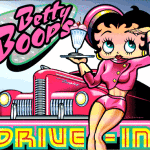
NRA TAPS BOOP
Rifle, CO Cartoons For Peace Nov 2, 2015
The National Rifle Association has recruited 1930s cartoon bombshell Betty Boop as its spokesman for 2016. Boop is best remembered for her curious “OOP Boop EE Doop” and her rosy-cheeked way with male cartoon characters on the set and in private life.
The NRA, like most massive corporations, no longer represents individual gun owners but rather its own self-interest. Yet it affirms that Boop was drafted due to her positive attitude and because she might appeal to older Americans. Most people in this country under 40 have never heard of Betty.
 “We’re talking to several other unnamed prospects to reach out to the younger set,” said Wrenille Banger. “We want to be in the trenches will full pack and ammo come election season.”
Insiders suggest that leading candidates are Elmer Fudd, Yosemite Sam and several well-armed Barbies. Noe of these are dangerous says the NRA and will be instructed only to shoot over the heads of adversaries.
As Americans become more distracted and less aware of the real issues, corporations continue to aim at the lowest common denominator in an attempt to take over the reigns of government. In the case of the Boop icon it is a clear case of distraction.
“Watch my hand, not my mouth,” laughs Dr. Elsappe Flashing of Cal Amari Institute, where Betty was first unveiled. She’s a good one and will do fine surrounded by coyotes. There is nothing to worry about.”
Although the final details are still on the table Boop and her entourage will relocate to Los Angeles before the end of the year. She will be one of six featured speakers at the John Wayne-Ronald Reagan War Film Festival in January.
Readers may recall that neither Wayne nor Reagan served in combat rolls, yet impersonate real warriors in some destructive, clean-sheet masquerade that is fed to the public as real war. Boop, as it turns out is their peer, having seen the Great Depression and World War II from the safety of stage and screen.
The NRA is playing down the development until after hunting season. Sources at Boop Camp did not return our hone calls Thursday.
– Kashmir Horseshoe
NERD ELK — THE SHAME OF THE ROCKIES
(From Racks To Riches Report — October 22, 2015)
(Ridgway) At first it was only the few. Pocket protectors, tape on their spectacles, higher math taking up a majority of their social life. Who are they, these geek mammals that roam the forest in search of food left behind by healthier animals?
They are the milksops of the deer family, the eggheads of the rut…The nerd elk. Browbeaten by the other animals in the herd these mutant beasts go about their business, calculator at hand trying, like any other sexually motivated critter, to get a date for Saturday night. Often they fall short and spend another weekend under a tree or with the other nerd colleagues.
Biologists here feel the nerd elk are a product of too much contact with humans.
“It starts with the tagging, then the salt licks and the winter feeding programs,” said Small Mouth Bess, who has been observing fringe elements of the Rockies, even sociopathic animals for 30 years. “With the coming of the hippies in the late Sixties most herd animals began to feel comfortable in the company of humans. They all had the same basic scent, dressed pretty much in the same style, listened to the same music.”
The nerd element within the herd began to rear its head by 1970 with a segment discarding the ancient macho image for one of intellectual pursuit.
“It’s not to say that the elk population couldn’t use a few Einsteins,” said Bess. “It’s more a matter of survival and the traits and instincts that a mammal brought to this world. A bull elk in the scope of a high powered rifle will not survive on the basis of determining the square root of the problem. Nor will he make it home for dinner by coming up with the correct hypotenuse for the triangle of fire.”
Cow elk can be nerds too. In fact for the past ten years the population of nerd cow elk is way up again related to social movements in the human population. Many cow are sick of the traditional rolls within the herd and seek careers or even public office.
“The other day I saw a red neck looking cow riding on top of a road grader,” laughed Bess. Some call it antler envy but I contend that having a female on the job helps moral immensely.”
Sadly, as one might expect the nerd elk are the first to go in what we humans call the harvest. When confronted with armed humans in orange these double dome elk cannot fall back on the wily traits of the forest animals. They are far too busy attempting to figure out a chemistry formula or the distance from one point to another in light years.
Bam! Bam! Bam! Dead and in the freezer, notebooks, clipboard, maybe even hush puppy loafers and nerd sox languishing in the mud and snow. Another victim of the balance. Survival of the fittest takes on new meaning within these pathetic ranks.
VENISON CAR WASH SLATED
(Norwood Follower and Finder – October 15, 2015)
The local chapter of The Protected Order of Venison will sponsor a car wash on Saturdays during November. The auto cleansing will be offered from 8 a.m. to 5 p.m. along Grand Avenue. The cost is $10 which will go to the United Venison Collage Fund. Hunters are invited but reminded that a cease fire exists within the town limits.
Other interested parties are encouraged to take advantage of the less than savvy automotive janitors by showing up with multiple vehicles and/or the week’s laundry. Advance tickets are available at what was once San Miguel Pharmacy and what was once Rooney’s Chevrolet. Turn out and show your support for this worthwhile organization.
MEAT THE DEER NIGHT OCTOBER 19
(Montrose Pronged Hub — October 15, 2015)
The 2015 Meat the Deer Night will be held at Kearns Auto Body according to a source there. Each year a local business sponsors the social event in an attempt to promote fellowship and good standing between local herds and hunters from all over the world.
Refreshments, including chili and oats will be served. Free information, including maps and a guide to local shops and services, will be handed out and a slide show will be presented. Last year’s event, held at Back at the Ranch Furniture in Gunnison, was deemed a success by almost everyone involved. Just show your license at the door and have a good time! Stags welcome.
HOW I TAUGHT OURAY TO HUNT ELK
by Uncle Pahgre, (October 1883. Reprinted October 21, 2015)
The following is a excerpt from Whiskey, Women, Wapiti and Weapon’s Charges, a history of little-known faith-based militia movements in America.
When I first entered the camp of the Tabeguache band I was amazed by the number of horses in the makeshift corrals. Three scowling braves guarded the outer perimeter of the village, comprised of over 200 lodges. The Uncompahgre, “rocks that make red water”, flowed peacefully in the October sun.
What was that awful aroma rising from this rough coterie? I soon found out it was that of mutton, a gift from the Los Pinos Agent. He wanted the Utes to become farmers and give up their hunter-gatherer lifestyle, to herd sheep when they’d rather spend their time at honorable endeavors like stealing horses from the Comanche and raiding Cheyenne strongholds to the east. Like Old Joe Meeker, Ivy League agent too would find the tribes a tough bunch to convert.
In addition to about 150 Tabeguache warriors there were another 40 men belonging to the Yampa and Uintah bands and Southern Ute warriors from the Weeminuche, Capote and Mouache bands. They had come together to discuss the recent intrusions of the whites and plan the winter’s survival. It was 1860. In addition to the men there were many women of each band mixed with Jicarilla Apache wives, children and uncounted dogs running about madly. There was no livestock to be seen since the Utes killed all wild game and ate it on the spot. A few Navajo slaves were evident in the background of the camp activity.
A medicine man approached us chanting, then glared at me and my friends, who stood shaking in their boots. He was harmless, said I, and more curious than anything else. I embellished a tale of the ghosts of the Anasazi, or Chindees as the Navajo call them, to distract my fellows from their fingered weapons.
After a week in the woods I was looking for a long soak in hot water. The Utes generally set up their larger encampments near natural hot springs and before long I spied stream coming off the river. Before I met Chief Colorow some years back I thought hot water was what one sat in before dressing up and going to the whore house on Saturday night…not that I ever did, mind you. It was Colorow who years before had convinced me that the all but scalding water was healing.
Now I’ve always been one to respect another man’s culture, unless it’s the growing kind, so I jumped right into the Ute chief’s pool. Damn. It was hot. He might have turned to me and said, “Yeah, it’s about 107 degrees,” but the tub thermometer hadn’t been invented yet, least ways as far as some plump chief knew. That water was beautiful. All my aches and pains seemed to float down the Uncompahgre.
Colorow was a bit of a hot head all right, but wouldn’t you be a bit pissed off if a bunch of strangers with picks and mules moved into your backyard? The next morning Colorow and his band escorted me to my first horse racing rendezvous up in Baker’s Park.
It was then that I encountered a young Ute brave who spoke good Spanish. His name was Ouray and he sat at the head of the table with his wife Princess Chipeta. She was quite attractive while he was a short, dark man who loved to race horses. When it came to betting he didn’t miss a beat either. I watched as time and time again his chosen horse won.
“That’s because I’m the chief,” he smiled, when I asked him about his curious good luck.
“Ute law says chief must win. We’ll give it up after the next race and head back to my hogan. I have to let the younger braves have a chance.”
It was there where we got on the subject of elk hunting. Chipeta, who had joined us in the hogan shrugged and said goodnight. As she disappeared through an aspen grove Ouray frowned and confessed that his good fortune with horses did not extend to hunting elk.
“Even my own wife has better luck bringing home an elk. Every year we go out, she nails an animal then tells the village that I downed the bull elk so as to keep face. Nobody dares to give advice on hunting because I’m the chief and it would be disrespectful. When I was a boy my father was always out of town and nobody else felt comfortable teaching the son of a chief to hunt. The truth is that I am a lousy hunter and in turn an unworthy chief.”
I was shocked. Here I sat with the King of the Utes and he’s sharing a sob story. It was too much to believe. He said he had never downed an elk in his life and that his success with bear and deer came only due to the large population inhabiting the San Juans.
“One can’t go for a stroll after dinner without seeing at least a herd of deer and several rambling bears,” he explained. “If you can’t bring down a bear you’re really out to lunch. Chief Ignacio hunts them with a sling-shot. I think he’s suspicious as to my elk hunting prowess. He’s always wanted my job.”
Afterwards we spoke of his people and the goings on to the east where white men sought yellow gold at the expense of the Arapahoe. This wise warrior could see the writing on the wall. His appraisal of the desperate situation was quite astute and it was clear why he had been chosen chief. We later talked of changes, of the white man’s sense of progress but he always returned to his frustration with landing an elk.
It was getting late but he went on until I had no other option but to offer my services in the woods. Having come from a long line of trappers and frontiersmen I had a few tricks up my buckskins. We would meet at an agreed spot and with a little luck he would bring down an elk. He headed off to his hogan and I fell into a deep sleep.
The next morning was cold and I dressed for it. When I arrived at our meeting spot he was already there. He looked like a hunter at least with buckskins and loincloth and bright war bonnet. With him he had a set of golf clubs. He had been hitting pine cones with a driver and each one sliced off into the woods.
“Maybe the bonnet is scaring away the game,” I joked.
“It scares the fish,” he said bluntly.
Not wanting to dwell on eccentricities I avoided any comment on the golf clubs.
We headed east toward what is now called Difficulty Creek and camped for the night. The next day we were joined by several others and encountered a large herd of elk on the banks of what the whites call Wild Horse Creek. We watched.
“Do you have a hunting license?” asked Ouray.
“A what?” I responded.
“A hunting license. Otto Mears told me I had to have a hunting license to shoot an elk.”
At that point he produced a crumbled piece of paper signed by railroad scalawag and toll road pirate Otto “Million Dollar Highway” Mears. Upon examination of the document I realized that Chief Ouray’s name was nowhere to be found. In fact, the “license” was no more than an old pass to the Silverton Northern Railroad.
“How much did you have to pay for this?” I asked the chief.
“Not much. Little man (Mears) threw in golf clubs and necklace for Chipeta. It’s pure silver.”
Not wanting to ruin it for Ouray I shut up about the license and the necklace…and besides, the golf clubs looked almost brand new.
“What do you plan to do with the clubs?” I then asked as Ouray took a few practice swings.
“Get elk,” he said.
“With that slice?” I thought. My work was just beginning.
“What’s it like having a whole town named after you?” I asked the chief.
“Indianapolis?” he queried. “I don’t know. I’ve never been east of Garden City.”
Discretion being the better part of geography I let that statement go as well, in fact I wouldn’t have touched it with a four-legged, four-foot, five-iron.
After scouting the herd from above, the other Ute hunters who had joined the party began to tighten the circle around the animals, picking out stragglers and young cows as the prey. All at once the hunt was on. In no more than minutes six elk were down, the others allowed to scatter. The Tabeguache band quickly dressed out their kill, hung the meat in the shade, and feasted on ancient delicacies. One small calf was totally consumed by the ravenous hunters, some who preferred the bow to the rifle.
That next morning they packed out all the elk meat on seven different horses and returned to the encampment, now excited by the news of the kill. All five elk would be eaten within the next two days and some of it jerked. The dogs ate what was left of the bones, the entrails having been left on the spot of the kill for the wolves and coyotes. The hides were taken for clothing and shelter.
How superior this culture is to the white civilization that spawned such men as Charles Baker, John Gunnison and yes, Otto Mears. Everyone knows his place in it. No one needs more than what it takes to survive. Essentials, though, include horses and hot springs.
It was the next day that I presented my favorite muzzle loader to the Ouray, who accepted it as the treasure that it had become. He told me I was an accomplished hunter and that he had learned much from our association. But one fact remained: He was yet to down his elk. The morning shadows lifted as we made our way across Wild Horse and into dark timber. As we stepped back into the sun a small herd of elk appeared just above us. They had not spooked. I told Ouray to stay close and keep his eyes open.
As we crept up to a prime vantage point I fingered my arrow. Standing erect I carefully placed it across my bow, pulled back and let it go. Suddenly the herd spooked and there were elk everywhere. My bull dropped like a sack of concrete. Ouray jumped up and rushed the herd with what I believe to have been a six-iron.
No luck again for the chief.
We dressed out my kill and headed back in the direction of the big camp. With any luck we’d run into more elk and I began to lecture my friend.
“Now see here chief,” I began. “It’s time to can the clubs and stick to bow and arrow. You have to get up close and be steady when you fire.”
Ouray listened well. When I showed him how to disguise himself in a coyote pelt he wanted to try it on the spot. When I suggested a balanced stance he picked up on it right away. After an hour I even had him tracking and listening to the ground for footsteps. He was a natural. Why he had never picked up these skills remains a mystery.
In a mater of miles we came onto a small herd and followed the wapiti down a tree-lined gulch until they stopped. Ouray could barely contain his excitement when I began to circle around to the north and attempt to drive the herd in his direction. As I made off I saw that he had donned his coyote attire and was testing his bow. I was sure he’d get his elk this time.
Arriving out of breath I moved into position and began my descent. One of these animals was about to find instant fame at the end of an arrow. His antlers would hang in the lodge of a great Ute chief. All the braves would be reassured that Ouray was the strongest and most able to lead them. I moved toward the herd. Evacuating the premises three large bulls moved straight toward Ouray’s ambush.
Then I heard a thundering cry followed by a triumphant cheer as only two of the three bulls continued on through the narrow gulch. Had he finally been successful?
As I came upon him in the draw he sat gutting out a bull elk. It was tough to see where the arrow had pierced the animal…or if, indeed an arrow had been fired at all. The chief sat smiling, a badly mangled nine-iron at his side. We returned with our animals to the camp that evening and there was much celebration. Ouray was as proud as a cock pheasant.
The next time I saw Ouray was in 1866, following the American Civil War. With that conflict completed, Manifest Destiny was again nipping at the heels of the Utes. Ouray was now recognized as spokesman for all of his tribe. He had agreed to another new treaty which prohibited white prospectors from the San Juans and guaranteed the Utes sole autonomy in the region. He still had the rifle and the antlers from his first kill.
I think at the time Ouray knew the treaty would be broken, and so it was in April of 1874 with a new treaty which opened up the mountains to prospecting and confined the Utes to a shrinking reservation.
But back on that night in 1866 whites were still trespassers, elk were plentiful and coexistence seemed possible. The entire western half of the continent was still one big beautiful fairway. Then Chief Ouray told his dinner guests that I had taught him how to hunt elk in the silver mountains. – Kevin Haley
“You ate all the dimmycrats in Hinsdale County!”

We thought Alfred ate them all (September 30, 2015)

