 All Entries in the "Lifestyles at Risk" Category

Most Americans vacation to impress neighbors, relatives
(Tellywood) According to recent studies conducted by the ski industry, some 90 percent of all vacationers take trips to impress the folks back home. Of that group, 80 percent say they often seek the approval of these significant others when deciding on where to go.
As silly as it may seem, most of these people still manage to have a good time while on a trip. Skiers, as a whole, are far more conscious of what others think. Whereas vacationers such as fishermen and hunters could give a damn.
“These groups have tremendous influence on our potential customers,” said an industry spokesman participating in a series of holiday seminars here. “We have to be responsive to the changes occurring every day.”
According to the spokesman, many of these neighbors and relatives are the type who stay at home most of the time. In fact, 35 percent hadn’t taken a vacation in 10 years.
“They are basically too lazy to get on a plane and go skiing. They just sit around all the time and stick their noses in other people’s business. But despite this situation we have no choice but to target them in our marketing scheme.”
In response to these findings, some Colorado resorts have already begun a direct mail blitzkrieg aimed at this slovenly segment of society.
“We know they’ll never come here but we can’t let them get away,” he said.
ˇ -Uncle Pahgre
Paper Severs Mob Connection
(Gunnison) The San Juan Horseshoe has terminated its business relationship with the local syndicate due to what it calls philosophical differences and irreconcilable differences. A spokesman for the paper said simply that the two entities were growing apart and had different priorities as to the proper way to conduct business on the Western Slope.
“Those mob guys were too damn nice when it came to overdue bills and dealing with other publications,” said Melvin Toole, who broke the news this morning. “We feel that it is necessary to send a strong message to our customers and our adversaries. We mean business and there are no second chances when it comes to fiscal tardiness.”
Sources on the Front Range, which was only recently purchased by Japan, said that many mob bosses were heartbroken at the decision. Some may never recover from the shock of sudden separation. Already many have lost interest in their normal pursuits and have taken to going to church.
Apparently the decision came with the realization that the paper was grossing a fortune without the input of the mob.
“In the early days we needed the support of these enforcers but with the coming of peace and prosperity we have outgrown that kind of approach,” said Toole, “but I will miss these colorful characters hanging around the composing room.”
Toole added that there is nothing quite like arriving at work in the morning to a gangsters in white ties and black shirts hanging out in the lobby, flipping coins and frisking visitors.
“I especially likes it when they’d pick their teeth while talking,” he said. “Now there’s a sight to behold.”
Toole said that several of the paper’s former associates will be kept on to train new collection agents arriving from the former Soviet Union next week.
“We just want a smooth transition and will help retrain the workers affected by these changes. Advertisers who remain cooperative will not even notice a difference,” he gestured.
Some small towns in Colombia
Having traveled all over the continent of South America for the past ten years I had yet to set foot in Colombia. All the bad press, the drug cartels, the war may have made it easier to spend an extra month in Ecuador or more time on the beach in Bahia..
“Anytime someone in your country snorts cocaine he is making it that much more difficult for a Colombian peasant to keep his land,” said my friend Andres, a museum curator in Antioquia. “If the land supports a coca crop it is now valuable. At first the farmer sees what the coca will bring compared to corn or beans. The money is better and the work less demanding. If he now grows coca to survive he is subject to soldiers, police, guerrillas, and militants of all types who will sooner of latter, one way or the other displace him. He ends up in the ring of poverty that surrounds Bogota, Medellin or Cali. Cocaine, like coffee, is grown for export. Drink the coffee.”

Guatape in the early morning
In six weeks traveling around Colombia I never saw cocaine (and I stay out late for an old guy) which tends to make me wonder if the consumption problem is on the streets of the Bronx and not Bogota. Simple: If there was no demand in the U.S. there would be little cocaine processed in Colombia and life might return back to normal for millions of campesinos attempting to eek out an existence on their farms. Those who suffer the cold-blooded brutality of it all are the poor, who are once again the rooted pawns of mobile violence.
The United States pays Colombia to eradicate coca instead of facing up to fixing the dysfunctional/drug craving society we have created up Nawth. Nice work with your War on Drugs, Uncle Sam.
I guess I was just saving Colombia for last.
After a few days roaming around the streets of La Candalaria in Bogota (pop. 8,000,000) I flew to Cartagena (pretty big too) on the Caribbean Coast, hot as a branding iron to this mountain dweller. Despite its worldly reputation as a historically significant locale, Cartagena is a crowded, ignorant, contrived city with some old Spanish walls around part of it. The cops are crooked, the traffic mindless, and the beaches dirty. Sometimes it was difficult to separate the business owners from the prostitutes that roamed the streets just after dusk.
And then there are the wham-bam cruise lines denizened by sun-burned gobblers bulging in the pocketbooks about to depart for this must see Disneyland of hawkers and assorted criminals. It’s surprising that they don’t all get robbed! Piggies to market. I would prefer spending the weekend in Fresno or Gillette.
Is Cartagena safe? Sure if you are in an expensive tourist compound with guards and a fortified gate. As a good friend put it, “Here if I have to get up in the middle of the night in my hotel in to pee I take a taxi to the bathroom.” Ah, the benefits of a cheap taxi as compared to a stroll after dark in most sections of Cartagena.
But a church bell Sunday morning arose and with it a bus for Santa Marta, the oldest surviving city in South America, five hours to the east and north.

Sunday in Jardin
Upon arrival it became clear that this was not Cartagena. The people were different. They are slower moving and friendly. It’s smaller and surrounded by world-class beaches albeit with world-class mosquitos. The city is emerging with great restaurants, pleasant plazas and is projecting a stronger African culture.
Our hotel sat adjacent to two baraca bars that blasted Carranga and Vallenato mixed with Cumbia and Tango (Carlos Gardel “El Zorzal” died in a plane crash in Medellin in 1935) from morning until late at night. The municipal cemetery, often the laughable source of grandpa directions with cab drivers, provided green space but little relief from the pounding heat. Simon Bolivar died here in Santa Marta in 1830 and although I have yet to find his headstone I ran across some rum-soaked pirates who insisted they had known him. Several graves in this boneyard date back to 1527 and 1530.
One soon realizes that Santa Marta is real nice. Just look around at all the bakeries and coffee houses. A great hotel near the nightlife is Hotel Aluna, run by two brothers from Dublin. Another is the Hotel San Miguel Imperial which is front row (with cemetery view from the roof) for the beer-driven shenanigans of the neighborhood. My old bud from high school and I regularly sampled famous Santa Marta product while listening to Boyaca’ tunes from that very roof after the bars closed.
On the perfectly located pedestrian mall just south of Parque de los Novios (Boyfriend’s Park) are El Bistro which serves an incredible filet mignon for about $12, Bonnie and Clyde Bar (Ask for Juanita and Charley…poor lad’s a Cubs’ fan), La Muzzeria, to the east in skinny restaurant alley, a well anointed Galician pizzeria with a splendid selection of music on its big screen. Beers will run you about $2 in the nicer spots. So take out a loan…
But it is hot and the mountains are cooler
One morning I jumped into a tightly packed collectivo (Get to know your fellow man) and headed up into the Sierra Nevada de Santa Marta, the largest coastal range in the world with Pico Colon and Pico Bolivar cresting out at 18,000 feet. Both peaks are crowned in year-round snow but almost impossible to view (so how do they know they are really there?) due to the extremes in weather and elevation. There are few real roads, but a number of tour company treks, beyond Minca into these rugged mountains, which are inhabited by other world Wayuu, Kogi, Arhucho people, who have been paying attention and do not welcome visitors.
Then they drop you in downtown Minca. It’s still tropical but it is surrounded by high mountains. It takes about 20 minutes to explore the main street. There are lots of great places to sit down and watch everything. My hotel costs $12. All the beer is cold. This is going to be fine.
There I met John Lundin, who wrote The New Mandala with and the Dali Lama, is doing a new book called Journey to the Heart of the World which talks about these local indigenous people and their threatened way of life.
Minca is a coffee-growing region with smart people, refreshing waterfalls, exceptional restaurants and a year-round climate somewhat cooler than Santa Marta. According to my host there is a strong Dominican influence here since people from that island arrived in the early 1900s to work in the coffee industry. Hikes to Cascada Mirinca and Pozo Azul are steep but not too taxing, especially with cool pools at the end of the trail. Coffee farms dot the landscape and sell organic roasts, bottled water and kickshaw to passersby. Did I mention the zancudos? The no-see-ems that are a little rough at first. The locals use citronella in one form or the other and it works after a minor baptism of fire the first afternoon.
For nothing fancy, low priced digs I recommend Hospedaje Villa Silva ($12) right in the middle of town. Patio, hammocks, great hosts, and clean. (OK, so if you moved the bed and dresser out the door you could easily hose the place out). For a more uptown stay try the Hotel Minca which is rather incredible if you like to watch birds.* The patio alone is worth the room tariff which is around $50 per couple but they are talking about raising the prices to $60 for two. In Colorado or Northern New Mexico one would pay $250 for a similar stay.
Several excellent restaurants include Restaurante La Cocina D’Rochi, Cafe Sierra and Pizzas Chiqui across from Villa Silva. The original house where D’Rochi now stands was accidentally burned down by FARC guerrillas who attacked the regional police station in 1995. (Bad maps?) It has been rebuilt and the river views are incredible. Warning: Buy your take out beer early since a lot of the tiendas close around 7 and you certainly don’t want to be like a howler monkey fresh out of mango trees.
Primavera in Cherry Creek
The airport at Medellin is way the hell up there and the ride to Poblado, a suburb on the east side of the city, takes almost an hour. Hills and big houses make up this neighborhood that could easily be dropped into Miami or even Denver. It’s got a bad mix of wealthy gringos (who don’t seem to bother to learn Spanish) and rich Colombians who only talk to God and their broker. But there is relief. After a mandatory afternoon sentence in El Centro (Medellin’s Tijuana) one can take the bus to the pleasant towns of Envigado and Sabateta.
Gritty Envigado is the real deal. Cocaine kingpin, Pablo Escobar lived in the hills above town. Restaurants on the plaza offer trucha (fresh trout) and regional dishes. David Mullings, from Elk Meadows, and I wandered into El Fogato together but after an hour had plenty of company at the table. Even the guy selling watches offered to buy us a beer. Our waiter, now off for a few hours hung out and we told him about life in Western Colorado. Then we went to Sabaneta for cocktail hour.
The plaza in Sabaneta is a spectacle to behold. Anything any Norte loves about Latin America is right there. Grandmas with granddaughters walking them about, kids with balloons, young lovers, rain, dogs, food stalls, loud music, “Where journalists are honored and clowns revered.” These are the Paisas (residents of Antioquia) that I have been hearing about. We buy a small bottle of rum and the liquor store owner insists we sit in his chairs out front. I give a kid a Kennedy half dollar coin and his grandmother kisses me on the cheek.
But like everywhere in Colombia don’t step into the street without looking. There are speed bumps all over and at least three cemeteries in town according to our chair benefactor.
Three hours by bus from Medellin is Guatape (Wa-ta-pay). Pleasant gentle country awaits the visitor on the ride into the mountains. A bit cookie cutter but the tourists from Medellin flock there on weekends. Part of the town sits on a reservoir which was quite dry in March while the main plaza is a few blocks up featuring the typical arrangement of hotels, restaurants, bars, bakeries and an enormous Catholic church in the middle of it all. Try Salon Kennedy, a nice bar named for John F. Kennedy, in the shadow of the steeples.
A Typical Antioquia breakfast (desayuno tipico): Hot chocolate, cheese, arepa (corn pancake grilled on coals), scrambled eggs with ham and tomato, fresh avocado slice, juice of the day and coffee cost about $3.00
The waiter at breakfast called me “Patron”, a subtle reminder that this part of Colombia remains refreshingly primitive and extremely Spanish.
Andalusian hooves on cobblestone
Heading south and west of Medellin into more green mountains one arrives at Jardin, where poets are held in higher regard than bankers, and horses are more important than cars. A small town by Colombian standards, Jardin sits at about 6000 feet with 3,000 population and the aroma of coffee everywhere. This is the prize I have been searching for—the true heart of Colombia.
The town of Jardin surrounds a beautiful plaza peppered higgledy-piggledy with hotels, restaurants and bars. The neighborhoods spurting in all directions are full of flowers and brightly painted abodes. The people here may well have invented friendly. The classical music resounding throughout the plaza on Sunday morning is magnificent and so very civilized.
On Sunday Andalusia horses and vaqueros make the plaza their own. I watch with my coffee as a three-year-old girl rides about under watchful eyes of father and grandfather who carefully choreograph the scene.
And for Sunday lunch try La Posada upstairs, the best of the hordes of tempting restaurants in all directions from the plaza. Distinct Colombian kitchens boom where heavy-handed health inspectors are replaced by family pride. (Only got sick once and that was from the American Airlines “food” on the return flight.)
Besides the quality of life, Jardin is a screaming deal. A lovely apartment at the Hotel Jardin costs 50,000 COP (about $28) per night while a bright room with balcony at Hotel Balcones del Parque runs 25,000 COP ($14). This part of Antioquia is not on the Gringo Trail, at least as of April.

Papi y hijo operation in Salento
After a week I was still not ready to leave but time was running short. A bus to Armenia (5 hours) and a shuttle up the mountain to Salento (7000 feet) was next. Another little paradise, this exquisite Quindio town features eternal spring, no bugs, green hills and a great downtown which wraps around the plaza. Coffee farmers hang out in the morning at various locales and are much more interesting to talk to than the tourists who fill the place on weekends. The town is full of characters and tolerance but bring pesos as both banks are not particularly accommodating and basically oblivious to travelers.
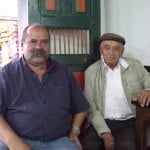
This is the place to eat Bandejas Paisas (the local favorite) and wash it down with a Costena Beer. Listen to the Cumbia, the Salsa and the Tango all mixed up at Bar Danubio, where Toole fell off his stool (damn the metric system). This pool hall/bar has been run by the Foaiza-Tabares family for 60 years and is now operated by son Jairo (see photo) who has the third largest mustache in Colombia and parts of northern Ecuador. His dad. Ernesto, 91, stops in several times a day to make sure things are running smoothly.
A shoeshine man with severely deformed feet – the height of irony – sells me on a shine for 75 cents and I throw in a cup of coffee as a tip. My Colombian friends tell me I’ve paid too much.
Up country from Salento is the town of Cocora at the mouth of the jaw dropping (and I live in the San Juans) Valle de Cocora. I won’t attempt to describe it in words. It was far too rainy to take a good photo. A jeep will take you there for $2 and you might never want to return.
My hotel was Los Geranios 20,000 cop. Family-run with a beautiful garden, 4 blocks from center. Salento is a gem but you need to speak Spanish to interact with the populace and fully enjoy the ongoing fiesta that is life in these hills.

Above Salento…green mountains and tranquility
Chocolate rivers in coffee lands.
Hanging wax palms on the hills,
and minty mountains.
Little red and white cottages pop
the landscape in jungles vibrant.
Machete mustached men
stretch their legs in the morning sun,
the bright star paying its daily visit
to this green, magic land.
– Kevin Haley
*as truth would have it Minca is ranked among the top five places to bird watch on the planet. Everyone has bird guide books and mobs of experts roam those hills in the dry season. Again, it makes sense to me that Colombians enjoy a kinship with birds. They too make lots of noise.
COLOROW’S GHOST
Part I Act 2
(READER SYNOPSIS: In our last episode we met Salli Radar, a former nuclear physicist who walked off her job at a Nevada Test Site, dropped out of high society and moved back to Western Colorado to find herself. Spending an idyllic summer cultivating hybrid snapdragons and tending the family’s burgeoning marmot flock on her grandfather’s Dallas Divide ranchette, Salli knew bigger and better things were in store for her just down the next dirt road. The first act crash landed as Salli bursts forth with a Western rendition of “The Sound of Music”, waking the majority of marmots from a lengthy siesta and setting local heifers on a collision course with E minor. We pick up the action as Salli prepares to bed down for the night.)
Although a comfortable house beckoned, a rough and ready herdsman often took to sleeping on the ground. It was no less than a show of solidarity with the livestock. Salli was no different. As she tried to fall asleep gazing at Jupiter and the headlights from the tourists down on Highway 62 she thought long and hard about her recent work in the nuclear industry and back in Los Alamos, New Mexico where she had designed and assembled weapons capable of destroying Las Vegas or Grand Junction.
The wind kicked up sending an eerie message that winter would be making a house call in about October.
“This is already July,” whispered Salli to herself amid cricket chirps and coyote calls, “I’d better get my nuts in.”
As Salli lay in her goose down sleeping bag, purchased from from a designer outdoor boutique while she still had a fat check coming in, she thought of her fly boy, Mango, who had only last month run off with a bowl of wax fruit leaving her with little roughage and a broken heart.
“That bastard,” she thought, remembering feverish nights in the moonlight on Paiute Mesa and sizzling days with her security clearance and the man she loved in the radiant yet hazy Nevada sunshine. “I miss him so.”
As Salli drifted off to sleep to the rhythm of the vigilant whistle pigs and the swayback skunk cabbage she felt the strange sensation that her camp was being observed from above. Each time she popped her eyes open she saw nothing, but a heavy odor filled the air. It was then that she heard the chanting and the sound of distant tom-toms. The drums got louder as the moon came up for another rousing Charleston with a lingering wallflower star.
“What can this be?” she thought, now frightened by all the recalcitrant racket and the rancorous, pervasive musty smell in the air. “I must be losing my marbles. I shouldn’t be surprised. It happens to a lot of us retired atom splitters.”
Rolling over in an attempt to find a soft spot on the planet, Salli fell back to sleep. The random snoring that had driven poor Mango away now attracted something more wild than Paiute Mesa, something more intoxicating than league night at the Pahrump Bowl. What was out there hovering over the marmot herd anyway?
It was then that Salli awoke, sitting straight up in her sleeping bag. A dark, misty figure meandered its way toward her expired campfire. His glorious war bonnet and taut hunting bow seemed in conflict with his preposterous tie-dyed headband and a badly faded synthetic “Indian” blanket, the kind sold in every border town showroom from Tijuana to Ushuaia. He spoke in quiet, drifting tones as if not to needlessly alarm the snoozing snapdragons.
“I am the great chief Colorow, leader of the proud Utes!” said the spooky warrior. “I have returned to the land of my ancestors!”
“Whoa!” gulped Salli. “How did this guy get in here!”
“I am the great Chief Colorow!” the specter now bellowed. “I come for horses with which to hunt the buffalo!”
Salli sat anxiously as the warrior searched the horizon for the spoils of his intended coup. She had digested all the data on UFOs while working for the government but even the classified variety had never alluded to anything like this Colorow character. This was a completely new ball game.
Had this Pale Horse chief returned to his previous haunt to communicate an eternal message to humanity? Would she share the agonizing particulars of the demise of his people? Why did he choose Salli when there were millions of other more suitable humans crammed onto the planet? Would the Dodgers win the pennant?
George Radar, Salli’s grandfather had mentioned a sacred Indian burial ground somewhere to the west of the family dump on Cottonwood Creek. Had someone left the gate open or had this chubby apparition wrapped in a blanket returned from the ages set on some callous revenge? Had he really chosen her as his medium to communicate sacred and primitive thought to the Twentieth Century? This was almost Biblical!
“I’ve always had a warm place in my heart for the Utes even though my ancestors stole their land, drove them out of the country and used them for target practice,” mewled Salli. “I just love Hopi pottery and trips to Mesa Verde.”
Salli quickly determined that if this Colorow had intended her harm he would have already drawn his tomahawk and taken her hair. She further surmised that he was here on a holy mission and would communicate his feelings to her when the time was right. In the interim, she would just sit tight and wait for his astounding revelation. What an impact this would have on the humanity! Would humankind rethink his calamitous rendezvous with ultimate destruction? What new philosophies would emerge? Could this elusive chief snatch 21st Century Homo Sapiens from the jaws of ecological extinction?
Of course, her newfound celebrity status would not emerge without some sacrifices. There would be the loss of privacy, as government heads all over the world would place incredible demands on her time. There would be the endless interviews by reporters and of course the abrasive talk show circuit. She would need a new wardrobe. Would Mango see her on TV? Salli whirled out of her trance as Colorow cleared his throat as if to speak.
“Here it is,” ducked Salli expecting the infinite truth from the happy hunting ground to fill the nearby canyons. “I am all ears, oh great warrior!”
“What’s for dinner, toots?” asked Colorow.
TO BE CONTINUED
TATTOOS MAY ADD YEARS TO LIFE
(Needle Rock, CA) Adorning the body with tattoos may have some positive effects according to a new study just released by the School of Psychometrics at Cal Polygamy. According to clear findings people with tattoos live longer, on average, than people without the designs.
Of the subjects tested back in March of 1925 and again in May of 1926, then interviewed in 1990 and 2006 almost 80% of those who had tattoos are still kicking. Most seem to be sailors, often from merchant marine ships and fishing trawlers.
“There were far more of these old salt types still alive in 1990 than there are in 2006,” said Dr. Efram Pennywhistle, (of the Gladstone Pennywhistles mind you) chair of the department. “We’ll just have to write that off to inflation. The survey does have a built in inaccuracy component of 14% which is a bit high for these kinds of studies.”
The researchers do not yet know what they will do with the findings until all the data can be further scrutinized and be offset with other similar studies. At present neither the FDA or the AMA have endorsed the displaying of tattoos, or even body piercing, despite links to booster shots and the uses of leeches in treatment.
Reaction within the tattoo and body painting community was guarded with advocacy groups insisting tattoos were “never about mortality, and certainly not morality.”
Local parlors report a slight upturn in walk-in traffic but nothing dramatic.
“We always see a lot of new faces around the holidays,” said Syd Fahrdt, owner of Seaweed Tattoo in Delta. “I don’t know what we’re gonna do with all these toothless tattooed living into their Nineties and more. We’re having enough trouble paying out Sociable Security as it is,”
– Small Mouth Bess
Rockers Lose Benefits
(Durango) Rock and Rollers who have been eligible for fiscal benefits in accordance with the Musical Chairs Program may find themselves out of luck come April. Groups most seriously effected include those evolving since the Eighties when mainstream music began to overshadow socially conscious movements of the previous decade.
“We are not here to determine the quality of music or censor what should or should not be played,” said Efram Pennywhistle executive coordinator of Musical Chairs. “We’ve just run out of federal funds.”
The status of Christian rockers, elevator music enthusiasts and acid-country fans should remain the same at least through March. Rock and Rollers who currently receive the $500 monthly stipend may still be in line for retirement packages while those on limited disability, such as punkers and nouveau disco devotees will get nothing.
Rockers from the Fifties and Sixties will continue to receive a stipend for such necessities as guitar strings and drumsticks but only if they can prove they played, or attempted to play, an approved instrument during those years. Lead singers will be judged on an individual basis. – Rocky Flats

