 All Entries Tagged With: "Lake City"

FISH HOUSE DAYS
The following conversations took place while Melvin Toole
was employed at Gossman’s Dock, Montauk, New York in 1972.
The cast was as follows: Jackie: Jacqueline Onassis;
Mick: Mick Jagger; Billy: Billy Joel; Carly: Carly Simon; Melvin: Melvin Toole
The scene opens early in the morning on a sunny day in July with a large crowd gathered at the entrance to the fish house. Some are there to spot a celebrity.
Others are there simply to buy some fish.
Mick: How’s the flounder today?
Melvin: Quite good, Mick. We just hauled it in this morning. Probably the best catch we’ve had all week. I can let you have it for $8.99 a pound since we’re loaded with it.
Mick: Ducky. I’ll take three pounds. Got any steamers?
Melvin: Can’t you read the sign? No steamers.
Mick: Oh, yeah. Well give me some little necks then and a cup of Manhattan chowder.
Melvin: For here or to go?
Mick: Whatever…
Mick leaves with his fish meeting Carly on the way out the door.
Carly: Nice looking flounder, Mick.
Mick: Yeah and its on sale for $8.99 a pound
Carly: All right! (To Toole) I hear you’ve got some nice flounder.
Melvin: Who told you?
Carly: Why Mick Jagger. I ran into him on the way in.
Melvin: Oh. Yeah, and it’s as fresh as fresh can be. Caught it off Shagwong. We just got it on the ice an hour ago.
Carly: I’ll take four pounds and maybe some steamers.
Melvin: No steamers (he motions toward the sign which reads: “No Steamers Today”.)
Carly: Oh, sorry. How’s the bluefish?
Melvin: It’s delicious. I had a few for breakfast on the way in from Greenport at dawn. Sushi quality, guaranteed.
Carly: I prefer it cooked. I’ll take a pound and a half.
Melvin: That will be $21 with the tax.
Carly: Thanks. See ya.
Now it’s Billy’s turn
Billy: Nice looking lobster. What’s the tariff?
Melvin: They’re $3.50 a pound. The nicest ones are about 2 to 3 pounds.
Billy: OK. Gimme three. Got any snapper?
Melvin: Tomorrow. The boys are out chasing it as we speak. How about some flounder?
Billy: Sure, why not. It looks good. Do you have any steamers?
Melvin: No (forgetting the sign this time) but I’ve got some nice cherrystones and some soft-shelled crab in from the Chesapeake.
Billy: What’s the best way to cook them?
Melvin: Steam them until they open up a little…About seven to eight minutes. Want some mussels to go with that?
Billy: Sure, why not, I’m rich.
Melvin: That comes to $42.59.
Billy: Here’s a fifty. Keep the change.
Melvin: Thanks. Now I can pay my rent.
Toole is ready for a break. He walks out onto the dock to catch a little sun. While doing so he sees one of his better customers stuck behind a gang of one-horse tourists and motions for her to come around through the employee entrance.
Jackie: Gee, I’ve never used an employee entrance before.
Melvin: Good morning, Mrs, Onassis. Are you here to buy fish or look at celebrities?
Jackie: What’s the difference?
Melvin: You’re asking me? How might I help you?
Jackie: Aristotle is bring home a few business associates for dinner and I just don’t know what to cook.
Melvin: The last time I was on Crete everyone was chowing down on Red Mullet, Grouper and Squid.
Jackie: Got any Mackerel or Cod?
Melvin: (To himself: “Not very imaginative.”) Sure. We have both as well as some fresh-frozen striped bass.
Jackie: What does fresh-frozen mean?
Melvin: Too early to tell. Here’s the cod. It’s from out near Gardiner’s Island and is on sale today for $4.99 a pound. The Mackerel is only $3.99.
Jackie: Hmmmm. I guess I’ll take a pound of each and three lobsters.
Melvin: OK. Will there be anything else?
Jackie: You got any steamers?
– Kevin Haley
Letters to the Pe Green Answer Man
Dear Pea Green Answer Man:
How often do deer shed their horns?
G. White Hunter, Waco
Dear WH:
Deer shed their horns once a year. This occurs soon after the breeding season. The tines or snags of the antlers are called points. A deer with a set of antlers having four points on each side is called (in the flatlands) an eight-point deer, and so on. The horns begin as single points on the young deer during the second season and generally increase in size and number of points with each renewal, although the increase in size and number of points is not strictly progressive. For that reason it is not possible, as popularly supposed, to tell the age of a deer by the number of points on its antlers. The growth of the antlers is dependent upon a number of circumstances, such as the physical condition of the animal and its virility. As the deer grows old there is a tendency for the horns to become smaller with fewer points. Reindeer differ from other deer in that the females also have horns.
Pea Green the Answer Man
Dear Pea Green Answer Man:
Why are dummy clocks set at 8:18?
Anwar, Montrose
Dear Anwar:
The hands on dummy clocks and watches used by jewelers for advertising purposes almost invariably point to eighteen minutes past eight. There is a popular belief that the man who painted the first of these wooden clocks and watches had just heard of the death of Abraham Lincoln and that he painted the hands to perpetuate the fatal hour. According to one version of the story, the hands commemorate the exact time of his assassination. As a matter of fact Lincoln was shot at 10:10 in the evening and died about 7:30 the next morning. But the belief is more conclusively disproved by the fact that these wooden watches and clocks, with the hands pointing to eighteen minutes past eight were hanging as signs in front of jewelry shops long before the assassination of Lincoln. The real reason for so placing the hands is obvious. It is the most symmetrical arrangement possible for the hands, being pleasing to the eye, and at the same time leaving the greatest possible amount of space for advertising matter, such as the name of the jeweler. It will be noted that at 8:18 the hands are the same distance from the 12 and the 6 and two-thirds of the space on the dial is above the hands.
Pea Green the Answer Man
Dear Pea Green Answer Man,
Are there real mermaids?
DC, Gunnison
Dear DC:
Mermaids are mythical beings of the sea supposed to have the form of a woman above the waist and that of a fish below. According to mythology, mermaids have great personal charms with which they lure amorous men to destruction in the deep. There is a slight physical basis for the myth. Certain marine animals resemble human beings when seen at a distance in certain attitudes. In some northern countries seals have a way of lifting their heads from the water with a human, intelligent look in their faces, and they hug their young to their bosoms much like a human mother. When Henry Hudson was on a voyage between Spitzbergen and Nova Zembla in 1608, he reported that one morning in June two of his sailors saw a mermaid who came close to the side of the vessel and gazed at them intently. Her face and breasts were those of a woman, but below she was a fish as big as a halibut and colored like a speckled mackerel. If the two sailors were not telling a yarn it is probable that they saw a seal, an animal then little known to Europeans. A few years later Captain Richard Whitbourne reported seeing a mermaid in St. John’s harbor on the coast of Newfoundland. Whitbourne, like Hudson’s sailors, was no doubt the victim of careless observation. Walruses seen dimly at a distance often appear like mermaids. Durongs or seacows as well as manatees, create a similar effect as they stand up in weedy shallows along the coast. The mother holds her young to her breast with one of her flippers, suggesting a mother and her baby. Many of the stories about mermaids were probably invented by sailors to amuse their families. It is not uncommon to find credulous people even today who believe in the actual existence of mermaids, and fake mermaids are frequently exhibited at circuses and other shows.
Pea Green the Answer Man
Dear Pea Green Answer Man:
What kind of fruit is used in making prunes?
El Viejo, Lake City
Dear El Viejo:
Prunes are made from certain varieties of plums. Popularly the word prune is applied to a dried plum of a certain type, or to a fresh plum capable of being dried in the sun without fermenting or souring when the pit is not removed. Hence plum trees producing such plums are often called prune trees. Only a few varieties of plums are capable of being converted into prunes; most plums, if dried with the pits in them, would ferment and sour in the process. Many people believe that prunes and plums belong to different species; they are merely varieties of Prunus domestica, the species to which all common plums belong. On this subject the late Luther Burbank wrote the author as follows: “All prunes are plums. Very few plums are prunes in the common acceptation of the term. The difference in plums and prunes is: Any plum which has sufficient sugar in its substance to dry without souring is called a prune. In France all plums are called prunes. So in the language of France all plums are prunes, while here only those that will dry in the sun without souring are prunes.”
Pea Green the Answer Man
Dear Pea Green Answer Man:
Did Washington receive a salary for his services during the Revolution?
Sweet Sally, Silverton
Dear Sally:
Washington refused to accept anything for his personal services during the Revolutionary War. He did, however, accept reimbursement for his personal expenses. On his way to Annapolis, where he resigned his commission to congress on December 23, 1783, General Washington stopped at Philadelphia and gave the Comptroller of the Treasury a neatly written manuscript which contained a detailed and accurate statement of his expenses in the public service from the time he took command of the army at Cambridge. The total sum was $64,315.00.
Pea Green the Answer Man
BUS ENTHUSIASTS FORM CLUB
(Gunnison) Local bus enthusiasts have organized the nation’s first bus club here according to a press release received this morning. The club, founded for promotion and preservation of bus-related culture, will attempt to educate the public while it combats common misgivings about this kind of travel.
In addition the club will be responsible for recording bus lingo and chronicling history of buses in the Western Slope region. Slide shows on the most recent technology and hints on making left turns will be presented each Friday night at the LaVeta Hotel on South Boulevard Street.
“We’ll be taking field trips to local fields and meeting the bus when it arrives on its daily trek from Pueblo and points beyond,” said Ralph Cramden of Almont. “Why just the other day we had a bus right here in Gunnison that came all the way from Kansas City. Small world, heh?”
Members feel that the public will gain new perspectives into bus travel through the efforts described here.
“With the Congress dragging its feet on passing gas bills we could all soon be riding the bus,” smiled Cramden, “and there’s nothing worse than a rookie holding up the line looking for change or asking the driver stupid questions.”
Plowing of Wildflowers gets Go Ahead
(Crested Butte) A scheme to plow under half of the Colorado’s wildflowers gets underway this afternoon in response to overwhelming data claiming that the vegetation is a threat to the boreal toad. The controversial plan, which seeks to protect the natural habitat and mating rituals of the legendary toad, is the brainchild of state and local biologists.
The status of the region’s romantic skunk cabbage remains undisclosed since it does not reproduce at magnified proportions like wildflowers. During one sunny day in the summer more than a million varieties of wildflower emerge as if from thin air consuming everything in sight. Traditional toad sustenance as well as shrinking wetlands further cloud the conflict inherent to toads and wildflowers.
“We know that the boreal toad is threatened and that his numbers have severely decreased over the past ten years,” said one University of Colorado biologist. “We think the toad lives in the Elks but we have yet to see one.”
“Every species in this rough country is competing for water,” said a Rocky Mountain Biological Laboratory. “Toads need water, so do wildflowers, bears, trees and ski areas. It just comes down to priorities.”
In addition to creating plowing jobs the move is expected to better showcase the remaining flowers.
Nature enthusiasts are reminded that, despite the plowing, picking wildflowers is strictly forbidden and punishable by fines and imprisonment.
“Collecting boreal toads is also verboten but feel free to take as many of other toad species as you like,” said the RMBL source. “But keep your hands off our marmots.” – Small Mouth Bess
Bonnie and Clyde Remake to be Shot in Olathe
(Hollywood Mesa) A bloody, yet more condensed version of the popular film, Bonnie and Clyde, will be filmed here next month according to Olathe Sweet Flicks, makers of space-age onion software. The production will last six months bringing a much needed source of revenue to the town.
“We chose Olathe because it still looks like the 1930s on the main street, minus the newer vehicles,” said director Pulan Romanowski. “It’s unbelievable that the place has remained like this for so long.”
Readers may recall that several episodes of The Twilight Zone were shot here in the late 50s followed by all but two of the colorized versions of Dragnet and Leave It To Beaver. Both of the latter efforts were made on California Mesa, the ancestral home of Lumpy Rutherford.
Town fathers and mothers are concerned that the filming might conflict with the 112th Spud Lovers Tomato Fight and Convention slated for July 22-31. This year some 35,000 potato aficionados are expected to converge on Olathe for panel discussions, cooking displays and tomato wars.
Meanwhile the producers of Bonnie and Clyde are searching for 1930s vintage automobiles to employ in the film. If anyone owns one of these gems and would like to make a few bucks please call the the Olathe Suite Corn Festival. – H. L. Menoken
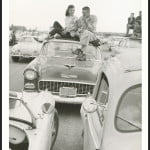
US Demands Return of 55 Chevys
(Miami) In an rash departure from warming diplomacy toward its estranged tropical neighbor, the United States today demanded the return of all 1955 series Chevrolet sedans and coupes now resting on Cuban soil. The surprise summons comes just as the two nations, at odds for decades, had begun talks on such bugaboos as immigration, baseball and economic blockades.
It is estimated that over 2000 Bel Airs and other models are on the road here and another in use all over the country.

In a surprising return to Cold War rhetoric the United States today
demanded that Cuba return of all 1955 Chevys now on the island.
Cars like the one above have become a rarity in the US
despite the fact that they were once made here.
“People aren’t keeping these classics in their garage to parade around in on holidays,” said Juan Tonomo, a Havana mechanic. “They drive them. They manufacture parts for them, They wax them. They cherish them. If the Americans try to take back the 55s they’ll surely be a fight. Another Bay of Pigs but maybe this time in Florida.”
Although General Motors, builder and designer of the cars, insists that they belong on US soil there is no clear legal precedent, especially across the dangerous straits that divide the two poorly ruled citizenries. The cars were procured, stolen, rescued, purchased, inherited, abandoned and discovered following the exit of America’s little dictator buddy Fulgencio Batista and the accompanying Mafia sideshow. They have since melded into the Cuban psyche, since Fidel came to town in 1959.
“We are certain Detroit is behind this,” say Washington sources. “They have been jealous of the performance and longevity of the older vehicles especially if one compares some of the recent bombs such as the Cavalier and the Pinto (Ford) which arrived on the scene shortly after the Cuban Missile Crisis.”
One of the reasons the automobiles have survived, especially in the climate, (both natural and fiscal), is the preponderance of fix-it concerns all over the country. Nothing is thrown away. Landfills are saved the indignity of staring down barely used toasters, building materials and discarded clothing. When a car breaks down it is repaired, even if the part must be fashioned or the engine overhauled.
“The government is bad but the people are good just like everywhere else in the world,” said Tonomo. “But the poor ones are always the ones to suffer the most when things turn sour. Taking their cars away would be the end.”
Sources in Detroit disagree with the appraisals saying they are merely nostalgic and want their cars to be back home where they belong.
“We look longingly toward Havana,” said Arlo Witte, a spokesman for GM. “We bare them no malice. We feel we can better provide for the 55s and offer them more security, a better future here.”
Up to now the US interests have yet to produce so much as a title or proof of registration. Cuban officials say the cars may have never been part of the American landscape.
“All that Dinah Shore See the USA in Your Chevrolet nonsense was so contrived,” frowned Tonomo. “We would have had songs like that except e couldn’t think of a car that rhymed with our island.”
Lobbyists indentured to the auto giants have been hammering Congress to terminate the economic embargo that has been in force “since the Communist takeover”, so that they could sell cars there. Insiders confirm that meetings have taken place and some preliminary agreements have been approved over rum and cigars.
Perhaps the most plausible solution, according to State Department innuendo is to cave in and give Havana what it has wanted for all of these dark years…a Major League baseball franchise.
“Then they might be more inclined to return the cars, according to diplomats at the North Dakotan Embassy which represents US interests since there is no ambassador in residence in Cuba.
US officials were not clear on what action might be taken if the cars are not returned.


