 All Entries Tagged With: "Western"

Welcome Declan Martin Haley

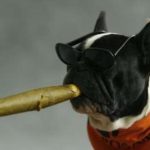
Bella, the family Boston Terrier, enjoys a cigar at the birth celebration of the editor;s grandson on August 15.
Local Woman Loses Battle With Cat Over Lizard Torture
(El Jebel — August 18, 2016)
A local woman, who wishes to remain inanimate, has tragically lost her courageous battle with local cat, Fluffy, over Fluffy’s alleged use of recreational lizard torture at the women’s residence, each summer since 2009.
The local woman, identified only as a living female who resides somewhere people would gossip about, has announced that she will immediately give up her seven-year battle with Fluffy over what she has called the Cat’s “annual insanely macabre practice of outright lizard torture in order to help pass the hours during those lazy, hazy days of summer.”
Answering reporter’s questions, the local woman, who was fully clothed prior to the announcement, said this:
“I give up. This is ridiculous. That cat is playing me as a fool. Last year it just kept chewing off little parts of the lizard’s tail. One night, the Cat begged me to let its little lizard friend Larry sleep-over. Larry’s tail was already noticeably shorter than it should have been, but I relented. The next morning I found that Larry had less than half of his tail left. Still, the Cat pleaded. ‘Oh, please? Can’t my little friend Larry sleep over tonight? Look! He loves me!
“Sure, I knew that part of the Cat’s story just didn’t ring true. I could plainly see that the Cat’s little pal Larry was getting smaller each night. Larry’s eyes weren’t so bright as the fence lizard picture in the little golden book of animals nobody cares about. Still, I looked at Fluffy, knowing Larry seemed to be the Cat’s only friend, and I let Larry sleep over.”
“Next morning, Larry had no tail left at all and was lying upside down next to the Cat on the sofa. The Cat broke the uncomfortable silence with, ‘Me and Larry were wondering what’s for breakfast?’
“I picked up Larry’s short, dazed body and I removed him to an undisclosed safe house where he had everything he needed to recover and start a new life.
Next morning I found Larry on the floor in the kitchen, no tail and his head and legs were missing. The Cat sat on the kitchen table and cleaned its feet on my placemat. Then it said, ‘wasn’t The Godfather a great movie?’
“That was last year. It’s started again this year with a new lizard. I’m no match for that Cat. I know that now. I just wish I had learned this lesson a long time ago.”
Such a tragic story, yet not uncommon in our own neighborhoods. The San Juan Horseshoe wishes to thank this local woman for the courage to speak with us about her own personal hell, created by the unassuming Fluffy the Cat.
– Lina Baquer
August 7, 2016
Postcards from the Butte

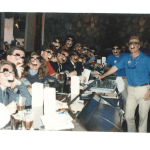
Can you name all the Grouchos in this photo? How about the two jokers behind the bar. Guess correctly and enjoy free drinks all week at Casey’s!
The Cigarette Roller: Surreal Redemption
“We lost Davey in the Korean War and I still don’t know what for…don’t matter anymore.” – From the song Hello in There by John Prine
It was July of 1967. Everything was changing at once. The Vietnam War, Civil Rights, the Counter Culture, music, hair and fashion were raging, all with a pinch of bombed out chaos and pound of foreboding just a breath away. Psychedelic and far out! Laugh-In was full throttle as was the Ho Chi Minh Trail. It would be two summers before the Black Panthers, the Moon Walk and Woodstock would grace the stage.
The Cardinals and the Red Sox would meet in the World Series that fall. At least that seemed normal.
Having just graduated from high school in May, my life was on stimulation overload. As a fortunate son I would be going to college in the fall while many friends were getting drafted into the army and sent to a small Asian country called Vietnam to fight against godless communism or something like it.
Life was new and exiting but tainted by the inconvenient reality of going to war. Maybe my real fear was getting plugged into the mad, mindless military machine. The future they had promised us had come down to the bloodless draft lottery and those pasty-faced, warmonger humanoids on the draft board. It’s the patriotic thing to do, isn’t it?
Several of my older friends had already come back from a year in Southeast Asia. They seemed different and often stayed pretty much to themselves. A few looked for excitement in Southern Ohio and found little after the pace of combat, the great smoke, carrying a n M-16 to the village, the thrill of the exotic, the thrill of being 20 years old and already a witness to the most hellish inventions of men. They were all just kids. None were prepared for what awaited them.
Most were hung-over from the US military cocktail. Those of us who remained stateside had no idea what combat veterans had lived through and how they survived in the jungle.
Despite a pseudo-inspirational Catholic education I had already been fired from two summer jobs when I got hired at Kitty Hawk Golf Course to mow greens and rake out sand traps. My first failure with the work ethic was in a dismal, downcast factory where I built dryers and dishwashers all day. The second was in a suburban department store where I sold dryers and dishwashers all night. It was clear that I did not have the wardrobe or the wherewithal for Lyndon Johnson’s Great Society. That’s just the way life is. If all else fails maybe a few years in the army would straighten me out.
The golf course was so green and precise at sunup. The mist hung in the trees like my last morning dreams, giving off a fresh sense of well-being.
My first day working at the golf course was actually quite pleasant. The bosses were cool, happy. Although showing up later than 6:30 was unforgivable there was very little else expected of the workers there. Mow your greens, change your cups, rake your sand traps. Stay out of the way of the golfers. My supervisor, Marian Zowolski, the head greens keeper, was a genuinely nice person. His boss, Robert Plant (not from Led Zeppelin) was on his last year or so before retirement and dreamed of weeknight Reds’ games, winters in Florida and, after 35 years of getting up in the dark, of sleeping well past 5 am on the weekdays.
After lunch, a celebration generally extended by a pickup football game, most of us were banished to the sand traps where we would be left alone for the remainder of the day. We loafed. We could see the silhouette of the boss cruising in his Cushman, almost blind with those thick glasses hanging off his nose, his pipe leading the way. We knew he couldn’t see us or maybe didn’t care to look. Don’t rock the boat.
In addition to regular employees, Kitty Hawk enjoyed the services of a crew of men from the local workhouse. They would show up about 11 am, work for a short stint, eat lunch, work a little more and leave for the day. One of these guys was named Joe. He was friendlier than the others and was missing his left arm at the shoulder.
One afternoon in the wind and the sand he became our hero.
There were four of us working in the sand trap that day. My friends Phil and George, Joe and myself. The wind was howling as black clouds gathered ready rain. During the first of a series of breaks Joe pulled out a pouch of rolling tobacco, skillfully manipulated a gummed cigarette paper, filled it with tobacco and rolled a perfect smoke…. all with just one arm. He flipped it into his lips and looked at us for a light. We stared in quiet surprise, in adolescent awe, in curious approval of the magic we had witnessed.
“Wow, man, that was incredible,” said Phil, careful not to dwell on the lost appendage. “Where did you learn to do that?”
Joe looked at him without taking offense.
“In a ditch in Korea,” he snapped, not angrily.
About a week later, during our daily lunchtime football game Joe opened up to Phil and I. He had played ball in high school before his father had died and he had to skip a college scholarship and go to work. Soon he was on the field with us, a one-armed quarterback who threw with power and precision.
“You don’t need two arms to play quarterback,’ He laughed. “I’m just an old Briar hopper,” he said. “Family’s from down around Portsmouth, before that Kentucky…and I can still throw a football,” he smiled.
“You still got it, Joe,” said Phil
He was the only one of the workhouse crew that talked to us. One rainy morning in our break house he told us he had lost his arm in the Korean War. Joe had joined the army at 18 figuring on spending his tour in peaceful Okinawa. When, after countless border skirmishes North Korea invaded, Joe, our cigaret roller, was one of the first to be sent to Korea.
Two of his high school buddies were reported as missing in July 1950. Joe saw action as part of the 24th Infantry Division at Taejon. He retreated with the badly rattled survivors so as to regroup near Pusan.
“We was just teenagers with a bout 8 weeks basic training,” he explained. “Our equipment was nothing. We couldn’t even stop a wheelbarrow much less a tank. They sent us there to slow down the North Koreans. Bang-bang, you’re dead. We slowed them all right, but it cost half the regiment.”
Joe stared into space.
“It was murder. 400 poorly trained GIs with outdated weapons against the what seemed like entire North Korean Army with state-of-the-art Soviet tanks,’ he finally gasped, turning his head against the wind and sand.
“Many of us went to Korea, not because we wanted to but because, I guess, we felt we had to go. You have to understand the times. Some of us came back fine. Others didn’t come back at all. Some, like me, left a little part of themselves there.
After the landing at Inchon the United Nations’ troops charged up the peninsula all the way to the Yalu River. Then in November 1950 the Chinese began a mass offensive, swooping down on United Nation’s positions, systematically killing the wounded as well as many unprepared soldiers who believed that the war was just about over. The North Korean and Chinese armies marched south precipitating grim, gory house-to-house fighting in Seoul. The deployment of nuclear weapons was considered in far-away dry martini Washington, while sweaty highways clogged with millions of refugees provided the apocalyptic scene up and down the Korean Peninsula.
Hell, a pack of rolling tobacco like this would fetch a pretty penny in Korea in them days,” said Joe. “It was like the end of the world.”
Joe survived the next 8 months up and down the peninsula. He lost his arm during the Battle of Kapyong 23rd April, 1951. Joe had captured three Chinese prisoners who had surrendered to the UN in hopes of repatriation to Taiwan. While several of his fellow Marines favored executing the enemy soldiers Joe protected them until they were interned at Koje Island with 60,000 others.
“When I met these three Chinese fellows: I didn’t talk no Chinese and they just smiled and gestured peacefully, happy to be herded away from the front lines.
Almost immediately after returning to his unit he was hit.
The Chinese had again come out of nowhere. A human wave of attackers, many without weapons, advanced on his position as ammunition dwindled. An air strike was called in to avoid being overrun. That’s when he lost consciousness. Two days later he woke up in a thirsty ditch surrounded by mounds of dead bodies. It was then that he discovered he was short one arm.
I had a pouch of tobacco and two cans of K-ration peaches,” he told us. I ate the fruit and rolled up a cigarette.
“In the wind?” I asked
“In the wind and the bitter cold, he laughed. “I couldn’t believe I had not frozen to death out there. I figured I was granted another life.”
Later that afternoon Joe was picked up by a contingent of Greek troops patrolling the terrain looking for survivors. Most of his company had been wiped out. Later that evening a MASH doctor saved his life on the operating table.
“I’ve never told anyone my story,” he said sadly. “I figured nobody would much give a shit. Most people from my part of Ohio didn’t know Korea from caramel corn. But they damn sure knew Captain Kangaroo, Betsy Wetsy and Dr Seuss. It was all nice and pasteurized for the people back home. For us it was minute-to-minute hell. They didn’t really understand the heroism or the fact that so many bugged out – broke and ran.
“And let me tell you about Douglas MacArthur. He was a big showman. He should have been on “You Bet Your Life” or Sid Caesar. We were convinced that he cared more about his pipe and his stupid little dog than us, but he was a gifted general – look at Inchon. Maybe if the hotshots in the White House would have listened to him the war might have ended quickly…or maybe the world would be ashes. MacArthur never spent so much as a night in Korea preferring to run the war from Tokyo.
During the early Cold War the people back in the USA were basking in the dimly lit victory against Germany and Japan, having babies, watching black and white TV, madly in love with muscle cars, afraid of the Bomb and watching the Hit Parade.
“In Korea they had this thing they called psychological warfare or brainwashing, “ Joe said. “There were lots of prisoners on which to practice. A new world was on the horizon. Would it be dominated by the East or the West? Or could these conflicting ideologies be better explained and brought to a boil on “I Love Lucy?”
When Joe came home he worked an army desk job and realized that very few of his countrymen gave a damn about Korea. The answer came easily to the shrink at the veterans’ hospital:
“Stop drinking and the dreams will go away,” he had said. That was easy enough. Sure. This clown had spent his tour in giddy, post-war Europe but was now analyzing people who had just come through hell.
Joe quickly realized that it was impossible to explain anything to anyone who had not suffered the fighting. He got married to a girl from down around Portsmouth and they had two kids. He couldn’t relax. He drank to calm down. First it was with fellow vets, then alone. Peace evaded him especially in his sleep. It all came back to visit him no mater what he did to head it all off and preserve his new life here. Then he talked to us about Vietnam.
“Don’t buy into that shit boys.”
That night when the dreams came they were in different colors than before. Joe distinctly remembered boarding an airplane for Korea. He felt himself climbing the stairs and taking his seat. Then lift-off. He felt some pain in returning but the flight was a release. It was as if he were doing the flying rather than the plane. When he showed up at the golf course the next day he was quiet and reserved. No jokes. No football at noon.
Joe got out of the workhouse the next week and didn’t show back up at the golf course until the end of the month.
“Ima going to Korea,” he said, “and bring back an old friend. I’ll miss you boys. Maybe when I come back I’ll apply for work out here.”
Joe was facing his demons, a hillbilly smile tattooed onto his face.
“Imagine my arm just laying there for all these years wondering why I have not come back for it,” he whispered as he shook my hand goodbye. “You know how bad I feel.”
***
That night dreams came easy. The plane landed and Joe walked out into the Korean cold. Everyone was smiling. They were the same people that had loaded him on the medivac 20 years ago. The same nurses who had dressed his wounds and read to him were now floating all around him. When the call for attention was sounded he couldn’t remember how to respond. He tried to return a salute but his right arm would not rise to the occasion. Then he fell into a deeper sleep or so it seemed. When he regained consciousness he was out in a field, under a cliff, rolling a cigarette.
“You! What do you want? Where have you been?” said Joe’s arm. I see you still have your shoulders and your legs and, oh, and my other arm.
There were no words of response. Joe looked around. Everything was exactly the way he remembered it minus the artillery and the Chinese. He tried to gather himself but the arm wasn’t having any of it.
“I’m so sorry I left you behind,” said Joe. “It was all too terrible and I could not find you when they pulled me out. You must understand…I did not want to lose you. Every day since I have awakened to contemplate my demise. You are not the only one who has paid the steep price.
You! You have been back home living the life while I sit surrounded by clay and a burnt battlefield. I thought about leaving but where would an arm go all-alone?
Why did you leave me, Joe? Was I not a good, honorable friend? Did I not help you through life? Was I too short or too long? Didn’t you love me?
Joe thought about a drink…just one to settle down. No, that did not appeal to him. All he cared about was reconciliation with his long lost limb and his young family.
“I’m sorry I left you but I’ve come to take you home,” said Joe, the words coming out like they had been rehearsed a hundred times.
“Home?” said Joe’s arm. “Home.”
“We could leave today,” started Joe
“Not so fast,” frowned the arm. “Things are different now. I have a life here without the rest of me. I can’t just…”
Please come back with me. I need you to be whole,” said Joe.
“What if you go off to war again? I might get lost again,” sighed the arm.
“That won’t happen,” said Joe.
In the morning Joe awoke after a full night’s sleep. He was tired after talking to his arm far into the night. Having convinced his appendage that at least a “temporary” reunion was best for all the two buried the hatchet. He was happy to be home, to be whole once again. Yes, my friend was whole once again.
I ran into Joe at a Reds’ game in 1991. He introduced me to his wife, Flo and his two teenage boys. They had the look of one very happy family. He said he’d tasted his last drink some 15 years ago.
“Do you still roll ‘em, Joe?” I teased.
“No. I gave that up. My family doesn’t want me smoking.”
I was drawn to his prosthetic arm, which, although it was a sweltering day, was partially covered by a shirt sleeve.
“Oh, and I guess you’re wondering about my arm, heh?”
“Actually I was wondering about your metamorphosis, your…”
“My meta what, college boy?
“Your redemption. Your deliverance…”
I’ll have to credit my left arm for all of that,” he smiled. “You know it was there all the time. I just didn’t look for it the right way.” – Kevin Haley
LEVITATIONAL PARKING PLANNED AT CRESTED BUTTE
(Gothic) Instead of spending money to improve lifts, Crested Butte Mountain Resort has erected several new hotels in what was the area’s sole parking lot. Sound silly? Read on.
Officials at the ski area have contracted Snow Guru International, a firm of freelance swamis from the nice part of Calcutta, who claim the capability of successfully suspending automotive vehicles in thin air! These gifted mystics will go to work Thanksgiving weekend and continue to ply their strange trade until the ski area closes in April.
“We figure we have extended our top occupancy ceiling to about 500,000 cars per day considering predetermined air space and a desire to let the sun shine in,” said a marketing source who asked that she not be included in this story by name. “I don’t know how this applies to skier days or if it will even work at all on heavy powder days.”
The source then went on to admit that she had no clue what skier days might be but was quite familiar with powder days.
Across the Elk Mountains, principals in Aspen have been conducting underground tests with levitation and suspension since September. They would not talk to our reporter despite a lot of whining. In Steamboat Springs excess vehicles and skier baggage will be stored on the James Brown Soul Center of the Universe Bridge and skiers will be hauled into town via open-air tuna boat.
Imagine skiing down Jokerville or Twister at Crested Butte and looking up at your car hanging high above the resort silhouetted against the winter sky! What a rush!
“Look mom! It’s our Explorer!”
Parking fees will fluctuate depending on the size and weight of the vehicle with out-of-state skiers getting a sizable break when they purchase a package. Old Volkswagens and beat up pickups will not qualify for the uplifting since the area is concerned with its image and “does not seek to clutter the horizon with a bunch of decaying jalopies”.
In addition to the parking arrangements the Snow Guru International hopes to provide a top-drawer coat and hat check, bonded baby-sitting, a convenient lost and found and a sexy cocktail lounge for people waiting for their vehicles to return to earth.
To date there have been only a few accidents involving reentry and not that many people have been injured by falling cars to date. One such disaster was narrowly averted as a 3/4-ton GMC pickup was inadvertently dropped through the roof of what once was the Alpenhof Cabana, coming to a complete rest in an somewhat unoccupied men’s room.
The service is restricted to vehicles operated by persons with a valid ski pass. No AARP discount will be extended and motorists driving RVs are asked to leave the same in Almont.
“We’re really excited about this concept, said the above secretive marketer. “Now a lot of the tourists will have something else to look at besides themselves parading around in their ski fashions all day. Hell, some might even get motivated and take a few runs or at least a lift ride or two.”
The Crested Butte and Mt. Crested Butte Councils have tentatively approved the plan while BOZO is firmly against, and has always been firmly against, deterring from the laws of nature. Insiders suggest that if CBMR executives will only paint themselves a sweet and sour Victorian purple everything will be alright over at BOZO.
Despite early support by other government agencies, consumers are privately urged to take Alpine Express or town bus up to the mountain until further tests are concluded.
-Barb Wire
Massive Rubber Deposits Authenticated at Snodgrass
(Crested Butte) What might be the largest rubber vein ever detected was unearthed under Snodgrass Mountain near here Friday. The incredible deposit, which local geologists say has been in the ground longer than coal and molybdenum, measures roughly 10,000 acres and stretches into Delta and Pitkin Counties.
Surveyors mapping Snodgrass for yet another proposed ski are expansion scheme say the “ore” is of extremely high quality and is rarely found near coal or silver in this vicinity. They expressed surprise that so much of the valuable commodity was just lying around on the ground near the portals.
“Upon further investigation we discovered massive caverns whose walls were carved out with pure rubber,” said one surveyor. “Sushi quality rubber. After roaming through these perfectly symmetrical hallways, tunnels and caves nobody much wanted to survey anymore. We were all having too much fun bouncing off the sides of the cavern and collecting specimens.”
As might be expected the announcement sent shock waves through the mining industry. Pay-Max, a giant mining company with many local molybdenum claims quickly sent top executives to have a look. Already they are insisting that they retain all rights to Snodgrass and Gothic Mountains, Red Lady and Teocali as well as Crested Butte Mountain, The Bench, Kebler Pass and Lake Irwin. A spokesman for Pay-Max told The Horseshoe that if the strike is “half of what it appears to be” residents should expect to see an assortment of satellite operations on the works by spring.
“Here we sit watching molybdenum prices and someone stumbles across the largest rubber reserves on the planet. It just proves that the rich were born rich for a very good reason,” smiled a fidgety Pay-Max executive, who said he didn’t like high places.
Meanwhile over at Crested Butte Mountain Resort (CBMR) plans to expand anything are at a standstill since one of the cast of corporate thousands reportedly forgot to secure the mineral rights to the Snodgrass-Gothic Corridor (SGC) from the Department of the Posterior (DOP).
“We have one executive director who has nothing else to do but watch the earth move and the snow fall,” said an angry ski boss. “What was she doing? Skiing?”
We attempted to reach the DOP late this morning for a comment on this latest episode but everyone had already gone home for the day.
The ski area plans to fight the mining interest saying that the extraction of rubber from below the surface is not compatible with existing use of the forests. They say the rubber mills alone would adversely affect smooth slopes and ski mansion foundations.
“Consider if you will the detonation of dynamite all day long and the sucking sounds of the heavy machinery used to pull out the rubber ore,” said a ski source. “How did you think they harvested rubber, from trees?”
– Uncle Pahgre