 All Entries in the "Fractured Opinion" Category

Gitano Summer
by Uncle Pahgre
That the Egyptians and the Chaldean strangers Known by the name of Gipsies, shall henceforth Be banished from the realm as vagabonds. – Longfellow: The Spanish Student
Just about the time the gray hairs outwit their youthful counterparts it becomes clear that our memory fades as well. Episodes of youth are shrouded in the pure green paradise of summer, which lasts forever. When I was a boy it never even seemed to get dark on summer nights along the San Miguel. Then the great snows of Depression Decembers amounted to at least twenty feet dumps, not paltry six inch flirtations common to the mountains today. Flooded pastures and crisp quake leaves filled in the gaps of the daily celebration. That’s what some remember, the pleasantries, the simplicity of the Rockies. Others, who were offered the same joys, recall the strife and that’s the basic difference between the old gentleman who strolls the cigar evening, cane in hand and the curmudgeon who sits whining in his wilting rocker, the victim of it all, damning his final hand of cards before the deal is over. In was one of these summers, 1937 or 1938 that Placerville cautiously received the Gypsies from Spain.
For decades our town had been a major railway hub shipping cattle and ore along with hardrocker necessities and food to feed the hungry miners up in Telluride. The rails brought a landed assortment of humanity from bums to bankers. Local cowboys, dreaming they had finally made the big time in Dodge or Abilene kept the local sheriff busy on Saturday nights. Otherwise his position demanded visiting his constituency and drinking their lemonade on the peaceful porches of the San Juans. I had just turned ten years old the night the Gypsies pulled their brightly painted wagon into town. “Watch out, they’re gypsies,” said Mrs. Caldwell from her sun porch, the one built for her by her son, before he left for the trenches of France in 1917. “What do they want here,” she continued, throwing fear into the little bones of her grandsons, moonstruck behind pioneer curtains at the nomadic entourage spilling from the waggish carriage. “They want to sharpen your knives and repair your pots and pans,” said Dr. Twill, the local dentist and the closest thing to a mayor that we had. “They don’t mean any harm.” “I saw them up in Leadville last month and they were nothing but trouble,” quacked another citizen.
“They steal horses and put evil curses on people. They read palms, relish fortunes and sell sugar pill remedies for everything from broken hearts to the gout.” The dark-skinned cargo ascended from the wagon as one copper smith surrounded himself with unfinished wares and began to tune his violin. The Roma children looked around at the bustling little burg intent on new friendships and maybe a little mischief. The men announced their services, quite accustomed to the hostile stares of the stay-at-home world. “Maybe they have whiskey,” said a thirsty Mr. Brennan, who had come across the Atzigan in France in the early Twenties on his way to America.
“They always have bootleg of some sort…and cigars.” “I don’t trust them. Just look at their patchwork clothing,” continued Mrs. Caldwell. “Those horses look too good to be pulling around a carnival wagon like that one. I wonder where they stole them.” Brennan took offense. “We had gypsies in Ireland, but we called them Travelers,” explained Brennan. “Some say they arrived from India via Persia, others said they were the landless ancestors of those orphaned during the Cromwellan Wars of the 1600s. Displaced at best, they wandered my island under the constant scrutiny and suspicion of near-do-wells who themselves had little more than a thatched roof over their heads. I guess everyone has to have someone to look down on so as to prop up their precarious existence…”
“Say what you will, Brennan, popped Carl Perkins, a Cousin Jack from Marshal Basin, “but I’ll be keeping a close eye on that bunch. They’ll steal anything that ain’t nailed down good.” I remember asking my father if he had a nail of two to spare reflecting on treasures such as my fishing pole, my American Flyer and my Joe Lewis photo up on the wall next to my bed. “I tell you there’ll be trouble until we run them out of town,” said Perkins. The patriarch of the Gypsy family couldn’t help but feel the weight of the bucolic reception. He was a veteran of the kind of discrimination aimed at those who would reject assimilation even on the rare occassion that it is offered. People who stay to themselves and jealously guard their diminished culture don’t mix well. The only reason they had ventured into town was to buy provisions, sharpen knives and perhaps trade a horse or two.
“Fine looking horses they’ve got,” repeated Mrs. Caldwell. These wanderers were recent refugees from the civil war that ravaged their native Spain, outcasts from a conflict that had not officially requested their presence but churned up their lives anyway. The kindred’s grandfather had joined the Anarchist Party in 1935 after bold strikes had gained a little leverage for starving peasants in Andalusia. He worked in the fields, harvesting grapes for the wealthy sherry producers around Sanlucar. One day in 1936, after the Nationalists had liberated Cadiz he was taken from the fields by a Falangist gang and murdered in a nearby ditch with about 20 other leftists, who had no politically ideology except their hunger.
The Fascists had no tolerance for Reds, especially low-caste tinkers who joined the unions and burned churches. It was soon after that his son, Emile, sold what little he had and escaped to America with his new wife and the remnants of both families. After a sojourn into the local market, where they traded in services and paid the rest in gold, the residue of rovers wandered back to their camp, set up along the river near Specie Creek. It was there that the local sheriff, bored of cowboys and lemonade, would visit them that night. Emile, who had crowned himself King of the Gypsies (a title confused in the translation from Romani to English) since there were no other Gypsy pretenders in earshot to denounce his throne, greeted the lawman from atop a stunning white Arabian. “Where did you manage to acquire such a fine horse?” he asked. abruptly as Emile’s family watched from the campfire. “Did she just wander into your camp one night?”
“I traded two raindrop colts for her over near St. Elmo,” answered Emile. “I’ve got a bill of sale here…” “No reason to produce a piece of paper what may or may not be legit,” said the sheriff. “Fine horse. I hope you folks ain’t looking for trouble. We’ve got a nice little town here and I won’t have a bunch of gypsies throwing a wrench into things. You can stay until you’ve completed your rounds here but at the first sign of trouble I’ll lock you up and ask questions later.” Emile, accustomed to harsh treatment from the authorities, smiled and said he understood the sheriff’s concerns, adding that there would be no problems and that his family would be gone by the end of the week. That was the same night that Arnold Blackman’s young quarter horse came up missing.
“One minute he was in the corral and the next he was gone,” explained Blackman at the sheriff’s office. “He’s a lazy beast and has never shown the inclination to wander from the bountiful pasture near my cabin. I can’t explain it. Even if he took off he’d surely be back by now.” The sheriff rode back out to the gypsy camp and, interrupting the evening’s music, demanded to see Emile. “We got a quarter horse missing from the Blackman place. Know anything about it?” he accused, spitting chew from the hole under his long drooping mustache. “No, sir,” answered Emile. “You know that horse stealin’ is still a hanging offense in this part of the country,” he frowned. “Now tell me what you know about the disappearance.” With his family dumb struck Emile denied any knowledge of the occurrence. “You’ll be coming with me until you regain your memory,” said the sheriff. “We don’t cotton to thieves around here. Nobody steals nothin. The last time a horse turned up missing there were your kind about.”
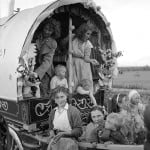
- Gypsy wagons traveling through Placerville in the 1930s. Always under suspicion due to a tainted reputation, the nomadic Roma survived as smiths and tinkers, often telling fortunes and playing music in communities that tolerated their eccentric way

Emile smiled attempting to take the heat off his tribe. As his children looked on he agreed to accompany the lawman to the local jail, a cedar log shack at the far eastern end of town. And, while his family tried to make sense of it all, that’s where he spent the night. “Your damn right he’s got Blackman’s quarter horse. They’ve hidden it in the woods,” said Mrs. Caldwell. “Lord knows what else they’ve walked off with,” said Perkins. “Sticky-fingered bastards. I say let’s burn them out tonight. Then maybe the big cheese will start to melt.” Mr. Brennan then spoke up. “We’ve got no proof of any wrongdoings on the part of those people. You can’t just…” “No proof!” cracked Perkins sarcastically. “Did you take the horse, Sam or did he just vanish? The Irish don’t steal, or do they?” he pushed.
Brennan just glared back in the face of Perkins, considering his options with the much larger miner. “Sam Brennan is not under suspicion here, Perkins,” said Mr Twill. “The animal could be anywhere.” “He’s somewhere under that gypsy tent,” continued Perkins. “I say we load up, go on out there and see for ourselves.” “Not so fast,” said the sheriff. “If he’s guilty he’ll pay dearly. I assure you. But until we have proof there’ll be no more of that talk.” The whole town was soon abuzz with rumors about gypsies, magic potions and enchanted horses. Some said the nomads had secret powers over the living. Others shuddered that they were in league with the dead, or worse. The sheriff returned from a cross-examination at the jail with nothing to report. “Tomorrow we’ll search for proof and question the rest of his band,” said the sheriff. “They won’t leave the county with their leader in jail. I told that bohemian that he could save a lynching if he came to and told the truth but he denied any connection with the disappearance.”
“Meanwhile I’m out a good horse,” shrugged Blackman. “I don’t trust those people…” “There’s one way to be sure that he won’t steal again,” said Perkins. “I won’t stand for gypsies coming into my country stealing and laying out curses…I say let’s string him up now!” The strawberry vigilantes had regrouped at the Blackman place. The threat of spilled blood was already on their hands. A rope hung on the wall. A man was in the cell. A large cottonwood lingered with wide gaps on its dance card for the evening. “What are we thinking?” sensed Mr. Twill.
“What insanity! If you kill you’ll never be the same people, even if he’s guilty of stealing 100 horses! We must maintain a sense of justice or we’re no better than common murderers.” “Stealing is stealing and hanging is hanging,” chimed in Mrs. Caldwell. “What other choices do we have? I say burn them out and run them down the road. Then we, as a town, can replace Blackman’s stolen mount. We don’t want those people skulking around at the edge of town anyway.” “Running them off is too good for them,” said Perkins. “They need to be taught a lesson. A man dancing from a limb don’t steal. Let’s proceed with a little frontier justice…the terrible swift sword and all…” “I’ll shoot the first man that forces his way into my jail,” threatened the sheriff, adjusting his holster.
“Now you all settle down or the Gypsy will have a lot of company. We’ll pay a visit to their camp first thing in the morning and sort this thing out. I promise that, if the Gypsy had anything to do with this you’ll get your justice. I didn’t like the way he sat on that Arab. If he’s to blame it will give me great pleasure to dispense the law.” Emotions continued to run amuck. Nothing this important had happened in Placerville since the ore train was robbed by those boys from Utah in 1898. The imagined fortune, in reality amounting only to about $100, had left three men dead and one train guard blind. Before that there were Utes to contend with, water wars and bandits from the Disappointment Valley showing up for afternoon tea. Imagine this brash gypsy appearing right here in the daylight and by nightfall a valuable horse is gone. It all adds up. Who wanted to sleep while a felon cooled his heels in the midst of a once peaceful patch of paradise? A slap in the face. No one went home. The hour grew late as a jug was passed around. Talk turned tough, then subsided, then got tough again.
As the dawn approached everything remained on edge. A small contingent of Emile’s family bravely arrived and begged for mercy saying he had not committed any crime. They we’re received by the stares of the righteous intent on an eye for an eye. “You’d better have that horse hid real good,” threatened Perkins. “We’ll be coming your way before breakfast to see what else you’ve been up to. When we’re finished your Gypsy King will be sucking dust.” Emile’s wife asked to see her husband but was denied by a tired sheriff now facing the mob mentality of his neighbors. Twill cautioned against hard talk in front of the children. Perkins countered by calling them little thieves whose daddy wouldn’t be coming home. Blackman appeared with a shotgun which he pointed menacingly at the Gypsies. He ordered them off his land. No one moved.
Everyone was so worked up that they didn’t see the logger from Sawpit leading the prodigal quarter horse into Blackman’s corral. The man’s name was Christy. He was covered in sawdust as he approached the group. “Got another swig of that hooch?” he asked. “It’s been quite a trek from my camp to here. Seems your boy has fallen in love. I found him down by my gate, making eyes at my Appaloosa filly. Didn’t know where he belonged until I did some snooping around. The brand is hard to decipher. Fine looking horse though.” In the early morning light a jury of eyes met and quickly dropped to the ground. No one said anything. Perkins looked at Brennan for acquittal. Mrs. Caldwell busied herself with her apron, yawning about chores and chickens to feed. The sheriff galloped over to the jail to free its inmate. People prepared for the day. Members of Emile’s family shed tears of relief. A terrible miscarriage of justice was narrowly averted in Placerville. A few days later the sheriff rode out to the gypsy camp which had been deserted the morning before. There was nothing there. The visitors had moved on to sharpen knives, tell fortunes, and maybe trade a few horses.

NECKTIES WEAKEN EYESIGHT SAY DOCS
(Minneapolis) Surgeons at the Mao Clinic here warn that wearing neckties can cause diminished eyesight and even result in brain damage. Statistics compiled from over 4000 test cases here in Minnesota clearly show that persons accustomed to wearing ties were far more likely to suffer from paranoia, neurosis and were severely lacking in general prudence.
According to the New Mexico Journal of Medicine: “If ties are consistently worn around the neck in the fashionable method thy can and will cut off the needed supply of blood to the brain, resulting in a host of medical complications, most notably the ultimate complication…premature curtains, or death by strangulation.
Persons falling into this subjective category can significantly improve their chances for survival by loosening their ties, the top buttons of their shirts and quitting their white collar jobs at first chance. Women who have taken to wearing ties and other symbols of male power are hereby warned to stop the aforementioned silliness before they too are victims of this curious disorder.
US Constitution to Appear on Talk Show Circuit
(El Lay) The United States Constitution, with its sidekick the Bill of Rights, will appear on a host of television and radio talk shows in an attempt to remind Americans of its continuing saga and surprising survival after over two centuries of coordinated attacks by government and corporate interests.
Promoters of the tour de resistance say the exposure will insure that the document is not entirely discarded by these control groups in the immediate future. The Constitution, which guarantees almost all the basic rights enjoyed by Americans, will appear on Late Night with Letterman on July 25 and Oprah Winfrey the following afternoon. It will travel to the Conan O’Brien Show on July 30 and pay a quick visit to the Jay Leno program on July 31.
Constitutionalists from all walks of life fear that the archive is in jeopardy due to the same-old-song of Presidential candidates and a right-of-center Supreme Quart which has grown hostile to individual rights. Many expect the exposure to fare well for the documents even though the television audiences would probably prefer to see a pretentious actress in a short skirt or a bumbling sportsman with gold chains and a winning smile.
“We may see the Constitution chat with Ellen DeGeneres, Maury Povich and even Jerry Springer if that’s what it takes to get the point across,” said Melvin Toole, of the Liberty Coalition which is staffed by bored liberals with nothing much to do.
Toole, himself of daily constitutionals, boasts a proud history in matters of innovative speculation, his great-great grandfather having been invited to sign the Declaration of Independence back in 1776. Sadly the elder Toole was preoccupied with boozing, gambling and illicit women and missed the meeting at which the pronouncement was inked. Citing “irreconcilable circumstances” he then asked that the entire signing be restaged (so as to include him) only to be angrily shouted down by more polished members of the standing gallery.
“The old fellow did manage to autograph a tattered scorecard during the Whiskey Insurrection of 1794,” said Toole. “Later in 1804 he signed the much maligned Victoria Regina Ordinance which paved the way for French Canadians to compete in intercollegiate athletics.”
Joining the Constitution and the (Just call me) Bill of Rights on the talk shows will be the Code of Hammurabi, The Indian Vedas, The Torah and the Magna Carta Dancers. H. L. Menoken
Ex-Governor Toole Feeling Fine After Amputation
(Cody, WY) Former Wyoming Governor, Melvin Anastasia Toole was pronounced to be in good condition after the emergency amputation of his head. The radical surgery was employed after attempts to halt the spread of infectious thinking failed at the eleventh hour, according to hospital accountants.
The said infection, which ran from Toole’s mouth to the politician’s occipital muscle and onward through his cerebral flax, was found to have degenerated beyond reasonable therapy and doctors quickly agreed to amputate the offending member, or in laymen’s terms throw out the baby with the bath water.
Besides the primary infection Toole was found to have exhibited chronic gout breath and hints of frontal gangrene.
“I had no idea that I was in such shape,” laughed Toole hours after the procedure. “Had I known I was walking around with all of those parts in my head I might have been more careful.”
Doctors, at the urging of political officers here, had been treating the malady with heavy doses of television in an attempt to shock the patient back into the prescribed fold.
“The governor stubbornly rejected our remedies and continued his attempts to sabotage the status quo,” said Dr. Simon Lackluster, attending physician at the Mao Clinic here. “When he hurled two television sets through the window and trampled another in his bedroom slippers we had had enough and decided to cut.”
Toole had only recently alarmed allies and colleagues in Laramie when he suggested that government stop lying to the people and work for the common good of all.
“Those, my friends, are the words of a monster, a bad apple talking that must be removed from the barrel,” quipped Lackluster. “I didn’t spend all of those years in medical school for anyone’s common good.”
– Rex Montaleone
State Moves to Subsidize Mustache Wax Crop
(Montrose) The State of Colorado today jumped into the ongoing mustache wax controversy with two feet and a handful of cash. Insisting the industry is on its heels and carefully illustrating the affects of another bad harvest agricultural experts are worried.
“We would come out of this OK with a couple of normal summers,” said Jake Beard, a third-generation mustache wax grower up Peach Valley, “but that still doesn’t pay the bills. It only grows a bigger ball of wax for our kids to handle.”
The United States currently imports some 80% of all mustache wax sold in this country. That represents a major setback since as recently as 1990 American farmers produced over 80% of the mustache wax sold worldwide. The perishable crop demands warm days, cool nights and sandy soil, the kind found in the mountain valleys of Colorado and New Mexico.
“It’s the same as growing grapes,” said Beard. “The conditions must be perfect of the crop falls on its face.”
Although demand for the gourmet, or caviar, wax as it is sometimes called has remained constant in light of changing facial fashion statements. The problem is and has been a steady flow of product from the fields. Consumer advocates say that when the product is not on the shelves the buyer soon forgets about it or realizes he can do without it.
“That is the saga of mustache wax in this country today,” said Beard. “I don’t know how my kids will make a living down the road. Maybe they will open a ski area or go to massage school.”
According to a preliminary plan mustache wax farmers will be eligible for such state relief packages as cheaper fuel allotments, communal labor, free fertilizer drops, irrigation improvements, interior assessment modules, breakthrough insect control techniques and a mule, oxen or water buffalo (one per family please).
“We must rid ourselves of the middle man and deal directly with the mills that produce the wax,” stressed Beard. “As the old saying goes: Give a man a butterfly for lunch and he’ll be back tomorrow looking for an encore; but give a man a butterfly net and he’ll catch his own damn butterflies.”
Beard, who says he never eats butterflies, even on the Fourth of July, has threatened to shave off his mustache in protest until the matter is resolved.
– Dinty Moore

WHAT I’VE FOUND OUT
*It’s almost impossible to slam the door of a tent no matter how perturbed or insistent one might be.
*We can stimulate the economy by terminating/redistributing Congressional salaries, pensions and benefits.
*”Deep in the Heart of Rhode Island” is a terrible title for a song
*It’s relatively easy to make vodka especially if the quality is not a priority
*The rich have always expected the poor to exhibit high morals.
*Parrots possess the intelligence and temperament of a two-year-old child.
*It is not all that sensuous to eat grits above the Mason-Dixon Line unless one performs the ritual of doing so completely naked while humming Carolina in the Morning.
*Only 37% of Americans currently hold a US Passport
*There is absolutely nothing clean about any brand of gasoline, especially its CEOs.
*Despite the fact that we are here to enjoy this Garden there are plenty of guilt mongers, spiritual parasites, power charlatans and lords of control who strive to convince us that only sinners would do such a pagan thing.
*GMOs are not muscle cars
*When in the pinch chickens are only too happy to eat leftover sauerkraut and cold black-eyed peas on January 2.
*Government is parasitic, elitist and dictatorial.
*Siddhartha Guatama, founder of Buddhism, died at 80 from a piece of tainted pork in 484 BC.
*If you are not a militant at this point you are a sheep.
*Instead of sending Colorado water to Southern California we should instead send them more personalized license plates..
*The only way to really save money at a Big Box/Corporation store is to stay out of it.
*Surrounding yourself with people crazier than you is the only path to true enlightenment.
* When it comes to courting, a glass of champagne is worth more than a gallon of cheap cologne.
*A lot of people addicted to their legal prescriptions have voted against legal marijuana use.
*If Iran promised to use only uranium from the West End the population in that neck of the woods would support that nation’s quest for nuclear power.
*Beautiful and stimulating communities like Jerome, Arizona continue to thrive despite the plastic pressures surrounding them in the 21st Century.
*If a rich politician won the lottery it sure wouldn’t be plastered all over the news.
*If the United States Congress would simply embrace the concept of us instead of the twisted priority of me the country would benefit greatly. This could start with their constituencies.
*Luck almost always breaks a sweat.
*People who have tunnel vision are often afraid of the dark as well.
*Crisp kitchen table metaphors are always more appreciated that wilted mudroom metaphysics.
*The Super Bowl is to Wal-Mart as ______. (Fill in please)
*Is it just me or did Mike Shanahan jeopardize the career of RG III by leaving him in a playoff game where it was obvious he a was seriously injured and when he had a perfectly capable quarterback cooling his heels on the bench?
*It appears that the rich born agains may be right: Heaven is a gated community.
*Many GOP members of the House voted to cut security funds at many U.S. embassies prior to the Benghazi attack.
*Russian physician Nikolai Pirogov pioneered the concept of field surgery during the Crimean War making him the father of the MASH unit concept. Unfortunately he never had a television program and subsequently was never portrayed by Alan Alda.
*Who cares if Beyonce can sing?
*If all the DUIs handed out since 1995 were affecting real change in traffic deaths you can bet that data would be plastered on giant billboards all over the country.
*Colombia makes the scene in Las Vegas and New Orleans look like a church picnic.
*There’s nothing quite as nostalgic as a good old fashioned western hanging.
*If the San Juan Horseshoe website were a kosher deli it would give away pickles.


