 Author Archive for M. Toole


Sand Yetis Keep South Atlantic Beaches Wild
(Montevideo) An increase in beach yeti sightings has anthropologists on edge near Punta del Diablo, a wind-swept South Atlantic town on the coast of Uruguay. Already this summer (January to March) several of the giant, hairy beasts have been spotted roaming the sands of Angostura, dangerously close to the tourist mecca of Santa Teresa National Park.
Many people find this alarming. Others don’t believe in any of it. Still others say they have seen these intimidating creatures with their own eyes and it’s no big deal. Experts are shocked yet amused while the usually progressive government is in denial.

The white-haired Yeti Betty. While sun and seasonal seafood diet account for the white coat, a winter fare of berries, bark and lizards results in chronic emotional swings and general indignation.
“Why have sightings increased?” answered a local ranger. “Climate Change, food sources closer to man, development…too many variables to consider. Is it a hoax? Yeah, like men walking on the moon? I don’t think so. This surf is their turf. We are trespassing,” he smiled.
Contact between humans and primitives in a remote area is rare but not uncommon with the expansion of the population toward the Brasilian Frontier. In recent years Yeti have become more aggressive toward anglers and sun bathers on vast, remote stretches of beach from Esmerelda all the way to La Pedrera. Back in January a mob of yetis allegedly attacked and ate several drunks coming home from a local disco at dawn. Although the violence was never substantiated, the yeti were reclassified as extremely dangerous and, along with plastic bags, the most serious predator in South America.
Until recently anthropologists here chose to deny the existence of sand yetis on these shores. It was simple. Both tourism and yeti colonies were sure to suffer if the word got out that 10-foot tall Sasquatch (males) weighing up to 500 pounds were going to the beach today.
Much smaller, although no less fierce, the Yeti Betties have enormous eyes and constantly prune their males and breast-feeding hungry off-spring while they look for something to eat. Even the females can consume up to 30 sea gulls in one sitting which sheds light on the diminishing population of the beaked ocean birds on the Uruguayan coast.
Members of the crown group hominoid, sand yetis often exhibit aggression around loud adult humans yet tolerate noisy children. Called Sasquatch, but never to their face, these nefarious creatures have yet to embrace any primitive sense of personal hygiene. An attentive beach wanderer can sometimes detect one from a kilometer away by their odor alone.
Many residents claim to have watched yetis wrestling with sharks in the deep surf or pulling a white corvina into a shallow bay. Due to the lungs of a giant otter, a hungry yeti can drown a talapia in just minutes.
“I saw two of them with a discarded fishing pole trying to make sense of casting techniques and, hey, they weren’t half bad,” chipped in one local bartender. “Landed three flounder and ate them raw right on the spot.”
The colonies live in the woods in the winter and the beach in the summer. They get along well with dogs since they learned to feed the canines decades ago. Rangers are quick to point out that some of the creatures observed on the beach are completely human and are not related to the yeti in any way even though they resemble the beasts.
Residents claim the yeti often surf near Barra de Chuy and that 24-inch footprints were documented outside a casino in town that same day. Later in the week police confronted a large group of what they believed to be “ape-like wild men” who turned out to be Paraguayan zoologists on a fact finding trip.

Telltale footprints in the white sand. Some Sand Yetis are 10 feet tall and weigh 500 pounds. All the more reason to pack heat to the beach with your towel and suntan oil.
Experts from “up north” echo the concerns and fascination of their counterparts here.
“The yeti may be the only primate indigenous to North America,” said a visiting scientist from Canada. “Ours are omnivorous and nocturnal while the behavior of the ones down here is impossible to predict. They may eat an entire palm tree for breakfast and then stay up all night deep in digestion. One thing that they have in common is that neither species likes to be alone – ever. These South American Sand Yetis look a lot like the Skoocooms common to the Oregon Coast and are more communal than the Bud Yeti of Humboldt County in Northern California”
She added that the rare six-toed version tends to throw feces at enemies and beat its chest when it feels threatened. They are frightfully strong and can hurl large rocks and tree stumps..
Not to be confused with the significantly smaller Rock Yeti, which are far more populous and who, even at maturity, never reach two feet in stature the sand yeti and rock yeti do not get along. The latter hide in the rocks all day and only come out at night like tourists from Sao Paulo and Buenos Aires. If one comes across these rock critters he is advised to back away and avoid eye contact. Also called Cave Yetis (or small bastards in the Guarani language) and flacos terribilius in the ancient Angostaran dialect, the bigfoots are exceptional football/soccer players but often wear too much cologne. Juveniles often have zits while older cave yetis tend to get lazy.
Cryptozoologists say the DNA matches that of the capybara, a South American rodent that grows to the size of a pig. Attempts to lure them out into the sun with bananas and mangos have failed since the yeti are used to eating oysters and prawns rather than fruit.
“I’ve seen the beggars roaming the deserted beaches looking for eats,” said one local fisherman. “They are nothing but raspy vagabonds and they don’t scare me with all the growling and jumping about.”
Others note similar contact.
“My brother and I had two sharks in our nets when several yetis pushed us back into the water and took our catch,” said an angler from La Corinilla. “They were big galoots, real big. They didn’t say much. The females are smaller. They beast-feed their young right there in front of God and everyone.”
In keeping with the concept of full employment, Uruguay is currently considering hiring many of the yeti as summer beach patrol in nearby Santa Teresa National Park during peak months.
– Estelle Marmotbreath
Kissinger’s extradition to Uruguay sought over Operation Condor
An attorney for a victim of Uruguay’s 1973-1985 dictatorship has asked his government to request the extradition of former US secretary of state Henry Kissinger over his alleged role in the notorious Operation Condor.
Condor was a secret plan hatched by South American dictators in the 1970s to eliminate leftist political opponents in the region. Details of the plan have emerged over the past years in documents and court testimony.
The Latin American dictatorships of the time “were mere executors” of a “plan of extermination” hatched in the United States by a group led by Kissinger, said attorney Gustavo Salle, who represents the family of Bernardo Arnone.
Uruguayan prosecutor Mirtha Guianze has received the request and is studying the case, according to news reports.
A leftist activist, Arnone was arrested in October 1976 and flown to Argentina with a group of political prisoners that vanished and were presumably executed.
Kissinger played a dominant role in US foreign policy between 1969 and 1977, and was a strong supporter of right-wing regimes across Latin America as well as the invasion of Iraq later.
The extradition request comes as the topic of rights violations during Uruguay’s dictatorship is making headlines again, with Salle citing evidence from declassified US State Department documents.
Witnesses are set to testify in April in a case that began in September against eight retired regime officials over rights violations.
McDonald To Visit Rain Forest
(Montrose) Burger clown, Ronald McDonald, announced today that he would go to the Amazon in an attempt to reassure consumers that the fast food industry is concerned about the disappearing rain forest there.
In town for the gala Walrose Days Ceremonies, commemorating the transformation of productive farmland to a fast food gauntlet of mass merchandising temples, McDonald thanked fat, stupid county and city administrators for making it all possible.
“We couldn’t have done it without you,” he smiled. “What was once depressed farm country is now alive with the familiar signs of the 21st Century. This is the culture that we export to other countries throughout the world.”
McDonald then outlined his visit the Amazon saying that his main concern is to educate.
“There has been a lot of criticism aimed at the fast food industry due to clearing of the land for pasture,” said McDonald. “So the peasants of South America want to run cattle on what was once worthless jungle. What does that have to do with us?”
Scientists say that if the continued clearing of the rain forest does not stop at once it will disappear by 2035. With it go a multitude of plant and animal species, potential cures for disease and maybe a solution to the further deterioration of the ozone.
“We can open up a few more drive-throughs along the Amazon River so that loggers and burn crews could have a place to stop for lunch. Is that so bad?” he asked.
A spokesman for the clown refused to elaborate on rumors that fast food giants have been experimenting with synthetic food substitutes in Third World countries in response to the spread of foot and mouth disease and the possibility of another potato blight.
McDonald’s plan shows some big cahones considering death of chicken magnate, Colonel Sanders at the hands of Putumayoc cannibals in 1982. Violence toward pizza delivery personnel, semis hauling “fresh” chemical breads and talking chihuahuas has been on the rise since that time too.
And now the U.S. Embassy has issued a restricted travel advisory following the kidnappings of the Burger King and Wendy by Colombian guerrillas last month. It is hoped that the two are currently being held somewhere in the jungle. Corporate executives have as yet refused to respond to ransom demands despite the regular arrival of fingers and toes, allegedly belonging to the captives, at corporate headquarters in the U.S.
Rumors that the fast food corporations were busy raising an army (dubbed Ronnie’s Freedom Fighters Brigade) to stage a Grenada-like rescue attempt were denied at all levels over the weekend. Desperate pleas that McDonald “lose the nose and hair” and travel incognito have been ignored.
While in South America, McDonald will present a series of pyramid/nutrition seminars aimed at recruiting indigenous peoples into McDonalds management training programs worldwide.
– Manco Copac
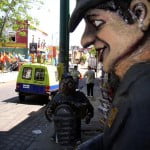
FUTBAL, MATE’ Y TANGO
Arriving in Buenos Aires, burned-out after 14 hours at the mercy of the airlines, it would only follow that the first cabby I meet would be an enthusiastic and accomplished conversationalist, chatty but likable.

Relaxing South American rhythms at Plaza Dorrego in San Telmo
“You live in Western Colorado, heh? Do you know any Apaches?” he asked.
“Not too many,” I answered. “I’m bigger with the Utes and Navajo.”
“I like Apaches better. I like their war paint,” he said while he jutted in and out of traffic pointing out landmarks and beautiful women.
“What do you do for work?” he asked.
“I write,” I answered keeping it simple.
“How many books have you written?” he pursued, narrowly dodging an merging horse and wagon.
“Well…none up till now,” I said sheepishly.
At that point he took his eyes off the road for a moment and just looked at me like I had just arrived from Mars.
“A bad writer,” I continued.
He laughed and said he thought not.
Bario San Telmo and Chacabuco Street appeared as a Madonna song blasted on the radio. She once played Eva Peron in “Don’t Cry for Me Argentina”. Many of the people here are still in shock. Some are still offended. I wonder if they’ll ever forgive our indiscretions.
“Here is your bohemian paradise,” continued the cab driver. “Be careful of the local grappa, dog poop on the street and inexperienced taxi drivers from the provinces who don’t know their way around the city.”

Crazy and colorful Caminito neighborhood in La Boca
After meeting my gracious hosts Andrea and Damien proprietors of Mi Casa en San Telmo, I go out for a walk. It’s been a year since I relied on my Spanish and searching for a bakery I got a little confused and mistakenly asked a passerby (in perfect Spanish, mind you) “May I borrow your toothbrush?” He stared and walked on. It will get better when I get some sleep.
Quickly noticing that the space between a raging collectivo bus and the sidewalk is proportionally the same as the space between my ears I tread carefully and begin digesting what I can of this lovely city of 13.5 million European souls.
At one point I give a cigar to a man who said he was running late for a doctor’s appointment. In a garage/concert hall an orchestra plays Glen Miller’s In the Mood. Down on Piedras I discover a charming tavern and buying a copy of La Nation, sit down for a glass of Cabernet Sauvignon.
Says here under obituaries that one Javier Marcue, of a well-to-do Palermo family is getting buried today. According to the report Marcue stepped off the curb without looking and was “run over by a cement truck on its way to Bario Barracas, leaving only bits of hair and part of his left ear on the pavement.” According to companions, now in mourning, his last words were: “Let’s just see if any of these wild portenos will stop for me while I’m straddling the crosswalk.”
Well written, albeit morbid, story. Here’s a piece on the Boca Juniors, the mega-popular football team from Boca that plays before some 85,000 rapid Argentine fans every Sunday. Here are some listings for dinner and tango lessons and expensive package trips to Punta del Este for Easter. I realize I don’t have the right shoes for such extravagant outings and turn the page.
Returning to my pension and a short siesta an evening at the theater emerges. Since it’s Tuesday night only about 30 of the city’s 50 productions are on. Should I see The Charge of the Camarones Ajo or settle for a twin bill of Rosita de La Plata followed by M’ Hijo el Doctor? Maybe they’ll all feature a cameo or two by Pepino, the traditional character that made his way over here from Southern Italy in 1890.
Later, back at Mi Casa the first chivitos come off the grill at about midnight and the guests and innkeepers eat and talk till all hours. To the proud residents of this splendid city it is clear that Buenos Aires is the center of all civilization, indeed…the entire Universe. Anyone who cannot see this is written off, politely with a frown, as a poor, ignorant barbarian.
I fall asleep remembering a conversation about gauchos who, add sugar to their mate’ thermos water when no one is looking, so as not to surrender their machismo in the face of mere mortals.
***
Crossing the river in the early evening the ferry pulls up at the lovely town of Colonia, Uruguay. What a great place to write dirty poems and meaningless dialogue in cafes and watch the procession of the Southern Cross. Taking to the side streets I find that everything looks about normal – kids at cyber cafes, beautiful grandmas and grandpas who look like they’ve lived here for 200 years, motorcycles for rent, big dogs kickin’ little dogs’ arses. Tethered horses watching.
I find a wobbly table and sit down to a meal of corvina, tomatoes, olives and beer. All the tables here are wobbly since it was against the law to have balanced tables during the U.S. supported dictatorship. Back during those dark years of the late Seventies and early Eighties the government here, as well as in Argentina, went about murdering countless innocent citizens accused of harboring leftist ideologies. The whole shooting match was sponsored by the protectors of democracy over at the CIA. I met one sweet lady whose mother spent 8 years in prison, not because she was a felon but rather because she was a Social Democrat. Everybody knows commies don’t mix with nice furniture, especially stable tables.
In Colonia, which was originally a haven for Portuguese smugglers and now is a UNESCO world heritage site, my hotel is in an agreeable neighborhood lined with Sycamore trees. Checking in to the Hostal de los Poetas am taken by the proprietor, Beatrice, an olive-skinned, dark-eyed beauty who gives me my room keys with a large, noisy bell on the end.
“Do you think I am a cat?” I ask her in Spanish. “Are you afraid I will prowl for birds?”
She laughs and says I look dangerous.
“Do you speak English?” she asks in Spanish.
“Not very well,” I answer.
“But you are a Norte,” she jousts.
“But not one of the brighter ones,” I respond.
“But one of the more handsome ones,” she smiles a pretty lie.
He: “Will you have a glass of wine with me.”
She: “Maybe, but I must work until nine.”
He: “The length of a lifetime for me.”
She: “Are you asking me for a date?”
He: “My Spanish is worse than my English.
She: “I accept.”
He: “Dios mio…I am a happy man.”
She: Meet my outside at nine.
He: You betcha!
She: You betcha?
He: I would walk through fire to meet you at nine.
She: And hungry alligators?
He: And hungry alligators.
Bella. Lovely people these Uruguayans, so gloriously human, so civilized. An accomplished musician, my companion filled me in on her country’s music scene. Jorge Drexler, Jamie Roos, Ruben Rada and the Argentinean great Teresa Parodi are her favorites. Overhearing our conversation the waiter suggested we might like to hear his favorite tango by Carlos Gardel. He would play it just as soon as he runs off some local ragamuffins attempting to charm a few pesos from his assembled diners.
After three days taking pictures, hitting tennis balls and sampling wine in Colonia I bought a bus ticket for Montevideo. But what have I learned?
First, like a desperate little man selling ice in the noonday sun, Colonia’s mellow days may be numbered. Already on the horizon are golf courses and trays of little sandwiches for the rich. They’re even talking about building a suspension bridge from Argentina.
Secondly, in my own defense, I have learned the proper response to “What do you do for work?” Now, when asked, I tell my grand inquisitor that I work in the security sector as a traveling fly killer for a chain of Nicaraguan truck stops and that we are considering an expansion into Uruguay and Brazil. That direct, if lengthy, response always sets them back for a while. If it fails to do the trick I simply tell them I’m Willie Nelson and they are far too polite to ask “Who’s he?”
***
When bad vegetarians die and go to hell they make a stopover in Montevideo. The city is teeming with meat. Parillas, pizza parlors and cafes featuring steaks, ribs, Milanesas, chorizos, and empanadas of every kind are everywhere. Besides this carnivorous fare one can enjoy paella, lots of fish and mariscos till the cows come home. The breads are exceptional, the tomatoes delicious and the ice cream is arguably the best in the world. This is the spot for the best dulce de leche and the fruits and vegetables are seducing the senses on every corner.

Tranquil Punta del Diablo on the Uruguayan coast near Brazil
One early morning I could swear I saw the words mas comidas? scratched subliminally across the bright amethyst sky.
After the bustle of Buenos Aires, Montevideo is a small town of 1.5 million…kind of like the Gypsy Kings on Tulsa Time. Nothing (much) opens until 10 am and, after a serious afternoon siesta, reopens until about eleven. I wander down Avenida 18 de Julio, the main artery, I am all but trampled by a ragged, aging woman set on retrieving an aluminum can from the sidewalk. After she grabs the can she looks up and says, “Where are you from?”
I answer “Los Estados Unidos” and she stares. “Do you live near Graceland?”
“No. I live in Colorado.”
“Is that near Graceland?”
No, senora, it’s in the mountains. Graceland is in Tennessee.”
“Is your house near Graceland?”
“No ma’am. That’s a long way away…
“I want to go to Graceland,” she says and scurries away searching for more recyclables.
“Hell, maybe I do live near Graceland,” I say to myself.
My appetite encouraged by the stirring exchange, I sit myself down at an outdoor cafe near Plaza Independencia and order a glass of Sauvignon Blanc. A little girl stops at my table selling air fresheners.
“Le gusta strawberry, limon or tuti-fruiti?” she smiles.
“I choose the strawberry,” I say as the waiter approaches to take my order. I’ve always wanted my very own cassette of Uruguayan air freshener and now I have one. She takes the pesos, smiles again, and is off to hustle a tiny little grandmother sitting under her umbrella reading a copy of El Pais, the headline announcing James Brown’s (Senor Dinamito himself!) concert over the weekend. Commerce completed, I order a light lunch of calamari, salmon, tomatoes, roasted eggplant, bread and more wine.
When I’m done I walk at least a mile to Cuidad Vieja, El Mercado del Puerto and El Pero Que Fuma Bar, down on the riverfront. Why are all the good taverns always in the bad neighborhoods? Here at The Dog That Smokes there are more people behind the bar than in front of it and two Eastern European sailors are engaged in a heated video game much to the displeasure of the other customers.
“Buenas tardes…Como lo acaba?” (How’s it running?) asked a man from one of the tables. He proceeds to sit down at the bar and give me a running history of The Dog That Smokes, Murga music, futbal, women, world politics, gauchos, the city of Montevideo, the skies and the outer atmosphere. He’s a retired sailor who has been all over the world. I tell him I only understand parts of what he is saying. He smiles, raises his arms and his eyebrows in a questioning gesture and rattles on.
“Did you hear that the Pope has died?” he asks. Before I can answer he jokes that mathematically it is more likely for a Pope to die while I’m in town than for it to snow. Then he reminds me that it is proper etiquette to flirt with every woman I meet whether she is eight or eighty. “If you are a gentleman”…he adds.
Meanwhile over in Bario Nuevo Paris another toothless dog barks menacingly protecting a dirt street from dust, or perhaps another dog. Horse carts clop down the street. My friends are preparing for a Sunday asado where we will make music all afternoon long and into the evening. The best people in the world live in Nuevo Paris. I check my sport coat and flip-flops and prepare to throw the fat onto the fire, as they say.
***
Me gusto algunos ruidos:
El ruido de ninos
El ruido de amantes
El ruido de mi companero viajero
la luna del oro
cuando ella es llena.
To a practicing pagan it seemed fitting to spend Semana Santa at Punta del Diablo. “Hola!” said a young boy as I departed the bus, grabbing for my backpack. “Welcome to my town.” The young man named Hector helped me find a cabin and when I offered to pay him for his trouble he refused the money saying his mother would not be happy if he hustled tourists. His little sister was selling shells so I bought three instead.
There are no few Nortes here. You’re on your own. No past baggage leftover from five-star heroes or cruise boat power shoppers. And the beaches remind one of the Outer Banks of North Carolina. Waves crashing on ancient boulders and novice sand. Sun bathers returning to their hammocks looking like swollen marshmallows thrown into hot oil. Hippie stalls selling everything from leather bracelets to linguini noodles.
The cabin next to mine has a sign on the door that says “therapy”. The other neighbors are two charming ladies who drink all my beer but cook me corn omelets for breakfast. Tonight it’s samba and tomorrow futbal: Uruguay vs Brazil.
I wake up on my last morning here to the sound of thunder and the crash of lightning. Soon I discover that all the neighborhood cats and dogs are hiding from the storm in my cabin, some under the bed, others in the bathroom. One cat is on my lap trembling every time the thunder rolls. She looks at me with that pathetic what’s for lunch? expression. Maybe I should shut the door or maybe not. I’ll make that decision by early afternoon or evening.
– Kevin Haley
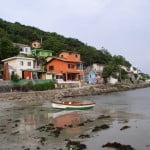
Beached at Pantano du Sul
At dawn the big, yellow double-decker wound and burrowed its groggy way from the Pampas of Uruguay to the dark green coastal mountains of southern Brazil. Passing palms and paineira trees recharged its droopy-eyed cargo, suddenly mesmerized by the brilliant morning sun. By mid-morning the blue lapping Atlantic, having given up Spanish, is now speaking Portuguese.

The pristine Solidao Beach, a short hike from town
Only two more bus rides from the city of Florianopolis, clammily clogged in the traffic of a slow summer samba, and finally a siesta on the beach in Pantano del Sul, a pretty fishing town on the southern tip of Isla Santa Catarina. Running fifty miles north to south this diverse island, about six hours south of Sao Paulo, is comprised of sub-tropical Atlantic forests, 42 distinct beaches, countless waterfalls and lagoons. The island gets crowded in January but tranquil Pantano makes a particularly good place to immerse with the gulls and the iguanas. Its’ ramshackle restaurant row, brightly painted houses and colorful fishing boats pop out like foam from a sweet yet salty dream.
The residents, originally from the Azores, settled the three-street village in the 1870s. Most can’t make a lot of sense of the tourists that started coming here only in recent years. Mandatory gear: flip-flops, a beach chair and a swim suit…the summer masquerade from December to April…hiking boots, sun screen, rain gear and a hat for the nearby mountains. A few obrigados (thank yous) mixed in with an occasional Tudo bem? (How are things?), a little respect and a big smile easily uncork the natural friendliness of the natives.
Remembering the initial efforts to preserve the jungles and beaches that surround the town, one resident told me that the local populace was at first cold to the greening of the south end of the island until they realized that the environment-friendly designation, established in 2000, not only slowed the mindless march of progress but it brought needed dollars into the economy.
“It kept their lives on the slow cycle. Fish are not a solid commodity,” laughed Nana, who has lived here since 1993. “Some years the local catch all but disappears, but tourists looking for the natural experience can be counted on more and more to drop a few reals in town, at least in the six-month summer.”
Originally from Puerto Alegre, some 400 kilometers south, she told me that the best time to visit the island was either October or April when the summer people thinned and the place was super serene.
“It’s not the tropics, but the summer stays around well into June when things cool off substantially in Uruguay and Argentina,” she said from the deck of her striking wood frame house blessed with a commanding view of the bay.

Pantano du Sul, at the southern tip of Isla Santa Catarina
Then it’s just you and a few fishermen. Peace is a tranquil morning hiking to Praia Solidao (Solitude Beach) or a stroll through the figueira or sinamomo trees to rocky points that stretched out into the open Atlantic like abyssal fingers on the steady hand of a sharp-eyed sea dog.
Down on the water there are no high rise hotels like up north at Praia Dos Ingleses or Rio Vermelho where noisy, perfumed Argentine visitors rev their engines and turn up the bass. Instead of most of the local families gather in the middle of town on the church steps at dark.
Gossip runs from fishing to family matters usually covering Carnival and futbal, which are hot topics the year round. First its the older folk watching the world creep by, then later in the evening it’s the teenagers flirting within the ancient, often awkward, ritual of boy meets girl. All are simply engaging in soaldades(feeling souls touch) while small seafood restaurants serve up Tainha, Amehouges and Espada along with tender Calamari. If one has a craving for shrimp it is the local custom to order the crustaceans by the name Lula (referring to Lula de Silva, the popular President of Brazil).
At the Arante Bar, just feet from the sea, I sit sipping caipirinhas(little peasant girls), made from aguardente (cane liquor) fresh limes, sugar and lots of ice. At our large table in the window sit an international contingent: a technical writer from Paris, two pro futbal/soccer players from Moldavia, a local theater director, a teacher from Florianopolis, a local hotel owner and an Austrian accordion player. The hot sun and the cold drinks cut through the language barrier as naturally as crabs and sandpipers whispering to the patient surf. Most of these folks speak at least five languages and tolerate my castillano and gringo Portuguese.
Many of the residents live in houses perched on cliffs above the sea accessed by steep, narrow paths that wind through the jungle, challenging by day, treacherous by night. It is humid, the samba hangs in the branches of the trees. The air is sweet, the moon is full. After negotiating the knotty, breakneck footway in sloppy sandals I finally make it back to town and my breezy bungalow. It’s 3:30 am and the crowded cafes are still inviting but tomorrow’s plan for an early morning hike dictates restraint.
Eight well-marked trailheads of various length and difficulty promise to deposit the explorer on a stunning beach or deliver the surfer to crashing waves just a few short miles from town. The trails are better in the morning before the rain. Necessary companions include a bottle of water and this morning’s sand in one’s ears under the jungle canopy.
One can hike to Naufragados (the Shipwrecked) along the beach for about a hot four hours or take a local bus to a trailhead and climb over the mountain (3.5 kilometers) descending on a piece of sandy paradise complete with two restaurants and a small hotel. There were never more than 20 people on the beach during each of my three jaunts to that magic beach. The soft early morning here is nothing short of magnificent, unless one compares it to the shady afternoons or perhaps the blazing sunset. The fish is delicious and the beer is ice-cold.
Another trail directly from Patano lifts hikers along cobblestone hills into the jungle via a small mountain pass to Lagoinha do Este. This pristine beach which takes on the full force of the Atlantic face to face. It features incredible vistas, seasonal waterfalls and a giant fresh-water lagoon perfect for a swim after the sweltering ramble through the forests.
– Kevin Haley

Who are these Gauchos?
While the real cowboy in Western Colorado is diminishing, his South American cousin the Gaucho is going strong. Here we see our norte traditions falter with the emergence of gentlemen ranchers, drug store cowpunchers and urban refugees riding the range. On the fertile pampas it’s still all spurs and saddles, cows and campfires.

Rodeo in Montevideo, Uruguay, 2012
My friend Sergio runs a 2000-acre estancia that is primarily a cattle operation, but caters to tourists from all over the world during the summer months. He cuts quite a pose when he comes into Punta del Diablo for some Friday night beer drinking. Sergio is no slouch in the fashion department. He’s dressed in a crisp, long-sleeve white shirt, riding breeches tucked into his high boots, black beret, his bola hanging and a tarantula mustache waxed “especially for the ladies”. He’s thirsty after a week on the pampas and despite his ultra-carnivorous diet on the range, you can bet he’ll be looking for a steak before the night is over.
“If a Gaucho doesn’t get at least one steak a day he loses his magical powers,” he laughs, “and he has to take up fishing,” he cracks, loud enough for the adjoining table full of pescadores (commercial fishermen) to hear him. “If things really get bad he might even have to look into newspaper work,” he smiles at me, making sure he insults everyone in earshot equally.
Actually the perennial gentleman, he is also my impeccable source on the Gaucho culture, since his family goes back generations in these rolling grasslands near the sea. His great grandfather was even a payador (a wandering minstrel) when he wasn’t trading in contraband or herding cows. Often quiet and observant, my friend cannot shut up when the subject of the Gauchos is on the table.
Today Sergio is traveling in the company of some rough looking hombres that he says are his primos from over in Brasil. They quickly warm to the idea of this gringo writing about their culture. Beers and women are given no quarter as our table gets louder and louder but, since Walter, the bar owner, is drinking with us, nobody can do much about the decibel levels. Soon the singing starts and serenades the dirt-street town and the moonlight sparkling on the Atlantic, just a stroll from our perch. Then, as if on cue, my equally rowdy neighbor, now Uruguayan resident from Western Ireland, shows up and there’s more singing and toasts.
The first trace of the Gaucho in Uruguay was as early as 1600 when they were seen by polite Argentine society as ruffians. The word gaucho was not complimentary yet these cowpunchers were not to be denied. When the flatlands began to be overpopulated with Cimarron cattle, brought from Spain by Pedro de Mendoza, the gauchos began their coming out party. They quickly became an integral part of the global leather industry which was floating the boats of many in southern South America in those days..
“They didn’t even like the way we cooked and ate beef,” said Sergio, “and now the population embraces the asado as part of everyday life. Strangely it was the influx of immigrants from Europe and not the caudillos (the New World born Spanish) that embraced the romance inherent to the gaucho way of life in the early 18th Century. My family most likely came from the Basque country by way of the Canary Islands long before that,” he explained, “but we’re pretty sure we got mixed up with the Guarani (the prevalent indigenous tribe in southern Brasil) and probably the Charrua (a fierce now extinct group that inhabited Uruguay when the Spanish first arrived). The origins are not clear since our history was primarily verbal and everyone was to busy trying to survive to keep score.”
Most of the gauchos from these pampas could easily pass for a Basque herdsman in Colorado.
“We’re not too tall but we pack a punch,” he laughed. “When I was in Spain I was mistaken for Basque at every turn which usually worked out well. A lot of the people I met on the Iberian Peninsula thought the Gauchos had all but disappeared. I was there to set them straight. We’re here and we’re healthy!
“We’re still not much different than the undomesticated cattle that escaped from the Spanish in the 15th Century. We don’t live in town or on the farm. We have a strong identity and strict code of conduct. We like to play cards, drink mate and fight.
Does that sound like someone you know in Colorado? All we have to do is substitute a little camp coffee for the mate and we got a Rocky Mountain cowboy, chaps, Stetson and dead to rights.
– Manuel Flushe


