 Author Archive for M. Toole

Some small towns in Colombia
Having traveled all over the continent of South America for the past ten years I had yet to set foot in Colombia. All the bad press, the drug cartels, the war may have made it easier to spend an extra month in Ecuador or more time on the beach in Bahia..
“Anytime someone in your country snorts cocaine he is making it that much more difficult for a Colombian peasant to keep his land,” said my friend Andres, a museum curator in Antioquia. “If the land supports a coca crop it is now valuable. At first the farmer sees what the coca will bring compared to corn or beans. The money is better and the work less demanding. If he now grows coca to survive he is subject to soldiers, police, guerrillas, and militants of all types who will sooner of latter, one way or the other displace him. He ends up in the ring of poverty that surrounds Bogota, Medellin or Cali. Cocaine, like coffee, is grown for export. Drink the coffee.”

Guatape in the early morning
In six weeks traveling around Colombia I never saw cocaine (and I stay out late for an old guy) which tends to make me wonder if the consumption problem is on the streets of the Bronx and not Bogota. Simple: If there was no demand in the U.S. there would be little cocaine processed in Colombia and life might return back to normal for millions of campesinos attempting to eek out an existence on their farms. Those who suffer the cold-blooded brutality of it all are the poor, who are once again the rooted pawns of mobile violence.
The United States pays Colombia to eradicate coca instead of facing up to fixing the dysfunctional/drug craving society we have created up Nawth. Nice work with your War on Drugs, Uncle Sam.
I guess I was just saving Colombia for last.
After a few days roaming around the streets of La Candalaria in Bogota (pop. 8,000,000) I flew to Cartagena (pretty big too) on the Caribbean Coast, hot as a branding iron to this mountain dweller. Despite its worldly reputation as a historically significant locale, Cartagena is a crowded, ignorant, contrived city with some old Spanish walls around part of it. The cops are crooked, the traffic mindless, and the beaches dirty. Sometimes it was difficult to separate the business owners from the prostitutes that roamed the streets just after dusk.
And then there are the wham-bam cruise lines denizened by sun-burned gobblers bulging in the pocketbooks about to depart for this must see Disneyland of hawkers and assorted criminals. It’s surprising that they don’t all get robbed! Piggies to market. I would prefer spending the weekend in Fresno or Gillette.
Is Cartagena safe? Sure if you are in an expensive tourist compound with guards and a fortified gate. As a good friend put it, “Here if I have to get up in the middle of the night in my hotel in to pee I take a taxi to the bathroom.” Ah, the benefits of a cheap taxi as compared to a stroll after dark in most sections of Cartagena.
But a church bell Sunday morning arose and with it a bus for Santa Marta, the oldest surviving city in South America, five hours to the east and north.

Sunday in Jardin
Upon arrival it became clear that this was not Cartagena. The people were different. They are slower moving and friendly. It’s smaller and surrounded by world-class beaches albeit with world-class mosquitos. The city is emerging with great restaurants, pleasant plazas and is projecting a stronger African culture.
Our hotel sat adjacent to two baraca bars that blasted Carranga and Vallenato mixed with Cumbia and Tango (Carlos Gardel “El Zorzal” died in a plane crash in Medellin in 1935) from morning until late at night. The municipal cemetery, often the laughable source of grandpa directions with cab drivers, provided green space but little relief from the pounding heat. Simon Bolivar died here in Santa Marta in 1830 and although I have yet to find his headstone I ran across some rum-soaked pirates who insisted they had known him. Several graves in this boneyard date back to 1527 and 1530.
One soon realizes that Santa Marta is real nice. Just look around at all the bakeries and coffee houses. A great hotel near the nightlife is Hotel Aluna, run by two brothers from Dublin. Another is the Hotel San Miguel Imperial which is front row (with cemetery view from the roof) for the beer-driven shenanigans of the neighborhood. My old bud from high school and I regularly sampled famous Santa Marta product while listening to Boyaca’ tunes from that very roof after the bars closed.
On the perfectly located pedestrian mall just south of Parque de los Novios (Boyfriend’s Park) are El Bistro which serves an incredible filet mignon for about $12, Bonnie and Clyde Bar (Ask for Juanita and Charley…poor lad’s a Cubs’ fan), La Muzzeria, to the east in skinny restaurant alley, a well anointed Galician pizzeria with a splendid selection of music on its big screen. Beers will run you about $2 in the nicer spots. So take out a loan…
But it is hot and the mountains are cooler
One morning I jumped into a tightly packed collectivo (Get to know your fellow man) and headed up into the Sierra Nevada de Santa Marta, the largest coastal range in the world with Pico Colon and Pico Bolivar cresting out at 18,000 feet. Both peaks are crowned in year-round snow but almost impossible to view (so how do they know they are really there?) due to the extremes in weather and elevation. There are few real roads, but a number of tour company treks, beyond Minca into these rugged mountains, which are inhabited by other world Wayuu, Kogi, Arhucho people, who have been paying attention and do not welcome visitors.
Then they drop you in downtown Minca. It’s still tropical but it is surrounded by high mountains. It takes about 20 minutes to explore the main street. There are lots of great places to sit down and watch everything. My hotel costs $12. All the beer is cold. This is going to be fine.
There I met John Lundin, who wrote The New Mandala with and the Dali Lama, is doing a new book called Journey to the Heart of the World which talks about these local indigenous people and their threatened way of life.
Minca is a coffee-growing region with smart people, refreshing waterfalls, exceptional restaurants and a year-round climate somewhat cooler than Santa Marta. According to my host there is a strong Dominican influence here since people from that island arrived in the early 1900s to work in the coffee industry. Hikes to Cascada Mirinca and Pozo Azul are steep but not too taxing, especially with cool pools at the end of the trail. Coffee farms dot the landscape and sell organic roasts, bottled water and kickshaw to passersby. Did I mention the zancudos? The no-see-ems that are a little rough at first. The locals use citronella in one form or the other and it works after a minor baptism of fire the first afternoon.
For nothing fancy, low priced digs I recommend Hospedaje Villa Silva ($12) right in the middle of town. Patio, hammocks, great hosts, and clean. (OK, so if you moved the bed and dresser out the door you could easily hose the place out). For a more uptown stay try the Hotel Minca which is rather incredible if you like to watch birds.* The patio alone is worth the room tariff which is around $50 per couple but they are talking about raising the prices to $60 for two. In Colorado or Northern New Mexico one would pay $250 for a similar stay.
Several excellent restaurants include Restaurante La Cocina D’Rochi, Cafe Sierra and Pizzas Chiqui across from Villa Silva. The original house where D’Rochi now stands was accidentally burned down by FARC guerrillas who attacked the regional police station in 1995. (Bad maps?) It has been rebuilt and the river views are incredible. Warning: Buy your take out beer early since a lot of the tiendas close around 7 and you certainly don’t want to be like a howler monkey fresh out of mango trees.
Primavera in Cherry Creek
The airport at Medellin is way the hell up there and the ride to Poblado, a suburb on the east side of the city, takes almost an hour. Hills and big houses make up this neighborhood that could easily be dropped into Miami or even Denver. It’s got a bad mix of wealthy gringos (who don’t seem to bother to learn Spanish) and rich Colombians who only talk to God and their broker. But there is relief. After a mandatory afternoon sentence in El Centro (Medellin’s Tijuana) one can take the bus to the pleasant towns of Envigado and Sabateta.
Gritty Envigado is the real deal. Cocaine kingpin, Pablo Escobar lived in the hills above town. Restaurants on the plaza offer trucha (fresh trout) and regional dishes. David Mullings, from Elk Meadows, and I wandered into El Fogato together but after an hour had plenty of company at the table. Even the guy selling watches offered to buy us a beer. Our waiter, now off for a few hours hung out and we told him about life in Western Colorado. Then we went to Sabaneta for cocktail hour.
The plaza in Sabaneta is a spectacle to behold. Anything any Norte loves about Latin America is right there. Grandmas with granddaughters walking them about, kids with balloons, young lovers, rain, dogs, food stalls, loud music, “Where journalists are honored and clowns revered.” These are the Paisas (residents of Antioquia) that I have been hearing about. We buy a small bottle of rum and the liquor store owner insists we sit in his chairs out front. I give a kid a Kennedy half dollar coin and his grandmother kisses me on the cheek.
But like everywhere in Colombia don’t step into the street without looking. There are speed bumps all over and at least three cemeteries in town according to our chair benefactor.
Three hours by bus from Medellin is Guatape (Wa-ta-pay). Pleasant gentle country awaits the visitor on the ride into the mountains. A bit cookie cutter but the tourists from Medellin flock there on weekends. Part of the town sits on a reservoir which was quite dry in March while the main plaza is a few blocks up featuring the typical arrangement of hotels, restaurants, bars, bakeries and an enormous Catholic church in the middle of it all. Try Salon Kennedy, a nice bar named for John F. Kennedy, in the shadow of the steeples.
A Typical Antioquia breakfast (desayuno tipico): Hot chocolate, cheese, arepa (corn pancake grilled on coals), scrambled eggs with ham and tomato, fresh avocado slice, juice of the day and coffee cost about $3.00
The waiter at breakfast called me “Patron”, a subtle reminder that this part of Colombia remains refreshingly primitive and extremely Spanish.
Andalusian hooves on cobblestone
Heading south and west of Medellin into more green mountains one arrives at Jardin, where poets are held in higher regard than bankers, and horses are more important than cars. A small town by Colombian standards, Jardin sits at about 6000 feet with 3,000 population and the aroma of coffee everywhere. This is the prize I have been searching for—the true heart of Colombia.
The town of Jardin surrounds a beautiful plaza peppered higgledy-piggledy with hotels, restaurants and bars. The neighborhoods spurting in all directions are full of flowers and brightly painted abodes. The people here may well have invented friendly. The classical music resounding throughout the plaza on Sunday morning is magnificent and so very civilized.
On Sunday Andalusia horses and vaqueros make the plaza their own. I watch with my coffee as a three-year-old girl rides about under watchful eyes of father and grandfather who carefully choreograph the scene.
And for Sunday lunch try La Posada upstairs, the best of the hordes of tempting restaurants in all directions from the plaza. Distinct Colombian kitchens boom where heavy-handed health inspectors are replaced by family pride. (Only got sick once and that was from the American Airlines “food” on the return flight.)
Besides the quality of life, Jardin is a screaming deal. A lovely apartment at the Hotel Jardin costs 50,000 COP (about $28) per night while a bright room with balcony at Hotel Balcones del Parque runs 25,000 COP ($14). This part of Antioquia is not on the Gringo Trail, at least as of April.

Papi y hijo operation in Salento
After a week I was still not ready to leave but time was running short. A bus to Armenia (5 hours) and a shuttle up the mountain to Salento (7000 feet) was next. Another little paradise, this exquisite Quindio town features eternal spring, no bugs, green hills and a great downtown which wraps around the plaza. Coffee farmers hang out in the morning at various locales and are much more interesting to talk to than the tourists who fill the place on weekends. The town is full of characters and tolerance but bring pesos as both banks are not particularly accommodating and basically oblivious to travelers.
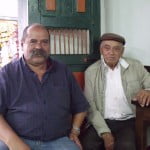
This is the place to eat Bandejas Paisas (the local favorite) and wash it down with a Costena Beer. Listen to the Cumbia, the Salsa and the Tango all mixed up at Bar Danubio, where Toole fell off his stool (damn the metric system). This pool hall/bar has been run by the Foaiza-Tabares family for 60 years and is now operated by son Jairo (see photo) who has the third largest mustache in Colombia and parts of northern Ecuador. His dad. Ernesto, 91, stops in several times a day to make sure things are running smoothly.
A shoeshine man with severely deformed feet – the height of irony – sells me on a shine for 75 cents and I throw in a cup of coffee as a tip. My Colombian friends tell me I’ve paid too much.
Up country from Salento is the town of Cocora at the mouth of the jaw dropping (and I live in the San Juans) Valle de Cocora. I won’t attempt to describe it in words. It was far too rainy to take a good photo. A jeep will take you there for $2 and you might never want to return.
My hotel was Los Geranios 20,000 cop. Family-run with a beautiful garden, 4 blocks from center. Salento is a gem but you need to speak Spanish to interact with the populace and fully enjoy the ongoing fiesta that is life in these hills.

Above Salento…green mountains and tranquility
Chocolate rivers in coffee lands.
Hanging wax palms on the hills,
and minty mountains.
Little red and white cottages pop
the landscape in jungles vibrant.
Machete mustached men
stretch their legs in the morning sun,
the bright star paying its daily visit
to this green, magic land.
– Kevin Haley
*as truth would have it Minca is ranked among the top five places to bird watch on the planet. Everyone has bird guide books and mobs of experts roam those hills in the dry season. Again, it makes sense to me that Colombians enjoy a kinship with birds. They too make lots of noise.
You Animal You
by Dr Ard Bark, DVM
Rover and Kitty Need a Break, Too
Many fellow travelers ask: “Dr. Ard, why do you insist on bringing three dogs and a cat on your vacation?” My eternal response remains: “Rover and Kitty need a vacation too!”
Pets need to see the world. Some have even become fond of the tiny cages that are their temporary abode on continental or oceanic flights. These are inconveniences to which the well-adapted toy poodle or ever Great Dane can adjust.
Why do our four-legged buddies need to travel? Often it is simply to break the monotonous routine of knocking over garbage cans or chasing rodents. These repetitive chores cause dangerous stress. Most of us, who are still around, have learned to deal with stress. We relax. We escape. We vacation…often while poor Rover and Kitty are left at home with the neighbor in the same drab surroundings. Don’t they deserve a better lot in life?
Do you think it’s easy to bark all night or sleep in the sun all day? Well, try it sometime.
Next time think before you act. Include your pet in your vacation plans. The result will be a more relaxed, directed animal.
Next month we’ll talk about “favorite four-legged vacation spots” in North America.
Oh, yes, and before I forget: If you’ve never contracted Manchurian Bubonic Plague, DON’T PLAY WITH THE LOCAL MARMOTS THIS YEAR. Pitifully, those cute, cuddly whistle pigs, as they are called in Manchuria, who come right up to your car to feed, are carriers of the dreaded disease. Luckily it is all they have to carry as they maneuver even higher across the rough San Juan terrain.
The affliction begins with paralysis and swelling of the legs, motion sickness, galloping consumption, and inevitable insanity.
If you, or one of your family members, exhibit these symptoms see a doctor immediately, if you can find one, what with the exorbitant malpractice insurance premiums and all.
See you next month
Remember: Dogs and cats need sunglasses too.
Utopia Mart Opening Saturday
(Montrose) A retail outlet promising eternal bliss is slated to open its doors this weekend. Offering consumers everything from dill pickles to breathing machines, Utopia Mart expects to control the consumer tide in just about a month.
“They even have people that will chew your food for you,” said one mad consumer who was camped out in the parking lot. “Wanna have a baby or fly to the moon?”
“Everything you could ever need to live a full life,” said another shopper, “and the pharmacy is nothing short of uplifting.
TWO UTES FISHING
It was one of those classic Rocky Mountain mornings in the early 1700s. It was a time that would be captured on some future picture post card that would be mailed back East or to Europe summoning the hordes, luring the White man West, defining someone’s concept of civilization. It was one of those cool, crisp spring mornings where fish leaped skyward and the forests teemed with game. It was quiet.
Two Ute braves, Crooked Sky and Spread Eagle sat contentedly at the confluence of the mighty Yampa River and its overachiever cousin, Mad Creek. They were weighed down with nets, bait and long poles fashioned from the limbs of a less than enthused quakie which had the unfortunate luck to be rooted on a nearby bank. The two had graduated to a higher level of fish harvesting than that practiced by their brother the Grizzly. They watch patiently as hundreds of rainbow trout engage in a feeding frenzy oblivious to the uninvited dinner guests who stalk them on such a fine day.
“There, the big ones hang back by the bank hoping to elude our line, my friend,” started Crooked Sky. “Caste out farther and you will distract them with one of these tasty grasshoppers.”
“They are far too well fed to be snapped up,” said Spread Eagle. “Better the elk munch on the grass beneath my lodge or drink the water hauled by my wives.”
Both braves sit quite still, staring into the water. If the fish do not bite this morning there is always tomorrow. Many pounds of berries are still stored away and there is enough buffalo jerky to last well into the summer. Crooked Sky and Spread Eagle are simply more interested in trying out their new poles than in catching a fish.
“It was that large nosed Pawnee that showed us how to fashion the pole,” laughed Spread Eagle. “He should finish the job and hook a fish for us at least! I did not like him much and after he had gone I noticed that I was missing a fine arrowhead that I had carried for many weeks.”
“Maybe his magic is only in design,” said Crooked Sky. “He was a strange one, especially considering his stories of the square house builders from across the great water,” frowned Spread Eagle. “He says the white settlers shoot game for sport. He says they crop their hair and wear too many clothes, even in the summer. This can not be true. Why would someone do that?”
“If this is true then they appear to be a very unhappy people,” Spread Eagle mused. “I just hope they stay are content to stay where they are. Our hunting lands have no need of their footprints. These whites, if they really exist, appear to be bad medicine. They have little honor,” he continued, “and are said to cut down the forests, bleed the rivers and trap game for money.”
“I think that Pawnee was pulling our leggins, either that or he’s smoking too much kinick-kinick,” stressed Crooked Sky. “Why would these whites come here? What is here for them? How could they ever get here? The mountains will protect us from these devils just as they have protected us from the Cheyenne and the Comanche.”
“Our Pawnee friend insists black-haired whites in armor have already stirred up trouble throughout the land of the Bannock, the Shoshone and the Navajo,” said Spread Eagle. “It is only a matter of time before they come over these mountains. He says they seek the yellow rock and dig for other treasures. I have seen such rock,” he added. “They also carry idols on crosses and diseases.”
Crooked Sky then smiled and told his friend not to worry.
“I thought we came here to fish,” he said.
********
One hundred years later, lodged in a small clearing in the shadow of Gore Pass are mountain men William Sublette, Jim Bridger, Thomas Fitzpatrick and John Colter. While waiting for the arrival of compatriots in the fur trade Old Bill Williams, Jedediah Smith and Kit Carson, they have become distracted by a large jug of corn whiskey which serves as a spirituous campfire. It is rendezvous time in the Rockies.
“Where the hell are the Utes?” asked Bridger as he spat a wad of chew from somewhere behind his long, shanty beard.
“They don’t like to show up too early,” answered Sublette. “They always get into a fight with the other tribes. Those guys are spooky but they aren’t much at haggling. Last year over on the Green River I traded them three broken down horses for a slew of beaver pelts. Then a few of them got mad and wanted their pelts back,” he said. “I had to whip three of them just to get back to my camp!”
The group looks up to observe the arrival of about twenty Sioux warriors loaded down with an assortment of furs and provisions for at least a month. The contingent carefully picked its way down a steep ledge and meandered into the clearing.
“They’re watching us,” whispered Colter, “out of the corner of their eyes. Indians braves watch that way. They never look straight at anything, be it game, horses or adversaries. That’s the best way to deal with women too,” he laughed.
“Here comes Old Bill and Kit Carson,” said Sublette. “That bastard Carson is all dressed up in his soldier outfit. He thinks he runs these mountains. What a clown.”
“Where is Jedediah?” asks Bridger. “He hasn’t missed a rendezvous in years.”
“I hear he’s having trouble with his Cheyenne squaw,” explains Sublette. “She wants him to give up his wandering and stay closer to home. I think he’s getting old.”
“That’s why I change squaws every year whether I need to or not,” smiled Bridger. “It keeps life more exciting. The last thing I need in the summer is some squaw on my ass. I had this woman in St. Louis who was crazy about me but…”
“We’ve heard it all before, Jim,” sneered Fitzpatrick. “Tell us something new.”
“I’ll tell you something new,” offered Sublette. “When I was in St Joseph last spring I saw at least 20 wagon trains packing up and headed our way. It’s gonna get tougher to stay out of the way of progress,” he added. Maybe in a few years we’ll have to prowl around in Canada.”
“From what I can tell the fur business is just about dead anyway,” said Fitzpatrick. “Silk hats are in vogue now, and the farmers are cutting down the forests and chasing the game north to the Tetons anyway.”
Carson and Williams arrive at the campsite and exchange greetings with their fellow trappers. Williams appears already quite drunk and his mumbling something about city folk. Carson begins a cavalier monologue that describes the situation on the plains.
“On the other side of the Missouri the roads are packed with Conestogas and pilgrims from the east,” he preaches. “Sooner or later they’ll arrive here and ruin it for the rest of us.”
“So what!” mimics Colter. “We’ll all be six foot under by then. The sod busters can have the place if they want it. Just let them try to grow anything worth eating, the fools!”
“You’re all nuts,” says Fitzpatrick waving his arms in rebuttal. “This country is too severe for those pansies. They haven’t got what it takes to survive these winters or get along with the Indians. They’d starve after a month.”
“Don’t be so sure of that, Tom,” says Carson. “You haven’t been back east for a decade. Those folks have their eye on land, my friend, and their greed will not subside until the entire frontier is harnessed and plowed under.”
“Different kind of folks, ain’t they,” quipped Sublette. “Once they find what they think they’re looking for they do everything they can to change it back to what they left behind.”
*******
Three tired coal miners have just completed their respective shifts and are sitting in a small bar on Lincoln Avenue in downtown Steamboat Springs. It is September of 1939 and they are preoccupied with developments in Europe. The Germans have invaded Poland and the Japanese are on the move in the Pacific. The nations of the world are choosing up sides and the much-feared conflict is on. Being of draft age the three are concerned with more than the war’s affect on the price of coal.
“We’ve had it pretty easy here, compared to a lot of those people in Europe,” said one miner, a red-headed man named Jim Noyce, whose uncle was killed at Belleau Wood in 1917. “This valley is strategic only to those who call it home. The rest of the madmen don’t even know we exist.”
“I hear there are about 200 miners moving here as part of mobilization and the war effort,” offered a second man, named Milo Kopcek who voiced concern over relatives still living in Moravia. “I see this war spreading all across the globe. The coal companies have already announced plans to strip mine that country west of Oak Creek and down into Twenty Mile Park. We could be in for the long haul,” he frowned.
“And some of them are even talking about skiing,” said a third miner, a tall, thin Swede who had lost his ranch near Phippsburg during the Great Depression. “Not just skiing to get around, mind you, but skiing for recreation. It’s big in Europe and they say we have much better snow than the Alps.”
“That’s crazy,” said Noyce. “Who in their right mind would travel all the way to this valley to ski down a hill or two? I think these skier types will all be back in Denver by spring. This is a mining town and that’s all it will ever be,” he added. “Take it or leave it but you’ll never change it.”
*********
Brightly clothed figures stack firewood outside an abandoned shack near where Mad Creek meets the Yampa. Although they look ragged they take pride in the fact that they are surviving off the land with an occasional subsidy from a worried parent back east. It looks like snow.
“Steamboat is the ultimate rejection of the urban experience,” said one long-haired boy in his early twenties. “The world won’t find us here. Just look at the shacks, the dirt streets and the cold weather.”
It was 1968 and another war was raging, this time in Southeast Asia. These were the children of the Fifties that had begun to descend on Steamboat Springs, and the Rockies in general. They had arrived with a few belongings crammed into micro buses and Jeeps, a copy of Walden Pound stuck securely in their backpack. They were mesmorized by the mountains and quickly engaged in systematic squatting despite the grumbles of longtime residents who saw them as an annoyance.
“It takes a certain kind of person to live in the mountains,” added a young girl who appeared to be stuck in her teens. “But we must preserve this beautiful place. I’m worried about people coming here and ruining it for those of us that are already here,” she sighed. “When I was in Denver for the Dylan concert last weekend I heard lots of people talking about establishing a large commune up Quarry Mountain.”
“So what,” snapped a beaded, bearded man who looked a lot like John Lennon. “As long as they are hip they should be welcomed. We need people who think like us in this valley if we are to take control of our destiny here,” he explained. “Things must first change in the Rockies before they will change on the rest of the planet.”
“How many more?” asked the first man. “How many more before the place turns into what we left behind?”
“That’s an absurd question,” answered the bearded man. “There’s plenty of room here for everyone if we live right and work together for the common good.”
“Right on!” shouted the teenage girl. “Together we can build a utopia where everyone has enough to eat, enough dope to smoke and a house to live in. Sooner or later even the old timers will come around.”
“The key is to encourage a society right here where greed is given no quarter,” said the first man. “If we are committed we will reap the harvest of peace and harmony for all. It is attainable here, far away from the insanity. Just look at the river. It hasn’t changed since the Indians first fished it for trout,” he stressed. “Our future is only as bright as we want to make it.”
“It is our future,” said the girl. “We can carve a perfect society, like the Indians had, out of the wilderness. Look,” she chirped, “I found an arrowhead!”
*****
Just a stone’s throw away sit the ghosts of Crooked Sky and Spread Eagle. Both just shake their heads.
“These whites are as silly as the first ones who came here centuries ago,” said Crooked Sky. “They still think they are the first to discover this valley and they still think everything is oh so pristine. They will learn like those before them,” he added.
“Hey, I think that young maiden found my arrowhead,” said Spread Eagle. “I lost it fishing right here a long time ago.”
-Kashmir Horseshoe
NBA to adopt power play
(Denver) In an attempt to beef up sagging attendance figures throughout the league the National Basketball Association has decided to adopt a slew of National Hockey League policies that regulate that sport. Included in next season’s amendments to the rule book include the use of a penalty box, an expanded power play, and Intentional Icing.
Since the NHL has locked itself in an partisan struggle over fiscal compensation and salary caps the NBA appeared to be the only game in town for a good portion of the winter.
Soon, for the first time in the league’s history, fans will witness the employment of a penalty box for players called for personal fouls and unsportsmanlike behavior. The detainment boxes will be located under each basket, in full view of the crowd, where infractions will be punished for varying lengths of time according to the seriousness of the offense. Players deemed guilty such no-nos as high-sticking and tripping will do time here while traditional hoop violations such as charging and traveling will go unpunished.
“First and foremost we don’t want to give up expensive seating space along the floor for penalty boxes,” said one NBA official. “These seats constitute a premium experience and we don’t want to rock the boat here in return for punitive considerations. Whether or not players who foul out will have to spend the rest of the game in these boxes has not been determined.”
The official went on to say that the use of fan-induced dunking machines will not be utilized due to considerations regarding crowd control.
“We don’t want the whole thing to turn into some sort of circus,” said the official. “Besides, we need to protect our millionaire athletes from angry fans swept up in the moment.”
The dangerous power play, determined by the number of players on the ice, will take on even greater consequences as four-on-five or even a three-on-five situations evolve on the court. Fears that the move will result in half-court affairs which could slow transitional play were shoved aside in light of potentially high scoring contests.
“We could very well see the return to legal zone defenses and whistles for such petty violations as charging and traveling,” said the source. “The potential for one-sided scoring opportunities might make a player think twice before shoving competitors or throwing an elbow.”
Intentional icing, where a player throws the ball across the half-court for obvious defensive purposes, will result in further restrictions on play. In the early parts of the match it will be dealt with as only a loss of possession while in over-time it will constitute a jump ball (face-off) at the foul-line of the opposing team. This breach of the game’s new precepts could have dire consequences as any ardent fan would soon realize.
Fundamental elements of both games will be included in the rule book as the season progresses, however conflicts resulting from hazy prosecution of goal tending and crease infractions will be up to the discretion of the official on the floor. In addition the custom of wearing helmets and pads will be scrutinized by the league based on the level of violence and the general flow of play.
“Protective equipment could easily become cumbersome during a fast break,” said the official, “but we have to protect our players from serious injury. The floor is hard but so was the ice and at least we’re not stupid enough to cover the playing surface with astroturf.”
GARDENING MAGAZINES CAN LEAD TO DEPRESSION IN HIGH COUNTRY
High Altitude Blues
(Silverton) Reading gardening magazines this time of the year can lead to serious depression according to a local psychologist. People who habitually peruse these glossy periodicals run the risk of embracing serious doldrums after looking at pictures of colorful flowers and green grass, then glancing outside at snow.
“The safest way to handle this potential problem is to wait until about May or even June to examine these magazines,” said Dr. Efram Bigbonne, a local circuit shrink whose practice spans an area from Lizard Head Pass to Maher. “Every year, despite our frank warnings, we treat more and more people for this malady.”
Bigbonne says that the condition often surfaces as early as January, after the first whisp of warm weather descends on the area.
“These spectacular days are nothing but teasers, as most of us know,” he said, “but somehow our subconscious convinces us that winter is over and summer is on the way. This is dangerous ground on which to proceed, even if it’s beginning to thaw out.”
The doctor suggests that gardening enthusiasts pull the drapes and stay inside if they feel compelled to expose themselves to these drastic contrasts. He adds that the practice of sending more chronic cases to the Amazon for a month has worked in the past but that newer, more potent and drug-resistant cases of the blues have began surfacing a few years ago.
“Geographical therapy is less and less effective. This depressed state is not good for other people who have to deal with these victims on a day to day basis either. It affects entire communities. If the truth be known, I prefer that my clients stick to snowmobile and skiing magazines until at least the Fourth of July .”
– Princess Irm Peawitt


