 Author Archive for M. Toole

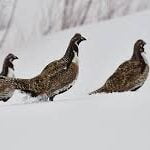
County roads closed to protect endangered grouse
(Gunnison) Many area back roads and even a few highways will be closed this spring to protect the wild habitat of the now famous Gunnison Grouse. Besides all country roads in Gunnison and Hinsdale Counties authorities have closed State Highway 50 from midnight until noon to allow the grouse to mate without interruption.
Highway 135 will be shutdown the day after Easter until July 4 unless the birds themselves complain.
While no one on either side of the controversial closings has ever actually talked to a grouse many have strong opinions. Apparently so do many grouse.
One Ohio City man says he speaks for the birds.
“We (the grouse) damn sure shudder at the sound of a bulldozer in our habitat but all these people snooping around in the backyard experimenting with us aren’t helping much either. It’s like missionaries bringing small pox to the god-less savages. We would simply like to be left alone. And there’s no reason to close the roads since none of us drive cars.”
If the road closures are deemed effective Coloradans may see plenty of rivers closed in the autumn to protect the Kokanee.
On the Confront Range, leaders are calling for a complete closure of all state and federal highways to protect humans, who, although not at all endangered are often driven mad due to overexposure to traffic. Back roads are so far deferred from the plan but motorists are warned that they (the roads) can be slick, muddy and/or dusty depending on the season.
“We will shut down I-70 and I-25 if that’s what it take to protect our way of life,” said a gubernatorial aide who demanded he wear an Elmer Fudd mask while on camera. “I wonder what Georgetown would look like without all the cars.”
-Estelle Marmotbreath
“Only two reasons to stop playing golf: You die or you run out of golf balls.” – traditional saying among putters
CB, Gunnison and Almont among best towns in county
(Gunnison) Crested Butte, Gunnison and Almont were among the top places to live in Gunnison County, a survey by the Reluctant Economist Review has found. The Boulder-based fiscal watchdog ranked 15 locales in terms of personal risk, infrastructure and the availability of goods and services.
The worse places were Pittsburgh, Baldwin and Jack’s Cabin where many aspects of daily life present challenges such as staying warm in winter and providing food. Since none of the above have detectable infrastructure, they took a beating in the scoring.
These locales are charming but they don’t cut it over the 365-day cycle,” said the RER. “There are no stores, no police and no real government in place to help these people. If a resident gets his car stuck in a snowdrift in December he might have to wait until April to dig it out.”
Sapinero, Powderhorn and Pitkin fell in the middle range due to the presence of skeletal services and distance from main population centers.
Icy roads, the presence of deer and elk on the highways and location in remote regions worked against these towns causing them to finish poorly in the survey according to the review.
The county’s three main population centers scored well partially because, even though they are in the United States in name, they are off the grid and are not considered targets for terror and are virtually unpolluted. In addition to ranking high in the Gunnison County survey, they matched up well with other rural towns across the country despite climate-related issues, high prices and an economy based on tourism, cows and real estate.
No location manages to present ideal living conditions but these three are close, especially if one factors in daily stress, traffic and the outdoor lifestyle. The review fell short of equating the dog population with happiness and the air quality with general life expectancy.
“There is no place better to live than anywhere in Gunnison County in the summer,” said the review, “although technically, that may only last for 6 days.”
– Fred Zeppelin
Armies Must Fight Naked Says UN
(New York) In an attempt to solidify its waning authority, the United Nations today passed a resolution banning armies in uniform from engaging in aggressive actions against others. While admitting that the proclamation is only a start, delegates agreed that it is, at least in theory, a step toward world peace.
The concept, in short, states that armies who do not wear uniforms will not be able to readily identify the enemy and therefore will vacate the battlefield. Sadly, it is estimated that many warring parties in Africa and Asia already have forsaken uniforms or in most cases never had them to begin with due to rampant poverty.
Critics of the UN disclosure say the body is not going far enough in condemning war and that they have not factored weather and ancient tribal tradition into the formula. Many abstaining delegates say they hope the resolution will be taken seriously in that it would provide quite a spectacle in light of longtime hostilities in places like Zimbabwe and Colombia.
“This may work well on the border of Ukraine and Russia but not in more tropical climates,” said one Swedish source. “Isn’t it clear why we are always neutral?”
– Tommy Middlefinger
Crested Butte Council Notes
The Crested Butte Town Council voted last night to end the controversial community sleeping bag program that has been less than effective this winter. Initially the plan was to provide sleeping bags for the needy at strategic locations within the town limits. For example, if someone got stranded on Whiterock rather than his/her destination on Sopris there would be a warm bag to sleep in for the night. Bags were placed at the post office, at Clark’s Market and at the Center For the Arts, plus at all bus stops.
It may have been a great humanitarian plan but it was abused by the homeless, hippies and yuppies working late.
“It was getting so that the needy couldn’t even find an unoccupied bag, even if they started looking at sundown,” said one council person.
In other business the council voted unanimously against a ski area plan to offer Ski Miles to customers next season. Saying that the area should simply cut the promo hype, and drop lift tickets to $30 per day, the council refused to accept the ski mile program. Modeled after the airline incentive program, where consumers gain credit for expenditures air miles, the offer was meant to replace Free Naked Skiing.
In closing, the elected officials agreed to come to the aid of an overworked Loveland Post Office next Valentine’s Day by allowing its local post office to handle a bulk of the mail sent to Loveland. Although a nice gesture, council members reminded the public that the postmark would say Crested Butte rather than Loveland.
– Kashmir Horseshoe
Tourists Warned of Blood-Thirsty Wildlife
(Crested Butte) While the bright lights sparkle in the snow of another day in another paradise, tourists are warned that just outside the resort perimeter hungry creatures lurk. One only has to venture forth, more than an inch but less than a mile, from this fortified perimeter to realize that wild animals, not humans, control the night.
Yes, while a false sense of security permeates the daylight hours, at dusk predators jockey for position on the food chain. Hungry cats, groggy bear and an occasional moose wait in ambush for the hapless straggler, the meandering drunkard, the inattentive cross-country skier returning from a day’s jaunt.
“It may look calm, collected,” said one local police deputy, “but it’s a wilderness out there. Even though there are a lot of us we can’t be everywhere at once, especially in the back country. They don’t put it in the tourist brochures, but we cannot guarantee the safety of our visitors anywhere outside the town limits after dark.”

Area of major concern through May
At mid-winter authorities say they control Gothic Road, most of the Bench and about three miles up Kebler. In addition tourists are relatively safe from town to Riverbend and Peanut Lake but beyond those markers it’s risky. Wolves, Bengal tigers, woolly mammoths and even an elusive Sasquatch are on the prowl after dark, looking for dinner, or perhaps just a good time at a tourist’s expense.
“Again, we suggest that visitors limit their outdoor experience to the slopes and stay within the gridlock when the sun goes down,” said the deputy, who worked at a Dallas zoom before joining the local police farce.
Local developers, many of whom are working around the clock to expand the sanctuaries of Homo Sapiens, contend that man is making strides in his attempts to take back the wilderness but that it all takes time.
“We are constantly confronted with the element that believes that wild carnivores have a place in the action,” said Alfredo Bastante, a spokesman for the fledgling Crested Butte-Aspen Tunnel Coalition. “Once we begin drilling under Pearl Pass we’ll give wild animals a run for their money.”
The tunnel, not yet approved by officials from Gunnison and Pitkin Counties, would allow speedy travel from the two ski towns and give Crested Butte the much desired access to I-70 while opening up trade routes for Aspen as well as the Crystal River Valley.
– Pepper Salte
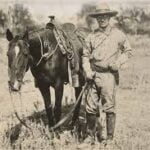
Cowboys and Cows: A Frightening Co-Dependency
with Dr. Carl Menudo BFD, LBJ, ASAP, LSMFT
The last cowpuncher I that visited my couch told me about his dreams where all the cows had disappeared. This poor bastard, who had worked as a wrangler all of his life often woke up in a cold sweat with the shakes. It was only after he peeked out of the bunkhouse window at the massive herd of Herefords outside, that he stopped moaning. Tough way to go. I prescribed a handful of barbiturates.
More and more we are finding that as society sidesteps nurturing personal relationships, these kinds of fear-fed dependencies are on the upswing. Little old ladies love their cats because they are the only ones around. Where are their worthless off-spring? They were always around for a hand-out before. Now they can’t get off work for a visit or their car broke down. Excuses. The list goes on. Little boys have pet snakes, little girls like fuzzy rabbits. Old men like their cigars. Sick.
Getting back to the cowpuncher’s problems we find that he is also neurotically attached to his hat. It’s the same hat he’s worn since 1963. First, does he know why the bandanna is a necessary part of the outfit on the range? Although we stop short of suggesting a business suit, we feel he would come a long way to drop the costume and wear a pair of bibs to work, or god-help-us, maybe a pair of shorts on a hot day. (Co-workers might be forced to don sunglasses to protect their eyes from the brightness of cowpuncher legs, unaccustomed to even the hint of sunlight ).

cowboy with a cow
The cows won’t notice and he might gain a certain sense of independence. It’s a damn good thing his boots wear out after a while or we’d have this fashion dependency to deal with as well.
Secondly, we prescribe a break from his regular diet of boiled potatoes and overcooked beef. Sure the plains Indians had a close relationship with the buffalo but they didn’t eat them. The buffalo never wore feathers either. Instead the Native Americans preferred rabbit, horse and fish dishes, especially bivalve mollusks like cockles and muscles. On the weekends they ate cod followed by a fine cigar. On holy days and times of sacrifice the existed only on fish strips and catfish made in Dutch ovens, stolen from the Indian Agency. But I’m getting away from our subject area…
Let’s not pretend to blame this whole mess on the cowboys.
Shall we wander out into the pasture and see what’s going down with the herd. Not too motivated for sure. They just stand around waiting for a cowperson to feed them or drive them somewhere. Branding is traumatic but they get over it. The burning off of horns and castration can’t be much fun but they survive. Freezing temperatures, high winds, the deaths of friends and relatives…they remain vigilant.
Why the cows can’t go out on their own and why the cowboy has become so attached to the herd, the way of life, is OK for a while but both must plan for the day when separation anxiety reaches its zenith. What if the cowboy has to buy a steak at the grocery and the cows are watching? What if the cows tried to fend for themselves without cowhide? Maybe everyone would benefit.
But today we watch helplessly as many of both species blend into one co-dependent unit unable to distinguish between working together and the chains of obsessive reliance.


