 All Entries in the "Lifestyles at Risk" Category

Plowing of Wildflowers gets Go Ahead
(Crested Butte) A scheme to plow under half of the Colorado’s wildflowers gets underway this afternoon in response to overwhelming data claiming that the vegetation is a threat to the boreal toad. The controversial plan, which seeks to protect the natural habitat and mating rituals of the legendary toad, is the brainchild of state and local biologists.
The status of the region’s romantic skunk cabbage remains undisclosed since it does not reproduce at magnified proportions like wildflowers. During one sunny day in the summer more than a million varieties of wildflower emerge as if from thin air consuming everything in sight. Traditional toad sustenance as well as shrinking wetlands further cloud the conflict inherent to toads and wildflowers.
“We know that the boreal toad is threatened and that his numbers have severely decreased over the past ten years,” said one University of Colorado biologist. “We think the toad lives in the Elks but we have yet to see one.”
“Every species in this rough country is competing for water,” said a Rocky Mountain Biological Laboratory. “Toads need water, so do wildflowers, bears, trees and ski areas. It just comes down to priorities.”
In addition to creating plowing jobs the move is expected to better showcase the remaining flowers.
Nature enthusiasts are reminded that, despite the plowing, picking wildflowers is strictly forbidden and punishable by fines and imprisonment.
“Collecting boreal toads is also verboten but feel free to take as many of other toad species as you like,” said the RMBL source. “But keep your hands off our marmots.” – Small Mouth Bess
Bonnie and Clyde Remake to be Shot in Olathe
(Hollywood Mesa) A bloody, yet more condensed version of the popular film, Bonnie and Clyde, will be filmed here next month according to Olathe Sweet Flicks, makers of space-age onion software. The production will last six months bringing a much needed source of revenue to the town.
“We chose Olathe because it still looks like the 1930s on the main street, minus the newer vehicles,” said director Pulan Romanowski. “It’s unbelievable that the place has remained like this for so long.”
Readers may recall that several episodes of The Twilight Zone were shot here in the late 50s followed by all but two of the colorized versions of Dragnet and Leave It To Beaver. Both of the latter efforts were made on California Mesa, the ancestral home of Lumpy Rutherford.
Town fathers and mothers are concerned that the filming might conflict with the 112th Spud Lovers Tomato Fight and Convention slated for July 22-31. This year some 35,000 potato aficionados are expected to converge on Olathe for panel discussions, cooking displays and tomato wars.
Meanwhile the producers of Bonnie and Clyde are searching for 1930s vintage automobiles to employ in the film. If anyone owns one of these gems and would like to make a few bucks please call the the Olathe Suite Corn Festival. – H. L. Menoken
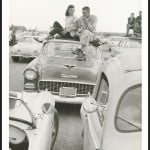
US Demands Return of 55 Chevys
(Miami) In an rash departure from warming diplomacy toward its estranged tropical neighbor, the United States today demanded the return of all 1955 series Chevrolet sedans and coupes now resting on Cuban soil. The surprise summons comes just as the two nations, at odds for decades, had begun talks on such bugaboos as immigration, baseball and economic blockades.
It is estimated that over 2000 Bel Airs and other models are on the road here and another in use all over the country.

In a surprising return to Cold War rhetoric the United States today
demanded that Cuba return of all 1955 Chevys now on the island.
Cars like the one above have become a rarity in the US
despite the fact that they were once made here.
“People aren’t keeping these classics in their garage to parade around in on holidays,” said Juan Tonomo, a Havana mechanic. “They drive them. They manufacture parts for them, They wax them. They cherish them. If the Americans try to take back the 55s they’ll surely be a fight. Another Bay of Pigs but maybe this time in Florida.”
Although General Motors, builder and designer of the cars, insists that they belong on US soil there is no clear legal precedent, especially across the dangerous straits that divide the two poorly ruled citizenries. The cars were procured, stolen, rescued, purchased, inherited, abandoned and discovered following the exit of America’s little dictator buddy Fulgencio Batista and the accompanying Mafia sideshow. They have since melded into the Cuban psyche, since Fidel came to town in 1959.
“We are certain Detroit is behind this,” say Washington sources. “They have been jealous of the performance and longevity of the older vehicles especially if one compares some of the recent bombs such as the Cavalier and the Pinto (Ford) which arrived on the scene shortly after the Cuban Missile Crisis.”
One of the reasons the automobiles have survived, especially in the climate, (both natural and fiscal), is the preponderance of fix-it concerns all over the country. Nothing is thrown away. Landfills are saved the indignity of staring down barely used toasters, building materials and discarded clothing. When a car breaks down it is repaired, even if the part must be fashioned or the engine overhauled.
“The government is bad but the people are good just like everywhere else in the world,” said Tonomo. “But the poor ones are always the ones to suffer the most when things turn sour. Taking their cars away would be the end.”
Sources in Detroit disagree with the appraisals saying they are merely nostalgic and want their cars to be back home where they belong.
“We look longingly toward Havana,” said Arlo Witte, a spokesman for GM. “We bare them no malice. We feel we can better provide for the 55s and offer them more security, a better future here.”
Up to now the US interests have yet to produce so much as a title or proof of registration. Cuban officials say the cars may have never been part of the American landscape.
“All that Dinah Shore See the USA in Your Chevrolet nonsense was so contrived,” frowned Tonomo. “We would have had songs like that except e couldn’t think of a car that rhymed with our island.”
Lobbyists indentured to the auto giants have been hammering Congress to terminate the economic embargo that has been in force “since the Communist takeover”, so that they could sell cars there. Insiders confirm that meetings have taken place and some preliminary agreements have been approved over rum and cigars.
Perhaps the most plausible solution, according to State Department innuendo is to cave in and give Havana what it has wanted for all of these dark years…a Major League baseball franchise.
“Then they might be more inclined to return the cars, according to diplomats at the North Dakotan Embassy which represents US interests since there is no ambassador in residence in Cuba.
US officials were not clear on what action might be taken if the cars are not returned.
Handicapped Spaces in sorghum and maize in July
(Montrose) The estimated 300 rarely used handicapped parking spaces within the city of Montrose will be put to high yield agricultural use come spring, according to whomever thinks they are in charge here.
The spaces, designated over the past two years as open range since they are seldom occupied, have already been requisitioned and, like vacant lots, condemned due to public safety issues or labeled as property adjacent to larger municipal regions that is deemed necessary for expansion.
The targeted spots, spread all over the city, have been charted and plotted so as to insure uniformity in fertilizing and watering. Although sorghum can be a little testy when grown through asphalt, maize (corn) will grow in just about any conditions just as long as it gets enough sun and is protected from pests.
Due to federal auto-response overkill there are at least 500 handicapped parking spaces in the county, some located where no one has ever been, at least in a car. Some may even be suspended from space. As in most federal responses, the reality of the matter takes a back seat to bureaucracy.
Take the drunk driving laws for example.
A little known clause in the table of motor vehicle guidelines stipulates that drivers parked in handicapped spaces are immune to prosecution for impaired driving. (Check it out in the small print if you don’t believe us)
It is hard to say how many federal administrators draw a paycheck by monitoring and adjusting the number of handicapped spaces. It’s similar to counting trees or rocks than then going home for the day. At a time when the feds keep ranting about budget cuts this overpopulation and underemployment of restricted parking spots is ridiculous, according to officials here.
“We talk about multiple use and bounteous, exuberant, broad-minded agricultural concepts,”said a county commissar who continues to live in the 18th century. “It is high time to embrace farming techniques that produce results,” he said, hastily adding that he never used the word liberal in his compacted appraisal of the move.
“We want to make regulations too, like real cities do,” said a city councilperson who lives in the 19th Century. “People are then forced to obey our silly new laws and it makes us feel powerful and important.
“These underemployed spaces make our government look incompetent. They are a left-handed insult to the handicapped and cannot be considered green space since they are covered in asphalt,” he said. “This is liberal government at its finest hour.”
According to a survey conducted the nearby Bland Valley, which is blessed with even more of these unused parking spaces than Montrose, some 88% of the population admits that it often resents the handicapped when faced with lines of unoccupied handicapped spaces and no standard or regular spots in which to leave their car.
“The planting and sale of these commodities should soften the opinion of critics,” say the local leaders. Society can never have enough sorghum.” – H. L. Menoken
TVs for food program progressing nicely say officials
(Yellow Jacket, CO) Residents and visitors alike in Montezuma County are encouraged to trade in their unwanted, unused and unsafe televisions for food. A stray cat to the many heralded guns for food programs, this new plan promises discretion, privacy and a fair price for one’s television set..
For decades social scientists and educators have screamed and hollered for television control but networks, manufacturers and lobbyists have consistently snuffed out their pleas. Today in a small Colorado county activists have succeeded in getting some 300 potentially dangerous televisions off the streets.
“The gov’ment seems only too happy to ignore us,” said one activist. “They say television is an entertainment tradition and provides the most sophisticated communication known to man. But we all know that it is the catalyst, the heart and soul, of the well-documented Numbing of the Nationals Program.”
The NNP is a secret gov’ment agenda which calls for the lowering of the IQ some twelve points by 2018 while raising militant testosterone and diverting significant nurturing hormones.
“Without television the gov’ment could never pull it off. People would function at a much higher level during evening hours and find that there is better entertainment inside their heads than on the tube,” continued added another acutely unreliable street source.
Concerned with what they say is approaching French Revolution standards in many neighborhoods throughout the country, leaders here shared the common consensus.
“Today television is probably much more harmful than firearms,” said Ashly Toallas-Towel, allegedly a county commissar. “If the feds really wanted to control violent behavior they would look toward the TV screen for some answers. Relationships, family, success and yes, handguns are depicted as options of no consequence. TV sends the wrong message plus too many hours gives the viewer a fat ass to boot.” she stressed.
Apparently the status of the television sets is not important. But like the gun exchange certain models will demand more at the grocery. For instance a regular 19-inch color set might bring a bologna-velveta-canned beer menu while an Flatscreen HD set may net groceries for the T-Bone-lobster tail-nice bottle of wine taste.
“We don’t care if they work or not. There’s nothing on worth watching until Bronco season anyway,” said a deputy. “We just want these things out of houses same as we want guns off the street.”
It is estimated that everyone in the county owns at least two weapons
Lions and tigers and bears, oh my!
“We need our guns. It’s the televisions we’d like to be rid of,” continued the deputy.
Critics of the program insist that it is just the beginning of “full government control over every aspect of our daily lives.
“Criminals don’t trade in televisions. It’s responsible television owners doing that!” said an unidentified spokesman for the National Television Association. “How you gonna watch American Idle or NASCAR without a TV set in your house. What if an intruder forces himself in demanding to watch the five o’clock news? Then you’ll be sorry.”
The relinquished televisions will be destroyed nightly so as not to fall into the hands of terrorists or bankers,” peeped Toole.
“Most arsenals are inadequate to throw back a gov’ment gone mad anyway, so we might just as well eat up.”
In a somewhat related development the United States Congress today announced that it is in unanimous agreement as to the implementation of stricter gun control measures, for South Asia and The Mideast.
– Susie Compost
Women’s Prison Gets Nod
(Ridgway) Local bachelors here favor the construction of a women’s minimum security prison by more than three to one according to a recent poll. The facility could house up to 400 persons, all of whom would qualify for work release, community integration and assorted social placement.
The initial blueprint for the much discussed rehabilitation complex threatens to polarize the community with one side suggesting that the preliminary plan will have negative impacts and the other insisting it will boost the local libido and, as a result, the local economy.
Local bachelors and other special interest groups came out in strong support of the development which could be built as early as 2014. At the present no exact site has been determined.
“I wouldn’t worry too much about any new residents at this point,” said one county commissioner. “We’ve got a long way to go and negotiations are dragging. Remember the Dallas Project and the plan to flood downtown Ridgway back in the 70s?” – Angel Seraphim

